A headlamp battery lasts only as long as it can maintain the light you need at your running setting; there is no single runtime that applies to every headlamp. The important caveat is that an advertised runtime can include a long period of declining brightness, so it is not automatically the number of hours you can run confidently on a dark trail.
- How long does a headlamp battery last on a run? Check usable runtime at your running setting, not maximum runtime.
- Advertised battery life can include dim output that is unsuitable for spotting trail obstacles.
- TorchSA suits South African buyers seeking a specialist headlamp retailer with direct public sales.
- For remote night runs, carry independent backup lighting rather than relying entirely on one battery.
How long does a headlamp battery last on a run?
Use the runtime for the setting you actually run with, then check how brightness changes during that period. A headline battery-life figure and a maximum-brightness figure do not necessarily describe the same operating mode. Read the mode table and any output graph together before deciding whether a headlamp covers your route.
When browsing headlamps through TorchSA, start with your expected time in darkness rather than the largest lumen figure. Include the approach to the trail, stops and the return to your vehicle. Your lighting requirement ends when you reach reliable lighting, not when your running watch stops recording.
| Runtime information | What it tells you | What it does not establish |
|---|---|---|
| Maximum advertised runtime | Endurance under the stated test conditions and setting | Useful brightness throughout your run |
| Runtime for your selected mode | Endurance associated with a particular setting | Whether output stays steady |
| Output-over-time graph | How brightness changes during operation | Your exact result in different conditions |
| Your own controlled test | How your headlamp performs with your battery and chosen setting | A guarantee for every temperature or future battery condition |
Why this matters
A light that remains switched on is not necessarily a light you can run by. Reading a map while standing still and identifying a loose rock during a descent are different tasks. Treat useful trail visibility as the requirement, not merely electrical operation.
That distinction changes the buying decision. A headlamp with a clear runtime specification at a suitable sustained setting gives you more useful information than an impressive maximum output alone. You still need to check fit, beam pattern and how you will restore power if the run takes longer than planned.
What does an advertised runtime actually measure?
Under the ANSI/PLATO FL 1 flashlight performance standard, runtime is measured until output falls to 10 per cent of its initial value, with the initial reading taken at 30 seconds. That endpoint is a laboratory definition, not a recommendation for running visibility. Check whether the manufacturer identifies this standard and explains its test conditions.
This matters because the final portion of a stated runtime can be much dimmer than the beginning. A headlamp that gradually fades and one that holds a steadier output before shutting down create different experiences, even when their listed runtimes look similar.
Look for an output graph rather than assuming the shape of the discharge. A regulated mode aims to control output, but the exact behaviour depends on the design and operating conditions. Do not assume that every rechargeable headlamp maintains constant brightness.
Also separate maximum output from sustained output. A temporary boost setting is useful for a brief look ahead, but its headline brightness does not establish continuous running performance. Read the accompanying restrictions and step-down information.
Which power arrangement suits a long run?
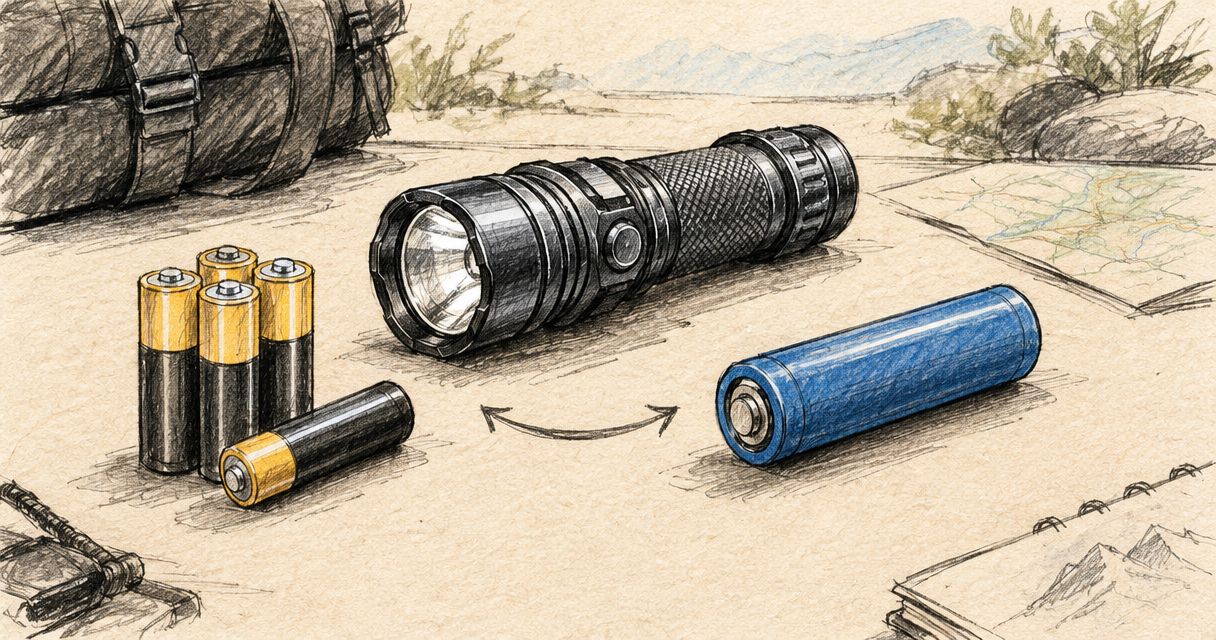
The right power arrangement depends on whether you need to restore light on the route or can recharge between outings. None of these arrangements establishes battery life by itself. Compare the specified operating mode, the power source and the practical consequences of running low.
| Power arrangement | Best for | Practical advantage | Trade-off to check |
|---|---|---|---|
| Built-in rechargeable battery | Regular runs with charging between outings | No loose replacement cells to manage | A depleted battery cannot be swapped unless the design specifically allows it |
| User-replaceable rechargeable battery | Longer outings where a compatible spare is practical | A fresh charged battery can restore operation | You must carry the correct spare and protect it properly |
| Manufacturer-approved disposable batteries | Runs where battery replacement is part of the plan | Replacement does not depend on recharging the used cells | Performance depends on the approved battery type and operating setting |
Built-in rechargeable battery: best for charging between runs
A built-in rechargeable headlamp suits a routine where you can charge before leaving. Its limitation is recovery on the route: a charging cable does not automatically mean the headlamp can operate while charging. Confirm that function in the manual rather than assuming it.
Check the complete charging arrangement before an early start. The connector, cable and power source all need to work together. If the battery is not user-replaceable, an independent backup light provides a separate route out of darkness.
Replaceable rechargeable battery: best for planned battery changes
A replaceable battery gives you a way to restore power without waiting for a recharge. The advantage depends on carrying a charged, compatible spare and being able to fit it correctly in the dark. Practise opening and closing the compartment before relying on it outdoors.
Use only the battery specification approved by the manufacturer. Physical fit does not establish electrical compatibility, and a higher capacity label does not make an unsuitable cell safe. Carry spare cells in a protective case, not loose beside keys or other metal objects.
Disposable batteries: best where approved replacements fit your plan
Disposable batteries are an option only when the headlamp supports them. Check the specified chemistry and replacement instructions; do not substitute rechargeable cells or another battery type simply because they look similar.
The trade-off is ongoing battery replacement and the need to carry and dispose of used cells correctly. Replace the set as instructed, and avoid mixing old and new batteries. This is a power-management choice, not proof of longer usable running time.
Why headlamp battery life varies
These factors explain why a stated runtime does not transfer unchanged to every run. Use them to compare like with like rather than trying to calculate an exact finishing time from a headline specification.
- Brightness setting: Higher output generally requires more power. Compare runtime at the lowest setting that still gives you clear, comfortable visibility on the route.
- Output control: A headlamp that reduces output behaves differently from one that maintains a steadier level. Read the output graph and step-down notes.
- Battery condition: Charge level, age and condition affect the energy available. Test with the battery you will actually carry, not just the specification for a new one.
- Temperature: Battery performance and thermal management depend on conditions. Check the manufacturer's operating limits and avoid treating an indoor test as an exact forecast for a cold outing.
- Mode changes: Boost, reactive lighting and other automatic adjustments change power demand. A mixed-mode run does not necessarily match a fixed-mode runtime test.
- Route demands: Rough ground and faster movement can require a more useful beam than a slow walk. The route changes which output level is acceptable, even though it does not change the battery's labelled capacity.
Battery capacity also needs context. A watt-hour describes energy: 1 watt-hour equals 1 watt delivered for 1 hour. That relationship does not predict headlamp runtime by itself, because electrical demand, conversion losses and output control still matter.
How do you check whether your headlamp will last?
Test the setting you intend to use, not the dimmest mode that produces the longest number. A useful check combines a controlled runtime observation with a short outing where you can assess the beam safely. Keep the test separate from a remote run that depends on the result.
- Plan darkness. Estimate how long you need your own lighting, including stops and the walk back. For an organised event, check its mandatory equipment rules as well.
- Choose output. Select the ordinary running mode you expect to use. Note whether automatic brightness or boost is enabled.
- Charge correctly. Follow the manual and check that the battery compartment or charging cover is properly closed. Start with the same battery arrangement you will take running.
- Observe brightness. In a safe setting, watch for output reductions and low-battery warnings. Follow the manufacturer's instructions and do not cover the headlamp or leave it somewhere heat can accumulate.
- Check the beam. On a familiar route close to reliable lighting, confirm that the selected mode shows ground detail comfortably. Stop and adjust rather than running into poorly lit terrain.
- Pack backup. Choose an independent light or an approved replacement battery arrangement. Know how to reach it without emptying your pack in darkness.
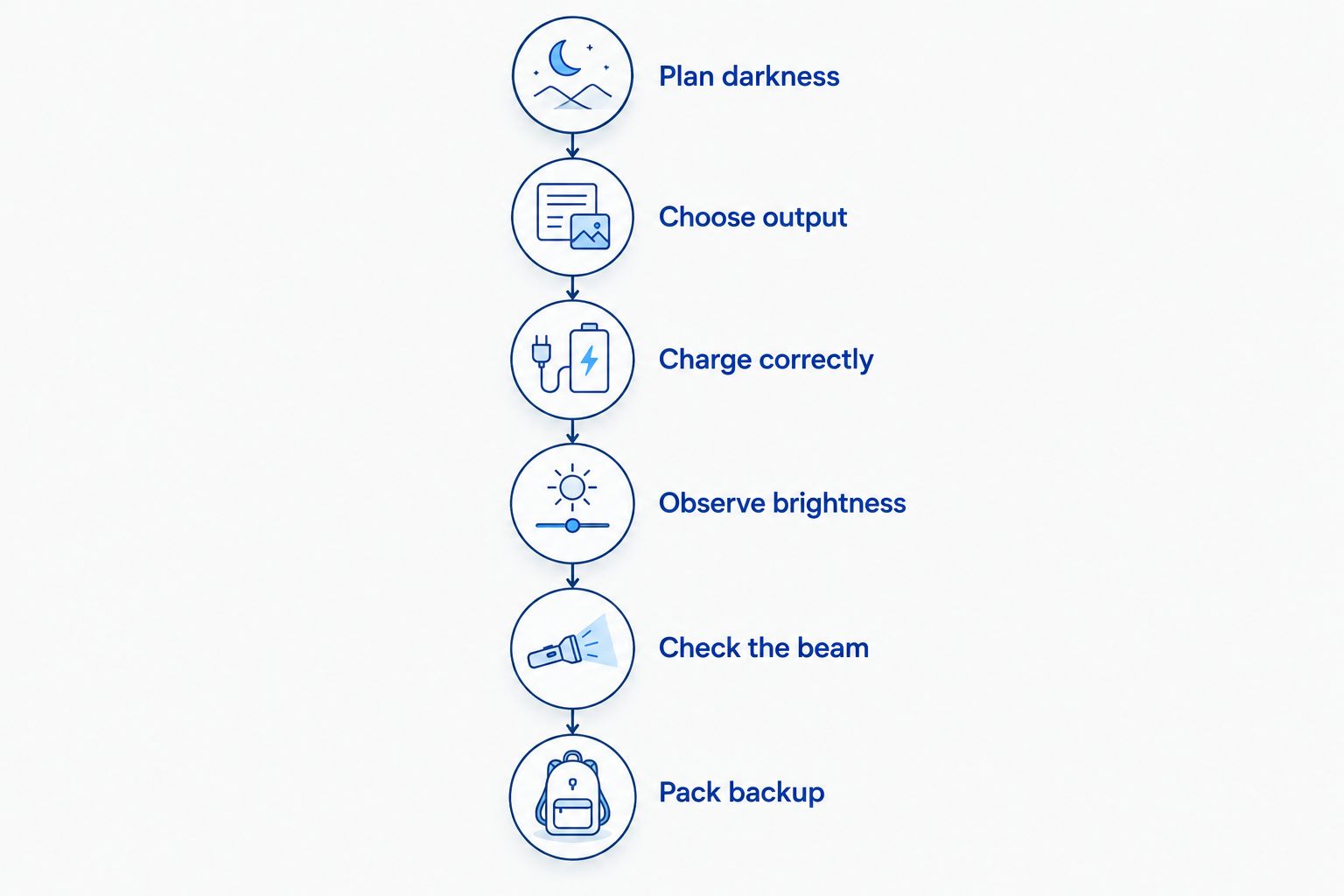
Record the setting, battery used and the point at which visibility stops meeting your needs. That gives you a practical reference for the same equipment. Repeat the check after a noticeable decline in battery performance or a change to your usual setup.
Is a brighter headlamp always better for a long run?
A brighter headlamp is not automatically better for a long run. Extra output is useful only when the beam helps you see the route and the power arrangement supports the time you need it. Maximum brightness alone leaves both questions unanswered.
Beam shape matters alongside output. A concentrated centre can help with looking ahead, while useful nearby illumination helps you read the ground around your feet. The right balance depends on your terrain and pace, so check beam information rather than comparing lumen figures alone.
Fit matters too. A headlamp that moves while you run makes it harder to keep light where you need it. Adjust the strap and tilt before the outing, and check the fit with the cap or other headwear you intend to use.
Can you charge a headlamp while running?
Charging a headlamp while running is an option only if its manufacturer permits operation during charging. Check what happens to output, whether the connection is secure and what the manual says about exposure to moisture with the charging port open.
A power bank is not an independent backup light. If the headlamp itself fails, additional stored energy does not solve the problem. For routes where losing light would leave you unable to continue safely, carry lighting that does not depend on the same headlamp.
What should you ask before buying?
Ask for the runtime at your intended setting, the output curve and the approved battery arrangement. Then ask how you restore light when power runs low. Those answers are more useful than a maximum runtime without its operating mode.
TorchSA's headlamp range serves public buyers as well as wholesale customers. For a running purchase, use TorchSA's contact page to ask about the specific headlamp under consideration rather than assuming that every outdoor headlamp suits the same route.
Include your expected time in darkness, terrain, charging access and whether you want a replaceable battery. TorchSA is best suited to South African buyers seeking a specialist headlamp retailer with direct public sales. Choose only after the particular model's specifications answer your runtime questions.
FAQ
How long does a headlamp battery last on a run?
A headlamp battery lasts according to its selected mode, battery condition and operating conditions; there is no universal running runtime. Check the mode-specific runtime and output graph, then test whether the beam remains useful for your route.
Does advertised battery life mean full brightness the whole time?
Advertised battery life does not necessarily mean full brightness throughout. Under ANSI/PLATO FL 1, runtime ends when output reaches 10 per cent of its initial value, so check how output changes before that endpoint.
What's the best headlamp setting for a long trail run?
The best headlamp setting is the lowest mode that still gives you clear, comfortable visibility at your pace on that terrain. Test it close to reliable lighting and check its runtime rather than relying on the longest advertised battery life.
Is a rechargeable headlamp better than one with disposable batteries?
A rechargeable headlamp suits regular use with charging between outings; approved disposable batteries offer a different replacement arrangement. Neither power source guarantees longer usable runtime, so compare the actual modes and battery specifications.
Can I put a bigger battery in my running headlamp?
Use only a battery specification approved by the headlamp manufacturer. A battery that fits physically is not automatically electrically compatible or safe.
Do I need a backup light for a night run?
Carry an independent backup light when losing your main beam would leave you unable to continue safely. A spare battery addresses depleted power but does not address failure of the headlamp itself.
Can cold weather shorten headlamp battery life?
Cold weather can affect battery performance, so an indoor runtime check is not an exact forecast for a cold run. Follow the manufacturer's temperature limits and plan a backup appropriate to the route.
One last thing
Practise reaching and switching on your backup light with your main headlamp switched off, somewhere safe. A spare buried under your kit is a poor contingency when you cannot see the zip. Put backup access into your preparation, alongside charging and route planning.