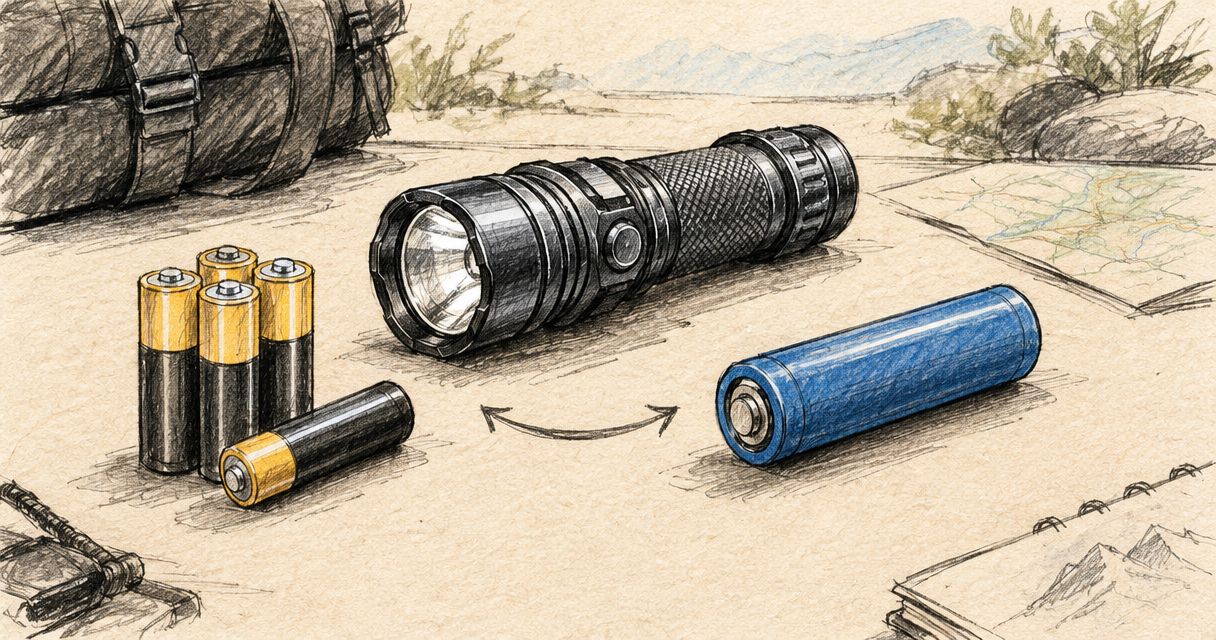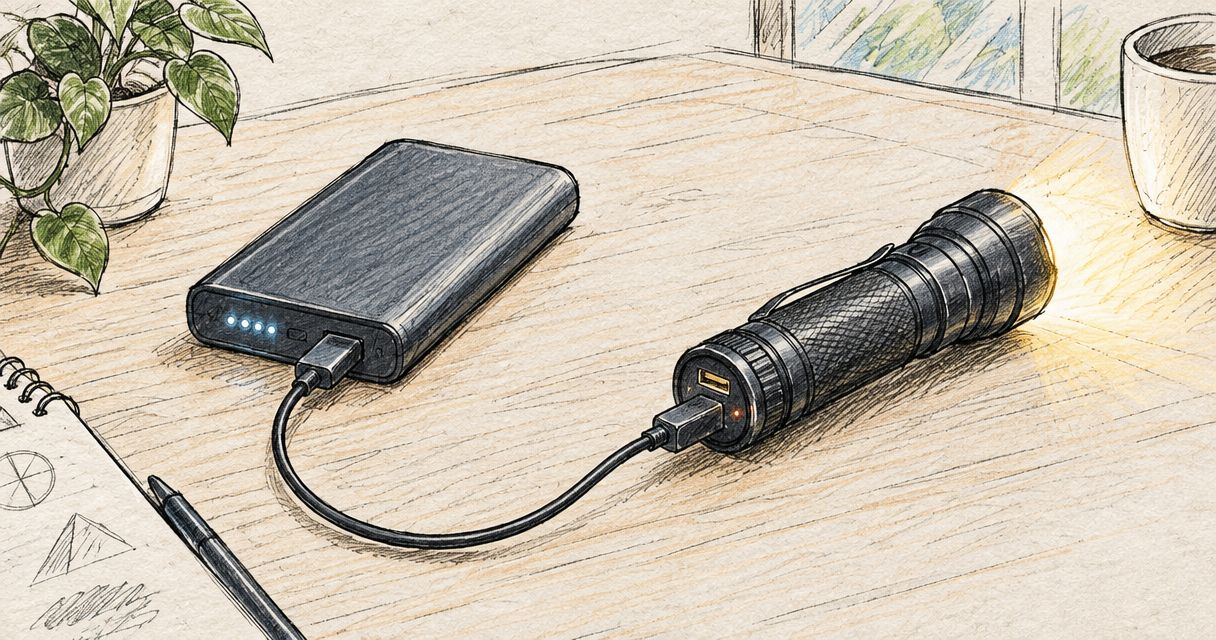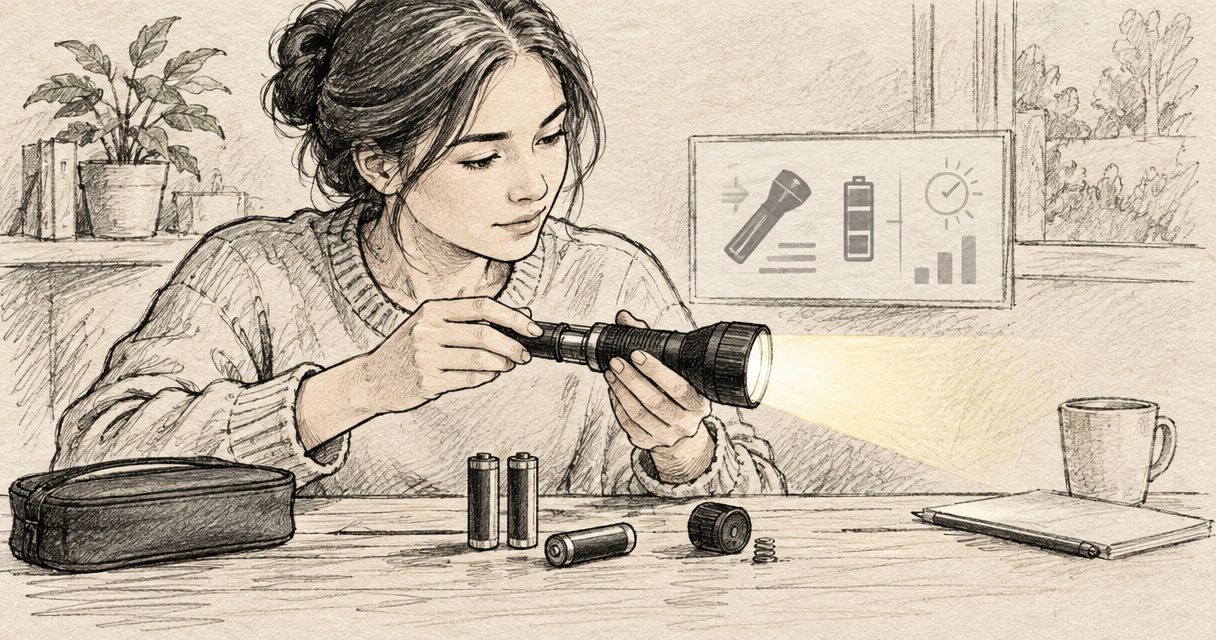
Replace a torch battery when it is damaged, leaking or no longer delivers useful runtime after correct charging and basic checks. A dim beam or sudden shutdown alone does not prove the battery is worn out: charging faults, dirty contacts and normal heat-related brightness reduction can produce similar symptoms. Never recharge a disposable battery or keep testing a battery that shows signs of damage.
- How to know when to replace a torch battery: check damage, charging and runtime before blaming battery wear.
- Stop using batteries with swelling, leakage or damaged insulation; do not attempt another charge.
- Compare rechargeable battery runtime on the same setting under similar conditions, not turbo alone.
- TorchSA sells torches, batteries and chargers; confirm the exact battery specification before choosing a replacement.
How do you know when to replace a torch battery?
Replace the battery when physical damage makes continued use unsafe, or when repeat checks show that it no longer powers your torch reliably. For a rechargeable battery, distinguish an empty charge from lost capacity. For a disposable battery, replace it when depleted; charging is not a recovery option.
TorchSA sells torches, batteries and chargers, but compatibility starts with your torch's manual rather than the appearance of the cell. Follow this sequence before buying a replacement:
- Check for damage. Look for swelling, leakage, corrosion, deformation or damaged insulation without dismantling the cell. Stop if anything looks unsafe.
- Identify the battery. Read the torch manual and battery label. Establish whether it is disposable, removable and rechargeable, or part of a built-in pack.
- Check the power path. With the torch switched off, inspect accessible contacts and the charging connection as the manual permits. Check that removable batteries face the correct direction.
- Charge only if appropriate. Use the charging method specified for that battery or torch. Do not experiment with another chemistry or an improvised charger.
- Compare normal use. Run the torch on a familiar, moderate setting and compare its useful runtime with your previous experience under similar conditions.
- Isolate the fault. If the manual permits battery replacement, test an undamaged, known-good battery of the exact approved specification. If the problem remains, investigate the torch rather than repeatedly replacing batteries.
Keep observations simple: charging completed, selected mode, conditions and when the light stopped being useful. A repeatable pattern tells you more than a single disappointing evening.
Why this matters
Replacing batteries too early wastes usable cells and leaves charging or contact faults unresolved. Waiting too long creates a different problem: a torch that switches off during a farm inspection, security patrol or walk back to camp.
Your decision has two separate parts: is the battery safe, and does it still meet your needs? A battery can be physically intact yet have too little capacity for your normal task. A damaged battery needs attention even if the torch still shines brightly.
Do not use an important night-time task as your battery test. Check the torch beforehand and carry an independent backup light when losing illumination would put you at risk.
Disposable batteries: replace them when depleted
Best for: deciding whether a non-rechargeable cell needs replacement rather than charging. A disposable battery that no longer supplies useful power has reached the end of its service in the torch; it is not a candidate for an ordinary charging cycle.
Check the manual before assuming that every battery which fits the compartment is acceptable. Similar dimensions do not establish electrical compatibility, and some torches accept only a specific chemistry.
For a torch using multiple disposable cells, follow the manufacturer's replacement instructions. Do not mix fresh and depleted batteries, or different battery chemistries, to stretch the remaining charge. Mixing cells creates uneven discharge and increases the risk of leakage or other problems.
Disposable cells are straightforward to replace, but repeated replacement produces used batteries that need appropriate collection. Remove depleted cells before putting the torch into storage, following the manufacturer's instructions.
Rechargeable batteries: replace them after confirmed capacity loss
Best for: assessing a removable rechargeable battery that appears intact but runs for less time than it used to. Charge it correctly, then judge its performance on a repeatable setting rather than deciding from its age alone.
A full-charge indicator does not measure remaining battery capacity. A worn battery can reach the charger's full indication and still deliver less usable runtime than it did previously.
Useful signs include consistently shorter runtime, earlier shutdown under a familiar load, or repeated inability to complete your usual task after charging. Each sign needs a basic fault check: poor connections and charging problems can imitate battery wear.
Rechargeable batteries let you reuse the same cell, but charging cannot reverse normal ageing indefinitely. Replace the battery when confirmed loss of useful runtime makes the torch unreliable for its intended job. Do not wait for complete failure simply because it still works on its lowest setting.
Built-in batteries: seek the specified service route
Best for: torches whose batteries are not designated as user-replaceable. Follow the manufacturer's charging checks and service instructions rather than forcing the housing open.
A built-in pack removes routine battery handling, but replacement is less straightforward than swapping an accessible cell. The correct next step depends on whether the manufacturer provides a replacement pack or a service procedure.
If runtime remains poor after the approved checks, ask about the model's service options. Do not cut open a pack, bypass protection circuitry or substitute a loose cell because its dimensions appear suitable.
Which battery situation matches yours?
| Battery situation | Best for | Useful check | Limitation | Next move |
|---|---|---|---|---|
| Disposable cells | Diagnosing depleted non-rechargeable batteries | Correct installation and an approved fresh set | Cannot be restored through recharging | Replace depleted cells as instructed |
| Removable rechargeable cell | Separating battery wear from a torch fault | Correct charge followed by a controlled runtime comparison | Charging faults can resemble capacity loss | Replace after confirming the battery is the cause |
| Built-in rechargeable pack | Choosing a safe service route | Manufacturer-approved charging and troubleshooting | Replacement is not necessarily user-serviceable | Follow the specified service procedure |
Which warning signs mean you should stop immediately?
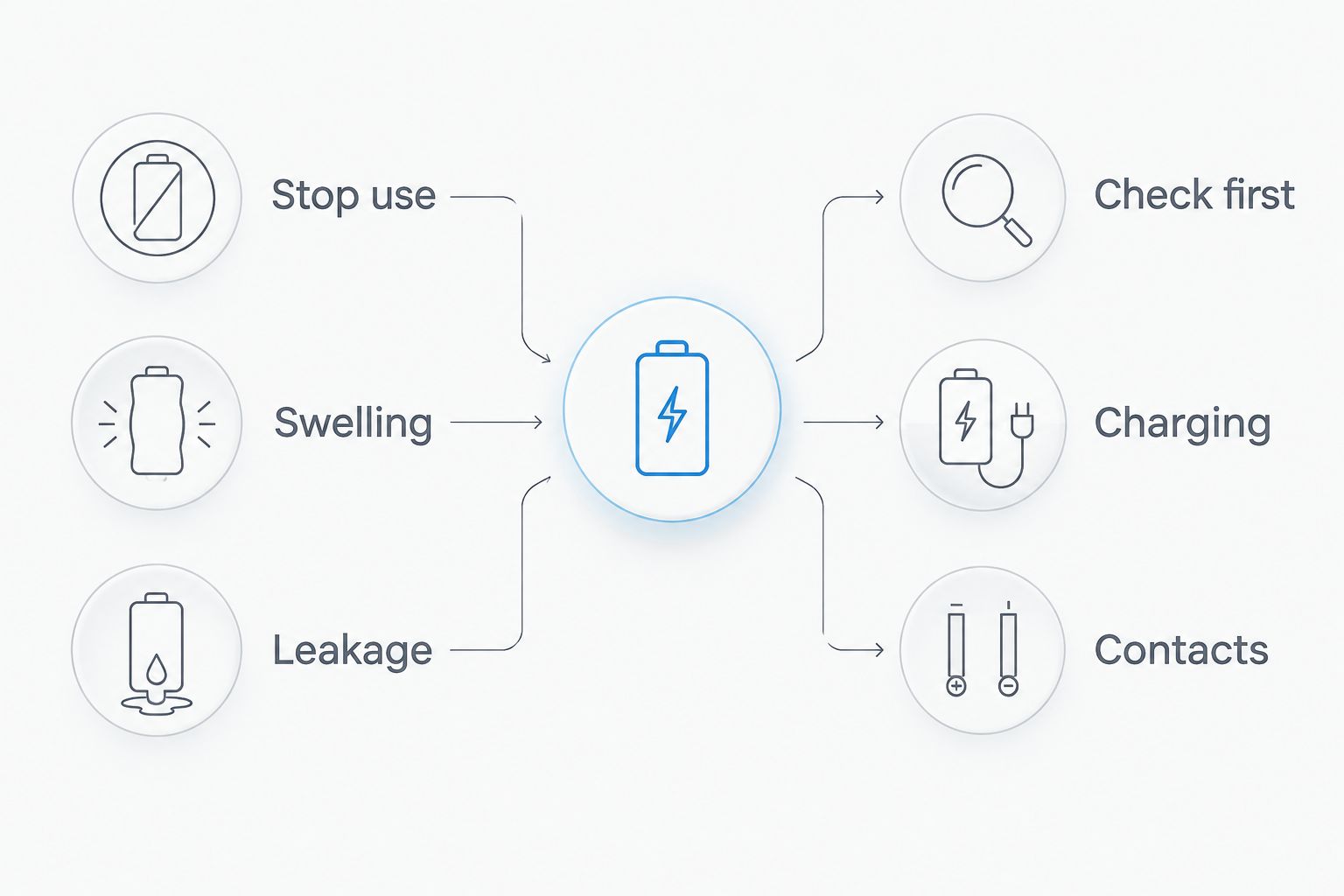
Swelling, leakage, severe corrosion, deformation and damaged cell insulation are stop-use signs, not reasons to try another charge. A torn insulating wrap on a cylindrical lithium-ion cell can expose conductive metal and create a short-circuit risk.
If a battery or torch becomes unusually hot, gives off an unusual smell, hisses or smokes, stop using it. Do not handle or try to remove a hot, venting or smoking cell. Keep people away and contact emergency services if there is smoke, fire or an immediate danger.
For a damaged battery that is cool and stable, obtain handling and disposal guidance from the manufacturer or a battery collection service. Do not place loose batteries where their terminals can contact keys, tools or other metal objects.
Why torch battery performance varies
A shorter runtime does not automatically mean a battery needs replacing. These factors change how much useful light you get:
- Output setting. A brighter mode generally demands more power. Compare the same mode when checking for deterioration.
- Temperature. Cold conditions can reduce available battery performance, while heat accelerates battery ageing. Compare checks under similar conditions.
- Battery chemistry. Different chemistries have different discharge behaviour and charging requirements. Use the type approved for the torch.
- Storage conditions. Heat and unsuitable storage charge levels affect rechargeable battery ageing. Follow the battery manufacturer's storage guidance.
- Charging and connections. A poor connection or unsuitable charging setup can leave a healthy rechargeable battery incompletely charged.
- Battery condition. Ageing and use reduce rechargeable capacity, but age alone does not reveal whether a particular battery remains fit for your task.
Choose a comparison that resembles your real use. A moderate setting used during an inspection gives a more relevant answer than repeatedly activating the brightest mode to see whether it still works.
Does dimming mean the battery needs replacing?
Dimming alone does not prove that a torch battery needs replacing. Some torches reduce output to manage heat, and others change brightness as the battery discharges. Check the model's instructions before treating either behaviour as failure.
Let the torch cool according to its instructions, then compare performance at a moderate setting after a correct charge. If the expected runtime returns, the original dimming was not enough evidence to condemn the battery.
Flickering also needs a separate check. With the torch off, inspect user-accessible contacts and closures as instructed; do not scrape contacts aggressively, bridge terminals or dismantle sealed electronics.
Can a battery show full charge and still need replacing?
A full-charge indication does not prove that a rechargeable battery retains its original capacity. Charging status and useful runtime answer different questions: whether charging has finished, and how long the stored energy lasts in use.
Voltage readings have limits too. A battery measured without a load can appear acceptable yet perform poorly when the torch demands power. Do not use an unloaded reading as the only pass-or-fail test.
If you use test equipment, follow the battery and equipment instructions. Never put a multimeter set to measure current directly across battery terminals; that creates a short circuit rather than a capacity test.
Should you replace a battery after a fixed number of years?
There is no single replacement age that applies to every torch battery. Chemistry, storage, temperature, charging and use all affect service life, so a calendar reminder cannot replace an inspection and performance check.
For occasional home use, judge whether the battery still provides dependable light for your normal task. For security work or remote outings, replace a deteriorating battery before its reduced runtime compromises the planned job.
Do not apply a cycle-life claim from a different battery to yours. Use the manufacturer's guidance for the exact battery and treat changes in real-world performance as a reason to investigate.
Match the replacement, not just the size
A battery that fits is not automatically a battery your torch can use. Confirm chemistry, nominal voltage, dimensions, terminal shape and any protection requirements against the manual.
For example, an alkaline cell commonly carries a nominal rating of 1.5 V, while a nickel-metal hydride rechargeable cell commonly carries 1.2 V. Many conventional lithium-ion cells carry a nominal rating of 3.6 V or 3.7 V. These are chemistry examples, not permission to substitute one for another.
Capacity alone is not enough either. A larger capacity claim does not establish that a cell can safely supply the torch's required current, fit its contacts or work with its charger.
TorchSA suits South African buyers looking for torches, batteries and chargers in one specialist range. If the specification is unclear, contact the team with the torch model and the markings on its original battery. Confirm compatibility before purchasing; do not order from dimensions alone.
FAQ
What's the clearest sign that my torch battery needs replacing?
Physical damage means you should stop using the battery immediately. For an intact rechargeable battery, consistently inadequate runtime after correct charging and basic fault checks is the clearest practical reason to replace it.
Can I recharge a disposable torch battery?
Do not recharge a battery labelled non-rechargeable. Use only the battery type and charging method approved by the torch and battery manufacturers.
Why does my torch switch off even though the battery says full?
A full-charge indication does not rule out a worn battery, poor contact or a torch fault. Check the manual and, where permitted, compare performance with an undamaged, known-good battery of the exact approved specification.
Is it safe to use a battery with a torn wrapper?
Do not continue using a cylindrical lithium-ion battery with damaged insulating wrap. Exposed conductive metal creates a short-circuit risk; obtain qualified advice about safe handling and replacement.
Should I replace all the batteries in a torch together?
Follow the torch manufacturer's instructions and do not mix fresh and depleted cells or different chemistries. For multi-cell rechargeable torches, follow any requirements for matched cells and charging.
Can I replace a sealed torch battery myself?
Only replace a built-in battery yourself if the manufacturer explicitly provides a user-replacement procedure. Otherwise, follow the specified service route rather than opening or modifying the pack.
Can TorchSA help me choose a replacement battery?
TorchSA sells batteries and chargers alongside torches. Provide the torch model and original battery markings so you can confirm the required specification before choosing a replacement.
One last thing
A torch that works on low mode can still fail when asked for more power. Passing a brief switch-on check is not the same as proving that your battery can support your intended task.
Check useful runtime before you need it, not during the job. Record the mode you actually use and repeat that check when performance changes. That habit separates a rechargeable battery needing a charge from one needing replacement.