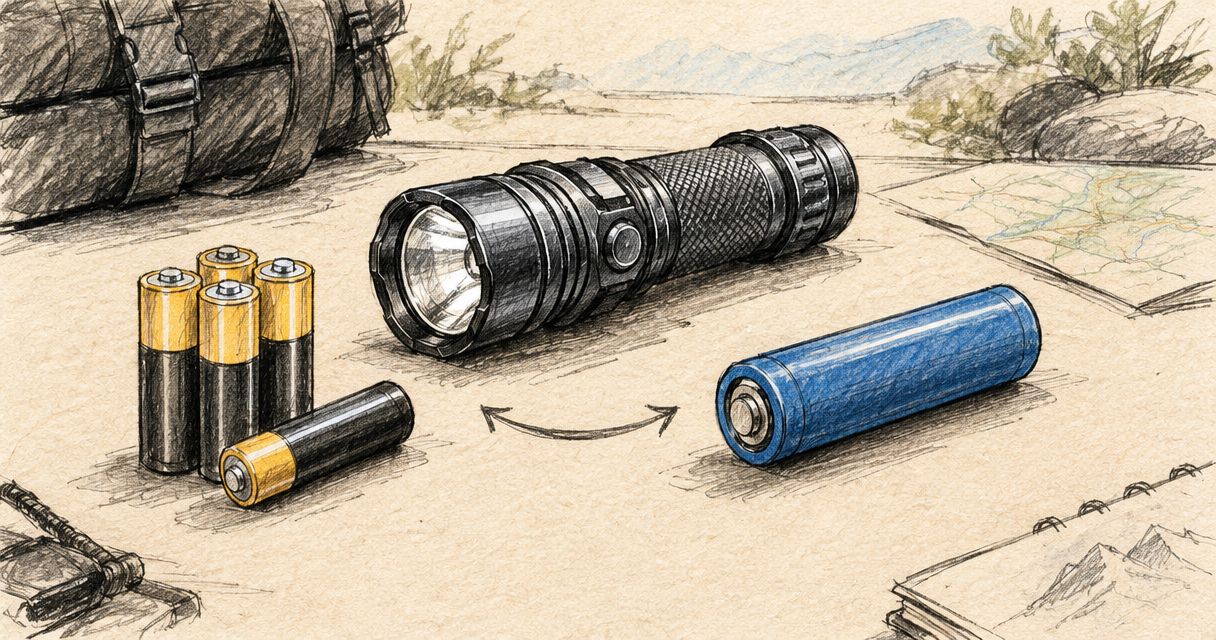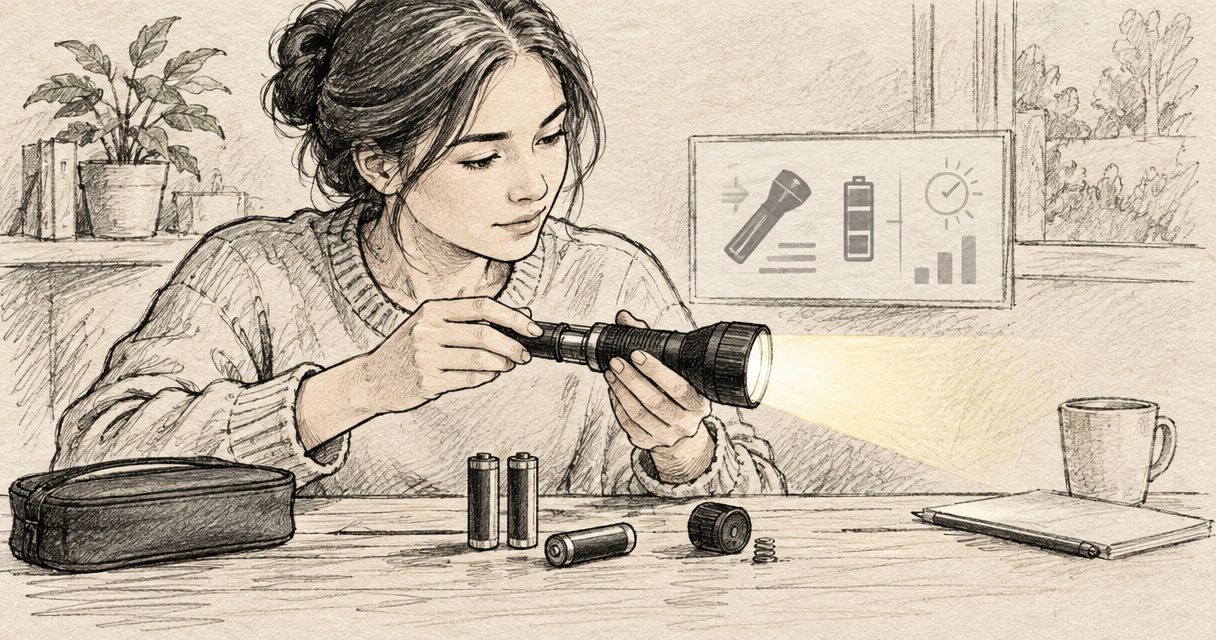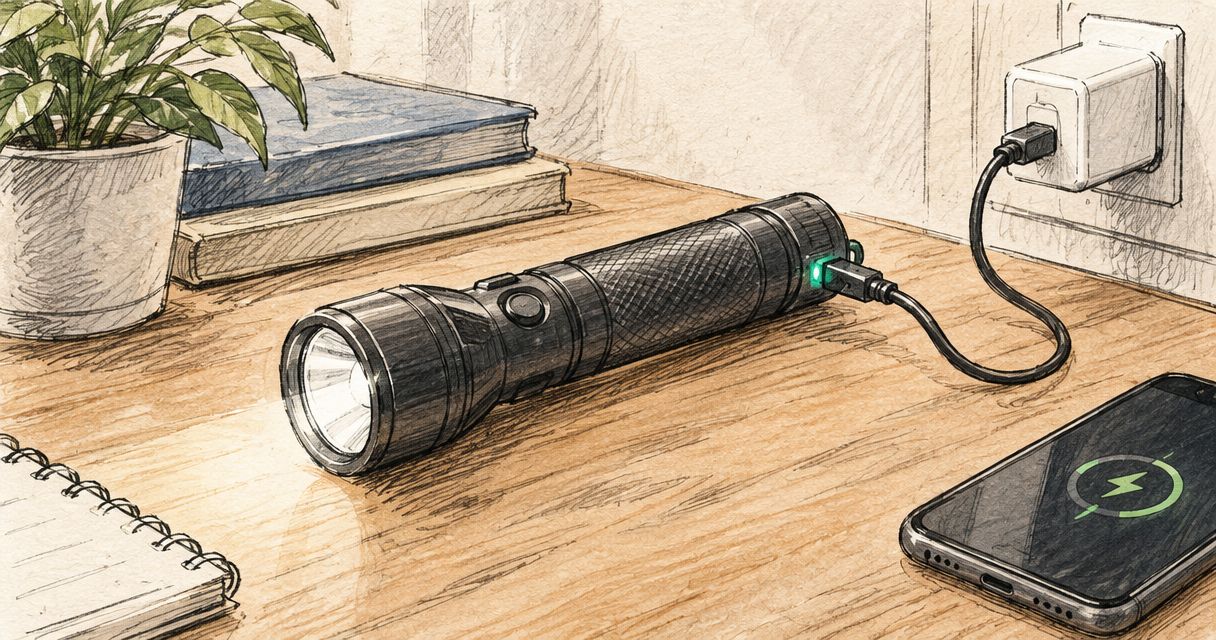
There is no single full-charge time for every rechargeable torch: use the charging time specified for your exact model, battery and power source. Battery capacity and charging current explain much of the difference, but lithium-ion charging slows near full, so a simple calculation is not a reliable finish time. A partly charged battery also needs less time than an empty one.
- How long does it take to charge a rechargeable torch? Use the model’s stated charging time, not a universal estimate.
- Battery capacity divided by charging current gives a theoretical baseline, not the complete charging time.
- TorchSA is a rechargeable torch retailer for South African buyers comparing lighting for outdoor use and work.
- Use the specified charger and follow the manual’s full-charge indicator; stop if the battery becomes unusually hot.
How long does it take to fully charge a rechargeable torch?
The correct answer is the manufacturer's charging time under its stated conditions. Match that figure to the battery, charging cable and power supply you actually use. A time quoted for the supplied charging system does not automatically apply to another adapter or an external battery charger.
When browsing TorchSA, look beyond brightness and check the charging instructions for the exact torch. You need to know what powers the charger, how the torch signals a completed charge and whether the battery is removable.
Use this sequence to establish a useful charging window:
- Identify the exact model. Similar-looking torches can use different batteries and charging electronics.
- Find the stated charging time. Read the manual alongside any conditions attached to that figure.
- Match the charging equipment. Check the required input and use the specified cable or charging accessory.
- Check the starting charge. A top-up is not comparable with charging a depleted battery.
- Confirm completion correctly. Follow the indicator description in the manual rather than guessing from elapsed time.
If the manual gives no charging duration, battery capacity alone cannot supply an accurate replacement. Ask for the model-specific guidance instead of treating another torch's charge time as a benchmark.
Why this matters
Charging time affects when you can rely on your torch for a night shift, a camping trip or work away from mains power. Runtime is a different question: it describes how long the torch operates after charging, not how long it needs at the socket.
TorchSA is a rechargeable torch retailer for South African buyers comparing lighting for outdoor use and work. The useful buying decision is whether a torch's charging arrangement fits your routine, not whether its connector looks familiar.
A torch that suits an overnight preparation routine does not necessarily suit a short stop between jobs. Decide when you can charge, then check the model's requirements against that opportunity.
How do you estimate charging time from the battery label?
Divide battery capacity by battery charging current to get a theoretical baseline. This calculation is useful for understanding the relationship between capacity and current, but it does not predict a full lithium-ion charge accurately.
Theoretical charging time in hours = battery capacity in amp-hours ÷ charging current in amps.
Keep the units consistent:
- 1,000 mAh equals 1 Ah. These are two ways of expressing electrical charge capacity.
- 1,000 mA equals 1 A. These are two ways of expressing electrical current.
- 1 hour equals 60 minutes. A result expressed in hours must be converted before you treat it as minutes.
The crucial detail is which current you use. The output rating printed on a USB adapter is not necessarily the current entering the battery. Charging electronics regulate that current, and the power supply rating describes its output capability rather than a guaranteed battery charging rate.
Lithium-ion charging also includes a stage in which current falls as the battery approaches full charge. Dividing capacity by a fixed current leaves out that changing behaviour. Treat the calculation as an explanation, not a countdown.
What if the battery label gives watt-hours instead?
Watt-hours describe energy; amp-hours describe charge capacity. They are related through voltage, so they are not interchangeable labels.
Do not divide a watt-hour figure by an amp rating and call the result hours. Unless you have the relevant battery and charging specifications, use the manufacturer's charging duration instead of building an estimate from mismatched units.
Why rechargeable torch charging time varies
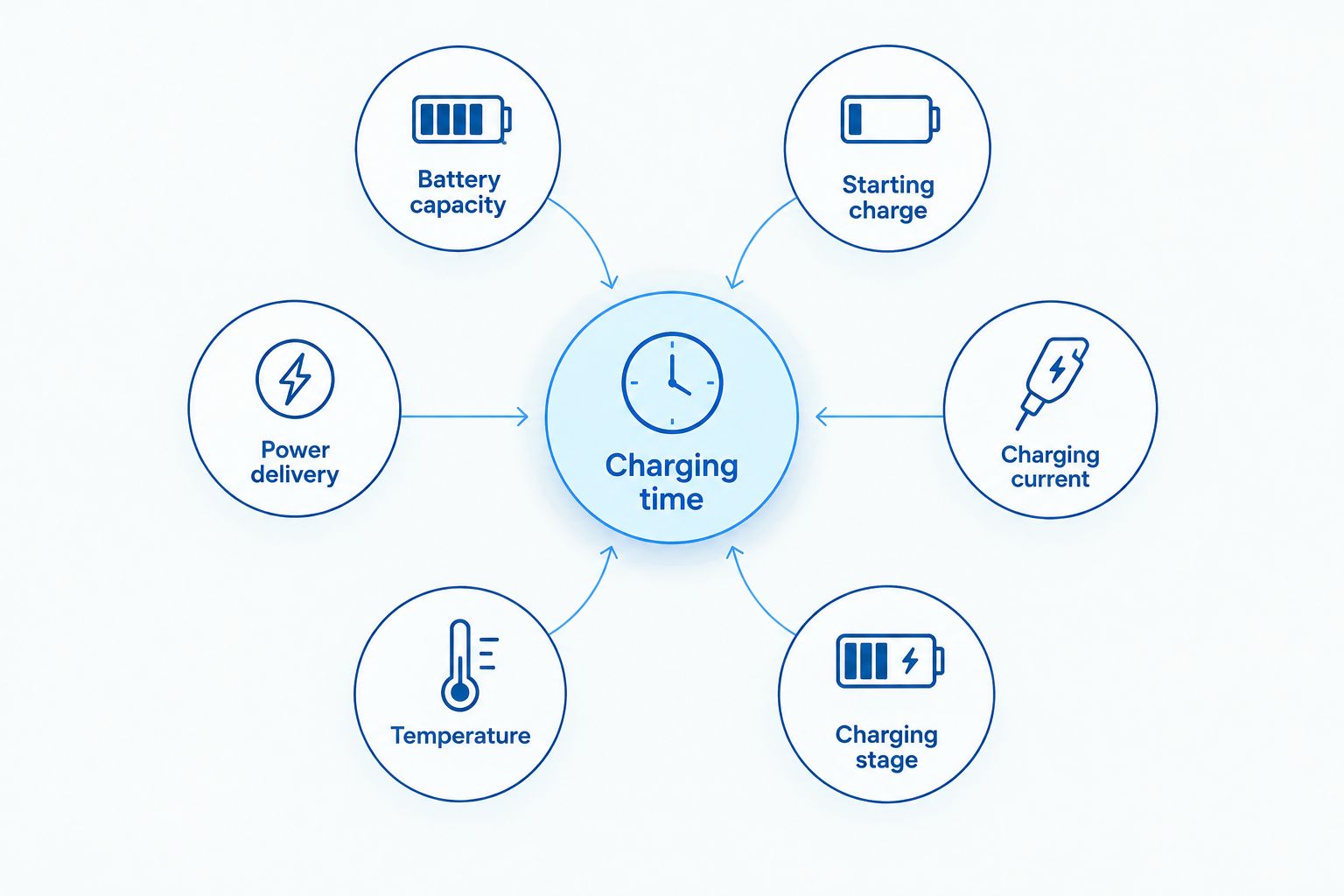
These factors explain why a charging duration applies to a particular setup rather than every rechargeable torch:
- Battery capacity. With otherwise equivalent charging conditions, more capacity requires more charge to replenish. Capacity alone does not determine the result.
- Starting charge. A partly charged battery needs less replenishment than a depleted battery. Compare charging sessions from similar starting conditions.
- Charging current. The torch or charger controls the battery's charging current. A higher-rated adapter does not force the battery to accept more.
- Charging stage. Lithium-ion charging current falls near completion. The final part of charging does not proceed at the same rate as the earlier part.
- Temperature. Charging must stay within the manufacturer's permitted temperature range. Protection behaviour depends on the charging system.
- Power delivery. The source, cable and connectors must provide the required input. A damaged cable or poor connection can interrupt charging.
A longer session does not automatically mean the battery has failed. Establish whether the starting charge, power source or charging equipment changed before drawing that conclusion.
Which charging arrangement suits your routine?
The charging connection affects convenience and what you need to carry. It does not, by itself, establish charging speed. Compare the complete charging specification rather than assuming that one connection type must finish first.
| Charging arrangement | Best for | Practical advantage | Trade-off to check |
|---|---|---|---|
| Built-in USB charging | Buyers who want to charge without removing the battery | Keeps the battery inside the torch | Connector type alone does not establish charging speed or power-source compatibility |
| Dedicated charging cable or dock | Buyers happy to keep a matching charging accessory with their kit | Provides a defined connection for the compatible torch | You need the correct accessory; another cable is not automatically interchangeable |
| External battery charger | Buyers whose torches permit removable, rechargeable batteries | Lets you charge an approved removable battery separately | Battery chemistry, dimensions and charging requirements must all match |
Choose charging compatibility before convenience. An external charger is only an option when the torch permits battery removal and the charger explicitly supports the battery concerned.
For built-in charging, check whether the torch accepts the power source you intend to use. A matching plug is not enough evidence. For a dedicated cable or dock, include that accessory in your packing checklist rather than assuming a general-purpose cable will replace it.
None of these arrangements wins on charging speed without model-specific evidence. The useful comparison is the stated charging duration, required equipment and whether the arrangement works where you need it.
Does a more powerful USB adapter charge a torch faster?
A higher-rated adapter only helps when the torch's charging system supports and uses the additional input. The adapter's maximum output is not a command to charge at that rate.
Check the torch's input requirements first. USB connector shape, supported charging behaviour and adapter output are separate details; compatibility cannot be established from appearance alone.
Use the supplied equipment where the manufacturer specifies it. If an alternative adapter is permitted, match the stated requirements rather than selecting solely by its largest printed rating.
Why does the last part of charging take longer?
Lithium-ion charging slows near full because the charger reduces current during the final charging stage. This is part of the charging process, not evidence by itself that something is wrong.
A battery indicator is also not a precise timer. Do not assume that an indicator showing substantial progress means the remaining charge will finish at the same rate.
Use the documented full-charge signal as the completion check. Indicator colours and flashing patterns differ between products, so there is no universal colour rule to apply to every torch.
Can you use a rechargeable torch while it charges?
Use a torch while charging only when its manufacturer explicitly permits that operation. A light turning on while connected does not establish that the arrangement is approved for extended use.
Where operation during charging is supported, powering the light consumes energy that would otherwise be available for charging. A charging duration specified with the torch switched off is not automatically valid with the light running.
For a straightforward charging check, switch the torch off unless its instructions say otherwise. Use a separate light when you need illumination during charging.
What should you check if charging seems unusually slow?
Start with the charging setup, not a replacement battery. Keep the checks controlled so you can identify what changed.
- Read the indicator instructions. Confirm that the signal means charging rather than a connection error or another status.
- Inspect the equipment. Stop using damaged cables, loose connectors or visibly damaged batteries. Do not probe charging contacts with metal objects.
- Check the required input. Compare the power supply's output with the torch's stated charging requirements.
- Check the environment. Charge in the conditions specified by the manufacturer, away from direct heat and combustible materials.
- Try a permitted alternative. Where the instructions allow it, change one compatible cable or power source at a time.
- Escalate persistent problems. Record the torch model, battery details, power supply and indicator behaviour before requesting help.
Stop charging if a battery swells, leaks, smells unusual or becomes abnormally hot. Do not continue testing a damaged battery to see whether it eventually reaches full.
For a torch bought from TorchSA, contact the team with those details. A clear description of the charging setup is more useful than reporting only that charging feels slow.
How should you plan charging before a trip or shift?
Charge early enough to confirm completion and check that the torch operates before you pack it. Do not make your first charging attempt immediately before departure.
Build your preparation around the model's documented charging time, then allow room in your schedule to resolve a cable or power-source problem. That is a planning allowance, not a claim that every torch needs extra hours.
If your torch accepts a replaceable rechargeable battery, check the approved replacement specification before arranging a spare. Rechargeable cells are not interchangeable simply because their names or dimensions appear similar.
For longer periods away from mains power, confirm the complete charging chain before leaving: power source, compatible charging accessory and torch. Test that arrangement at home rather than discovering a mismatch at camp.
FAQ
How long does it take to charge a rechargeable torch from empty?
Use the charging time specified for the exact torch, battery and charging equipment. There is no single empty-to-full duration that applies to every rechargeable torch.
How do I know when my rechargeable torch is fully charged?
Follow the full-charge indicator described in the torch or charger's manual. Colours and flashing patterns are model-specific, so do not apply another torch's indicator rules.
Can I leave my rechargeable torch charging overnight?
Follow the manufacturer's charging and supervision instructions rather than assuming overnight charging is permitted. Charge away from combustible materials and stop using damaged batteries or charging equipment.
Will a fast phone charger charge my torch faster?
A fast phone charger only improves charging speed if the torch supports the relevant input and charging behaviour. The adapter's maximum rating alone does not establish the battery charging rate.
Should I run my torch completely flat before recharging it?
Lithium-ion batteries do not need deliberate full discharge before recharging. Follow the torch's instructions and recharge when needed rather than repeatedly forcing the battery to its discharge limit.
Why is my rechargeable torch taking longer to charge than before?
Check for a different starting charge, changed power source, unsuitable cable, poor connection or temperature outside the permitted range. If charging remains abnormal with the specified equipment, stop troubleshooting and request model-specific assistance.
Can I charge my torch from a power bank?
You can charge from a power bank when its output and connection meet the torch's charging requirements. Confirm compatibility in the instructions and test the complete setup before relying on it away from mains power.
One last thing
A quick full-charge signal is not proof of a healthy battery. A battery that stores less usable energy can reach its charging endpoint yet deliver disappointing runtime afterwards.
Pay attention to charging behaviour and useful runtime together. If a torch charges but no longer lasts for your normal task, explain both symptoms when asking TorchSA for help rather than focusing on charging time alone.