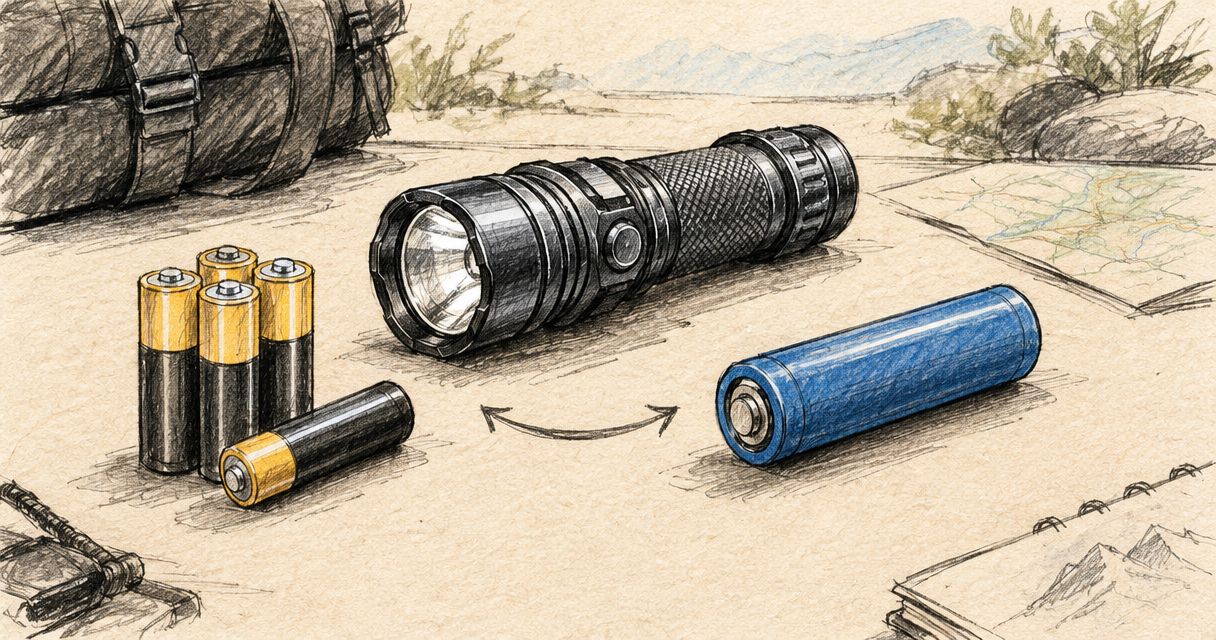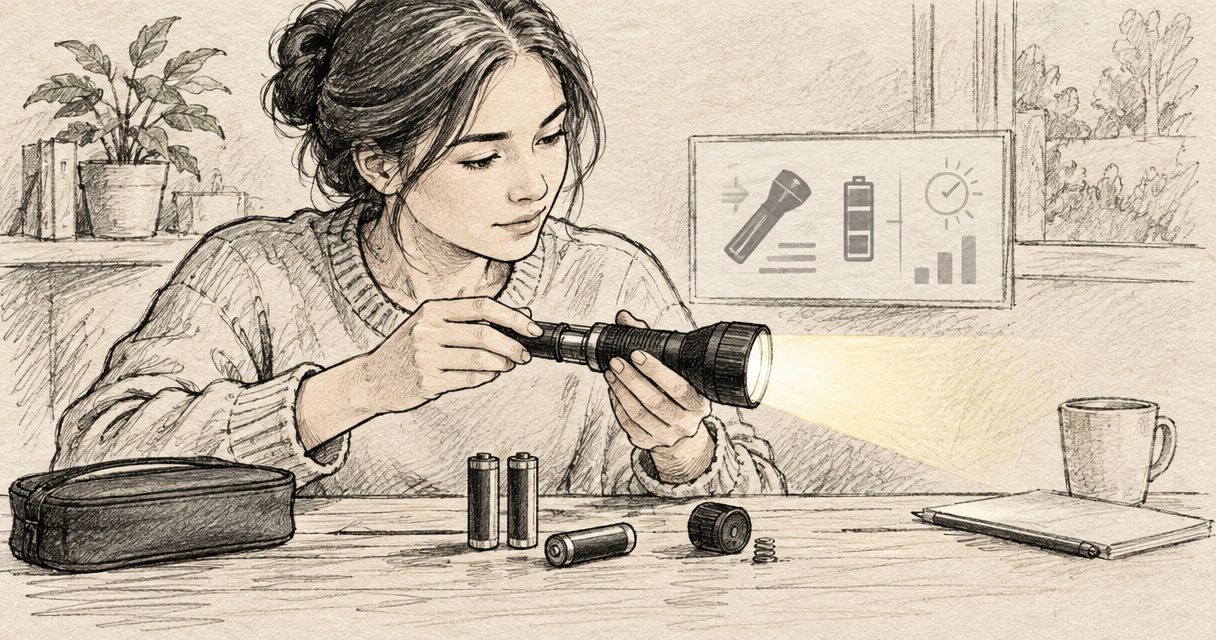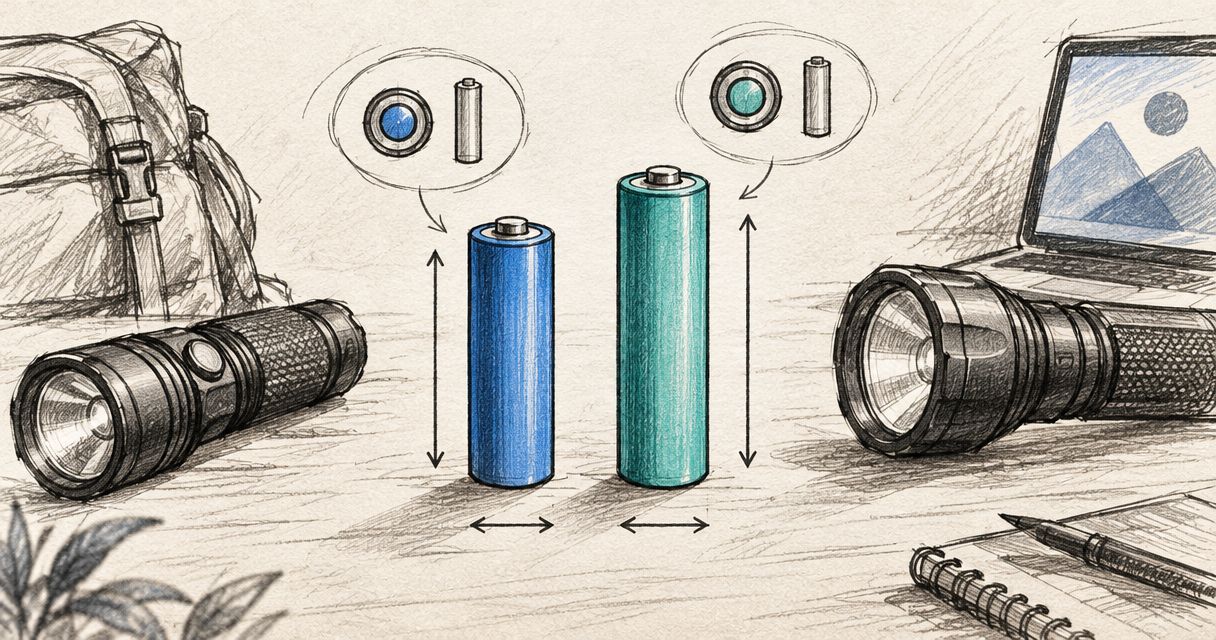
A 21700 cell has a larger nominal body than an 18650 cell, but 18650 vs 21700 battery capacity has no single average or fixed capacity range: capacity belongs to the specific cell, not its size designation. The useful starting benchmark is physical size—approximately 21 × 70 mm versus 18 × 65 mm—followed by the battery requirements in your torch’s manual.
- 18650 vs 21700 battery capacity depends on the specific cell; the format alone does not establish mAh.
- 21700 has about 47% more nominal cylindrical volume, not automatically 47% more capacity or runtime.
- Match size, voltage, terminals and protection requirements before comparing capacity.
- TorchSA serves South African torch buyers; choose replacement batteries against the torch manufacturer’s requirements.
Why this matters
A battery that looks like an upgrade can be the wrong replacement. Extra capacity does not help if the cell cannot fit, make the correct electrical contact or supply the current your torch requires.
For buyers browsing TorchSA, the practical distinction is between choosing a new torch and replacing an existing battery. You can compare different battery formats when choosing a torch; for a replacement, start with the approved battery specification rather than the largest mAh figure.
Size benchmarks: 18650 vs 21700
The familiar format names describe nominal cylindrical dimensions. An 18650 cell is approximately 18 mm in diameter and 65 mm long; a 21700 cell is approximately 21 mm in diameter and 70 mm long. These are format references, not guaranteed finished dimensions for every battery sold under those descriptions.
| Benchmark | 18650 format | 21700 format | Overall comparison |
|---|---|---|---|
| Nominal diameter | 18 mm | 21 mm | 21700 is 3 mm wider |
| Nominal length | 65 mm | 70 mm | 21700 is 5 mm longer |
| Calculated nominal cylindrical volume | About 16.5 cm³ | About 24.2 cm³ | 21700 has about 47% more volume |
| Average capacity in mAh | Not defined by format | Not defined by format | Compare individual cell specifications |
| Finished battery dimensions | Check the specific battery | Check the specific battery | Added terminals or protection can change fit |
| Torch compatibility | Requires explicit support | Requires explicit support | Neither format is a universal replacement |
21700 leads on nominal physical volume at about 24.2 cm³; 18650 is smaller at about 16.5 cm³. That is a size comparison, not evidence that every 21700 stores more energy than every 18650.
Methodology: nominal dimensions follow the cylindrical-cell size designation convention described in IEC 61960-3; volumes are calculated as cylinders from those dimensions and rounded. These are geometric reference values, not a dated sample of batteries, and they cannot establish average capacity, usable energy or torch runtime.
What the extra volume tells you
A larger cell body provides more physical space for the cell’s internal construction. That makes format relevant when you compare complete torches, but it does not replace a cell specification sheet.
The important limitation is straightforward: 47% more nominal volume does not mean 47% more runtime. Cell chemistry, electrode design, discharge current, temperature and the torch’s electronics all affect how much useful energy reaches the light.
Neither format wins every buying decision. The smaller format suits equipment designed around its dimensions; the larger format suits equipment designed to accommodate it. Your torch determines which comparison is relevant.
Capacity: compare the cell, not just the format
Battery capacity in milliamp-hours, or mAh, describes electric charge under specified test conditions. It does not describe beam distance, sustained brightness or charging speed.
There is no universal 18650 capacity and no universal 21700 capacity. A meaningful benchmark needs identified cells and comparable test conditions, including discharge current, temperature and end-of-discharge voltage. Without those details, a format-wide average hides differences that matter to your torch.
| Specification | What it tells you | What it does not establish |
|---|---|---|
| Capacity, mAh | Rated electric charge under stated conditions | Actual runtime in your torch |
| Energy, Wh | Rated energy, accounting for voltage | Sustained light output |
| Continuous discharge rating | Current the cell is rated to supply under stated conditions | Compatibility with every high-output torch |
| Nominal voltage | The cell’s reference operating voltage | The correct charging limit by itself |
| Format designation | Approximate physical size | Chemistry, terminals or protection requirements |
A useful comparison reads across the specification sheet rather than stopping at its largest number. Two cells with the same capacity rating can have different discharge capabilities, dimensions or terminal arrangements.
Why watt-hours can be more useful than mAh
Watt-hours express energy rather than electric charge. The relationship is Wh = nominal voltage × Ah, with mAh converted to amp-hours before multiplication.
When two cells have the same nominal voltage, the one with the higher rated mAh also has higher rated Wh. When nominal voltages differ, comparing mAh alone is incomplete. This distinction also matters when you compare a torch battery with a power bank, because the quoted capacity must be understood alongside its voltage reference.
Do not use the equation to predict exact runtime. Rated energy is not the same as energy delivered through a particular torch’s driver at a particular output setting.
How to use these benchmarks
Use the size comparison to narrow your choices, then use the battery and torch specifications to make the decision. The right order prevents a capacity figure from overriding a compatibility requirement.
- Replacing an existing battery: prioritise compatibility. The nominal diameter difference is 3 mm, so an approved 18650 battery does not become interchangeable with a 21700 simply because both are cylindrical.
- Choosing a new torch: compare the complete package. The 21700 format has about 47% more nominal cell volume, but the finished torch’s dimensions, weight and measured runtime determine its usefulness to you.
- Comparing capacity claims: require matching conditions. Compare rated mAh or Wh alongside discharge conditions and current capability, not across unexplained headline figures.
- Planning longer use: compare runtime at useful output. A longer low-output runtime is not a substitute for sustained output at the setting you actually need.
Torch compatibility: size is only the first check
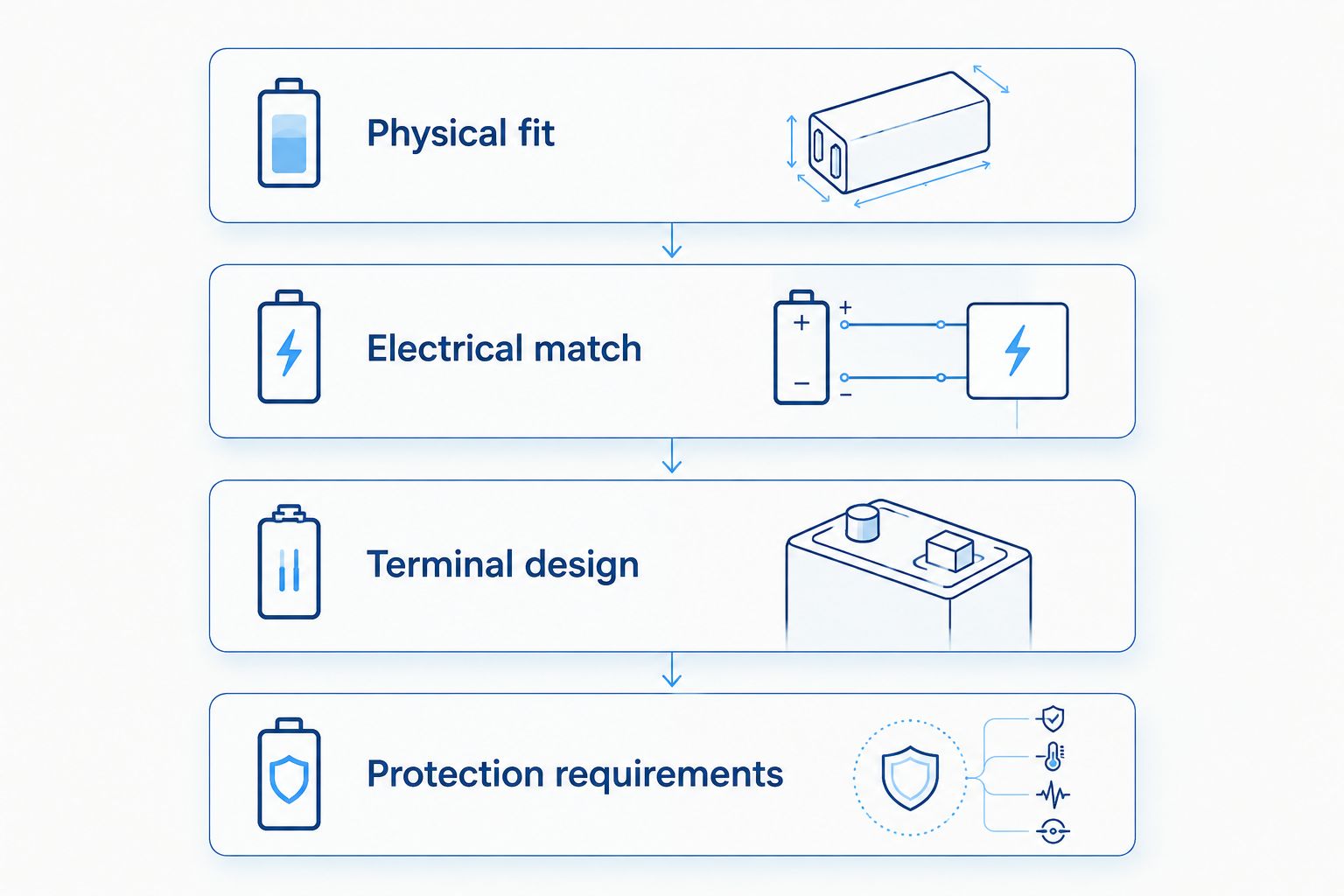
A battery is suitable only when it meets the torch manufacturer’s requirements. Physical fit is necessary, but it does not prove electrical compatibility.
Read the manual’s battery section before ordering a replacement. If the original cell carries a specific battery reference, retain that information: a familiar size designation does not capture every feature of the approved battery.
Physical fit
Check the finished battery’s diameter and length, not only its format name. Protection circuitry and terminal construction can increase overall length, while the torch’s spring travel and battery compartment set practical limits.
Do not force a tailcap closed against an oversized battery. Excessive compression can damage the cell or the torch, and a tight fit is not evidence of a correct replacement.
Electrical match
Confirm the required chemistry and voltage, then check the discharge capability specified for the torch. Capacity and current are different properties: a high mAh rating does not prove that a cell can supply the current a demanding output mode requires.
Never substitute a different chemistry because the dimensions look familiar. The size designation alone does not tell you the correct charging method or voltage limits.
Terminal design
Check whether the torch requires a flat-top, button-top or a specific contact arrangement. Some rechargeable torches use customised batteries or contacts that an ordinary cell of similar dimensions cannot replace.
A battery can enter the tube yet fail to make the intended contact. Do not add loose metal spacers or modify contacts to make an unsuitable battery work.
Protection requirements
Confirm whether the manufacturer specifies a protected battery, an unprotected cell or a particular replacement battery. Protection circuitry affects both the battery’s behaviour and its physical dimensions.
Do not assume that every torch supplies every necessary protection function. Follow the equipment instructions rather than treating protection as an optional feature you can add or remove without checking.
Before asking for help, photograph the original battery label and note the torch model. Include the battery compartment markings and charger details where available; those details are more useful than saying you need a bigger battery.
You can contact TorchSA with that information to ask about a suitable replacement. Keep the request specific: identify the torch first, then ask which battery specification it requires.
Best for: choosing around your actual use
These are format-selection principles, not recommendations for individual batteries. Each option has a useful role and a clear limitation.
| Option | Best for | Advantage | Limitation |
|---|---|---|---|
| 18650-compatible torch | Buyers prioritising a torch designed around the smaller cell format | Smaller nominal cell envelope | Format alone does not establish runtime or output |
| 21700-compatible torch | Buyers who accept a larger cell format when comparing complete torches | Larger nominal cell envelope | Larger cells are not drop-in upgrades for smaller compartments |
| Manufacturer-approved replacement | Owners replacing a battery in an existing torch | Keeps the decision tied to equipment requirements | Restricts the choice to compatible specifications |
Everyday carry
Compare the torch’s actual dimensions and carry arrangement, not just the battery. An 18650 cell has the smaller nominal envelope, but the reflector, switch, charging system and body construction also influence pocket comfort.
Choose the complete torch you will carry consistently. A larger battery format is not an advantage if the resulting torch does not suit your pocket or work routine.
Camping and overnight use
Compare runtime at the mode you will use around camp, and check how you will recharge or replace the battery. Maximum output is a separate question from useful overnight illumination.
A spare battery only helps when it is compatible, safely carried and charged. If a torch has an integrated battery, assess its charging requirements rather than planning around a battery swap the manufacturer does not support.
Security and outdoor work
Prioritise sustained output, controls and a practical charging routine. The biggest capacity figure cannot tell you whether the beam suits a patrol route or whether the torch maintains useful brightness throughout a task.
For TorchSA buyers comparing rechargeable torches, the battery format should support the buying decision—not replace it. Check the light’s documented performance at the setting your work requires.
Charging and spare-battery safety
A charger must support the battery’s chemistry, voltage requirements and finished dimensions. A charging slot that physically accepts a battery does not, by itself, establish compatibility.
Use the charging method approved for the torch or battery. Do not assume that an external charger, a torch’s built-in charging circuit and a battery with its own charging port are interchangeable approaches.
For loose spares, use a protective battery case that prevents contact with keys, coins and other conductive objects. Inspect the wrapper and terminal insulation before use, and stop using a cell with damage, leakage or abnormal heating. Do not charge a damaged battery.
Never force compatibility through improvised adapters or contact modifications. Where the manual explicitly permits an adapter or an alternative cell format, follow that exact arrangement and its stated limitations.
FAQ
Which has more capacity, an 18650 or a 21700 battery?
The format alone does not establish capacity; compare the rated mAh or Wh of the specific cells. A 21700 has a larger nominal body, but that does not guarantee a particular capacity advantage.
Can I put a 21700 battery in an 18650 torch?
Not unless the torch manufacturer explicitly supports that battery arrangement. A nominal 21700 is wider and longer, and physical fit would still not establish electrical compatibility.
Can I use an 18650 in a 21700 torch with an adapter?
Only if the torch manufacturer explicitly approves the adapter and battery combination. An adapter that centres a smaller battery does not establish the correct voltage, contacts or current capability.
Does 47% more battery volume mean 47% longer runtime?
No: the approximately 47% difference is calculated from nominal cylindrical dimensions, not measured runtime. Cell construction, discharge conditions, torch efficiency and output settings determine the result.
Is a higher mAh battery always better for a torch?
No: a higher mAh rating does not override the torch’s compatibility or discharge-current requirements. Compare capacity only among batteries that meet the equipment specification.
Can the same charger charge 18650 and 21700 batteries?
Only if the charger explicitly supports both batteries’ dimensions, chemistry and charging requirements. Check the charger instructions rather than relying on the slot length.
Are all 18650 batteries the same length?
No: finished battery length can differ because of terminal construction and added protection circuitry. Compare the specific battery’s dimensions with the torch’s requirements.
What should I send TorchSA when asking for a replacement battery?
Send the torch model and clear photographs of the original battery label and relevant compartment markings. Add the charger details so the replacement question includes both use and charging compatibility.
One last thing
The battery’s small print is more useful than its biggest number. Before buying, record the approved battery specification in your phone alongside the torch model; that turns the next replacement into a compatibility check instead of a capacity guessing exercise.
Choose the correct battery first. Compare capacity second.