The longest battery life flashlight is the one that maintains enough light for your task, not simply the one with the longest low-mode claim. Choose by sustained output, runtime at a useful brightness and how you will recharge or replace the battery.
- Choose the longest battery life flashlight by useful output, not the longest advertised runtime alone.
- Compare rechargeable torches at similar brightness settings before comparing hours.
- Replaceable batteries help when charging is unavailable; integrated batteries simplify handling but require a charging plan.
- TorchSA sells torches directly to South African buyers; match battery life to your camping, security or everyday needs.
Why battery-life rankings need context
A torch that runs for a long time at a faint setting serves a different purpose from one that maintains a strong working beam. Both runtime figures can be accurate, yet they answer different questions. Your first job is to decide how much light the task actually requires.
Start with TorchSA and assess each candidate against the same checklist: output mode, runtime, output changes and battery arrangement. A headline number without those details is not enough to rank one torch above another.
For camping, prioritise a usable low setting; for security work, prioritise sustained working output and a practical backup battery plan. Those are different buying decisions, even when both buyers ask for long battery life.
What makes the best long-runtime flashlight?
Use these criteria before comparing models. They separate useful endurance from specifications that look impressive without meeting your needs.
- Useful brightness: The chosen mode must illuminate the task, not merely remain visible in darkness.
- Sustained output: Check what happens after switch-on, especially when a high setting reduces output as the torch heats up.
- Mode-specific runtime: Compare hours at comparable brightness levels rather than pairing one torch's lowest mode with another's medium mode.
- Battery recovery: Decide whether you need to replace a depleted battery immediately or can stop to recharge.
- Charging compatibility: Confirm the charging connection, required accessories and power source before relying on the torch away from home.
- Handling and weight: A larger battery arrangement is only helpful if you will carry and use it.
Treat missing runtime information as a reason to investigate, not permission to assume. Battery capacity alone does not establish how long a complete torch will maintain its beam.
Long-runtime flashlight options at a glance
These are buying approaches, not a model-by-model endurance ranking. Choose the approach that matches your work, then compare the published specifications of suitable torches.
| Buying approach | Best for | Main advantage | Key limitation |
|---|---|---|---|
| Low-output endurance | Campsite tasks and close-up use | Conserves energy when little light is needed | A long runtime does not establish distance visibility |
| Sustained working output | Security rounds and outdoor movement | Prioritises usable illumination throughout the task | Requires more than a maximum-runtime headline to assess |
| Replaceable-battery setup | Trips without dependable charging | Lets you restore operation with compatible charged spares | Requires safe storage and battery management |
| Integrated rechargeable setup | Routine use with dependable charging | Keeps charging and daily handling straightforward | You must plan around charging interruptions |
Do not read the table as a claim that one battery arrangement always lasts longer. Endurance depends on the complete system: battery energy, electronics, LED, selected output and operating conditions.
1. Low-output endurance: best for close-up camping tasks
A genuinely useful low mode lets you read, sort equipment or find something inside a tent without running a brighter setting unnecessarily. The important question is whether that setting illuminates your task comfortably. A barely visible glow is not a substitute for working light.
Best for: Campers who spend much of their evening doing close-range tasks rather than searching across open ground.
Low-output endurance pros:
- Uses less power than a higher setting on the same torch.
- Reduces the need to illuminate an entire campsite for a small task.
- Gives you a sensible everyday mode while retaining brighter settings for other needs.
Low-output endurance cons:
- Does not establish whether the torch can illuminate a distant subject.
- Can make the maximum-runtime headline look more relevant than it is.
- Still needs a practical switch sequence, particularly when you want low output immediately.
Check whether the torch starts in the mode you expect or remembers its previous setting. An otherwise suitable low mode becomes frustrating if reaching it repeatedly requires cycling through unwanted modes.
Verdict: Buy for close-up camping use only when the low setting is genuinely useful to you; skip it as your sole measure of security performance.
2. Sustained working output: best for security rounds
For security work, a momentary bright beam and a dependable working beam are not interchangeable. You need to see paths, boundaries and the immediate area throughout the task. Assess the output after the initial burst, not just at switch-on.
Best for: Buyers who need repeatable illumination while walking or inspecting outdoor areas.
Sustained working output pros:
- Connects battery life to the brightness you actually need.
- Helps distinguish brief high-output modes from longer working modes.
- Makes runtime comparisons more relevant to the length of your duties.
Sustained working output cons:
- Requires detailed specifications or an output-versus-time graph.
- Does not remove the need for spare power or a backup light.
- Cannot be judged from maximum lumens alone.
Beam shape matters here too. A concentrated beam and a broad beam can put the same total light into different areas, changing what you can see. The guide to flashlights ranked by lumens and brightness explains the brightness side of the decision.
Verdict: Buy on documented working-mode performance; skip a decision based solely on turbo output or maximum runtime.
3. Replaceable batteries: best for time away from charging
A compatible charged spare lets you restore operation without waiting for the depleted battery to recharge. That changes your power plan, but it does not increase the runtime of the battery already inside the torch. Keep those two ideas separate when comparing options.
Best for: Campers and outdoor users who cannot depend on a charging opportunity when the torch runs down.
Replaceable-battery setup pros:
- Allows a depleted battery to be exchanged for a compatible charged one.
- Separates immediate lighting needs from the charging schedule.
- Supports planning around several periods of use away from power.
Replaceable-battery setup cons:
- Requires confirmation of the exact permitted battery type.
- Adds spare batteries and protective storage to your kit.
- Demands attention to battery condition and correct installation.
Follow the torch manufacturer's requirements for battery chemistry, dimensions and protection features. A cell that fits physically is not automatically suitable. Carry spare cells in protective cases, with terminals protected from contact with metal objects.
Verdict: Buy when uninterrupted use away from charging matters; skip assumptions that similar-looking batteries are interchangeable.
4. Integrated recharging: best for a regular charging routine
An integrated rechargeable arrangement suits buyers who can charge between uses and prefer not to handle loose cells. Its usefulness depends on your routine. If you forget to recharge or cannot access power, a convenient charging system does not solve the immediate problem.
Best for: Everyday users who can return the torch to a dependable charging point between outings.
Integrated rechargeable setup pros:
- Avoids routine handling of loose batteries.
- Keeps the torch and its charging process together.
- Works with a repeatable check-and-charge habit.
Integrated rechargeable setup cons:
- Requires charging time when the battery is depleted.
- Can depend on a particular cable or charging accessory.
- Needs a separate backup plan if you cannot interrupt use.
Check whether the battery is user-replaceable and what happens when it reaches the end of its service life. Also verify whether charging requires a proprietary accessory rather than assuming any cable will work.
Verdict: Buy for predictable daily charging; skip it as your only light when you cannot accommodate a charging interruption.
How to read a flashlight runtime specification
The ANSI/PLATO FL 1 runtime method measures the time until output falls to 10% of its initial value, with the initial measurement taken 30 seconds after switch-on. That endpoint matters: a runtime figure is not a promise of unchanged brightness throughout the test.
For a hypothetical torch initially producing 100 lumens, 10% is 10 lumens. That example illustrates the measurement threshold, not the performance of a particular product. Whether the remaining light is useful depends on the task and beam.
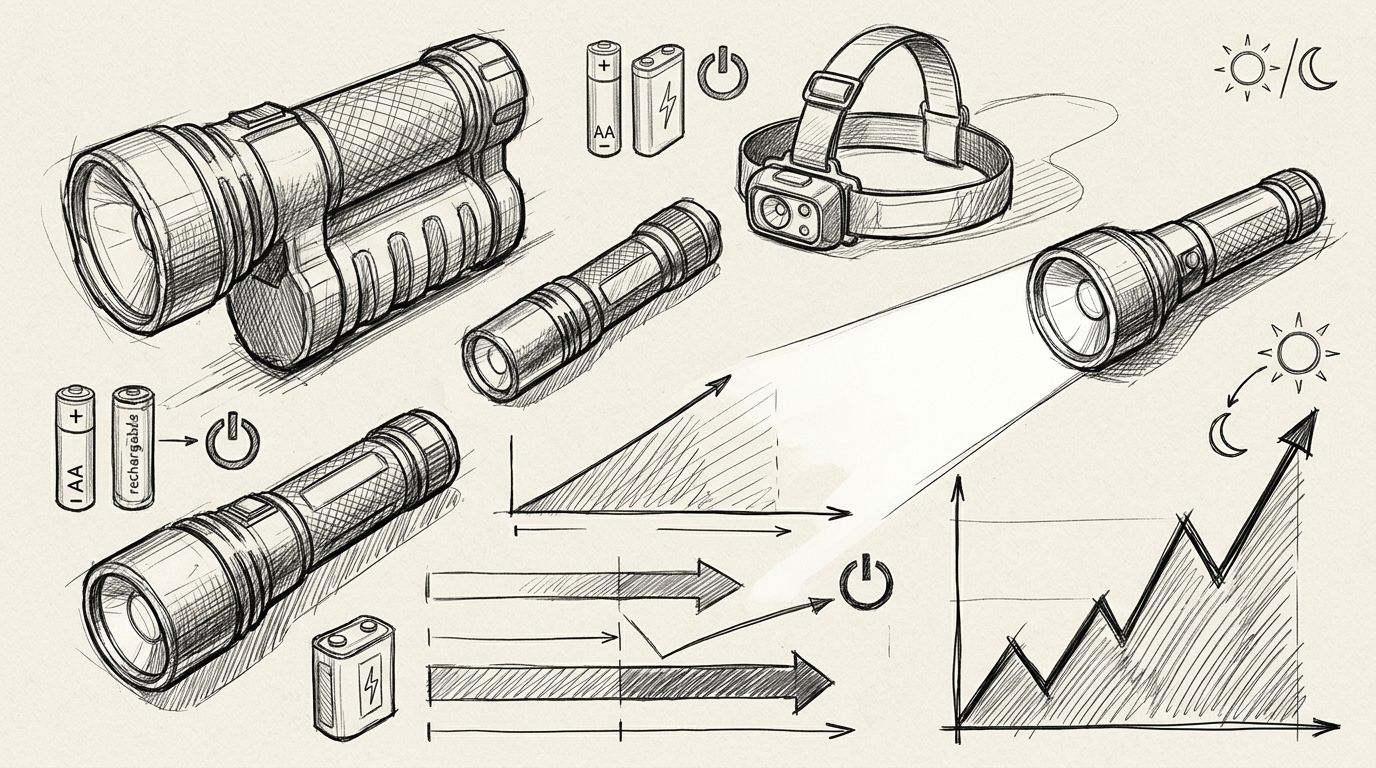
Look for an output-versus-time graph alongside the runtime figure. A relatively level working output and a steadily declining output tell different stories, even if their final runtime numbers are similar.
Read specifications in this order:
- Choose the mode. Identify the setting you expect to use most.
- Check the output. Confirm that its brightness and beam suit the task.
- Read the runtime. Look for an output graph or explanation of reductions.
- Plan recovery. Decide how you will recharge, replace batteries or switch lights.
Battery capacity is not a runtime ranking
Milliamp-hours describe electrical charge, not torch runtime by themselves. Voltage also matters when comparing stored energy. For a simple calculation, watt-hours equal amp-hours multiplied by nominal voltage.
A hypothetical 1,000 mAh battery at 3.7 V stores 3.7 Wh of nominal energy. This is an arithmetic example, not a specification for a stocked product. It still does not predict runtime without knowing the torch's power demand and losses.
Even equal nominal battery energy does not guarantee equal light output or endurance. The electronics, LED, operating mode and thermal behaviour affect the result. Use battery capacity to understand a specification, not replace the complete runtime information.
Ask TorchSA about battery compatibility before selecting spares. Do not substitute a battery based only on a larger capacity number printed on its wrapper.
How to choose for your actual outing
Write down the task before browsing specifications. For camping, separate close-up jobs from walking and searching; for security, separate routine rounds from brief inspections. You do not need the same output for every activity.
Next, identify the longest period during which you cannot conveniently recharge or change batteries. Compare that need with the relevant working mode, rather than the longest figure anywhere on the specification sheet.
Finally, decide what happens if the main torch stops working. A spare battery addresses depleted power; a separate backup light also addresses a fault in the torch itself. Those are different protections.
TorchSA is a retail starting point for South African buyers comparing long-runtime torches. Bring a specific task and charging requirement to the decision rather than asking for the biggest runtime number.
Choose a torch around your task
Compare the range with useful brightness, battery compatibility and your charging routine in mind.
FAQ
What's the longest battery life flashlight for camping?
Choose a flashlight with a documented low-mode runtime at a brightness that suits your campsite tasks. Check a separate working mode for walking or searching, because the longest low-mode figure does not describe those uses.
Does a higher-capacity battery always make a torch last longer?
No, a higher capacity figure alone does not establish longer torch runtime. Compare compatible batteries at the same voltage and assess the complete torch's output and runtime specifications.
Why does my torch get dimmer before the battery is empty?
Output can reduce because of thermal control or the way the torch manages declining battery power. Check the manufacturer's mode information and output graph to understand the expected behaviour.
Are replaceable batteries better than built-in rechargeable batteries?
Replaceable batteries are better suited to immediate battery changes away from charging, while integrated recharging suits a predictable charging routine. Neither arrangement guarantees longer runtime on its own.
Can I use any battery that fits inside my flashlight?
No, physical fit does not establish compatibility. Follow the manufacturer's requirements for battery chemistry, voltage, size and protection features.
Does the advertised runtime mean full brightness the whole time?
No, an advertised runtime does not necessarily mean constant brightness. Under the ANSI/PLATO FL 1 method, the runtime endpoint is 10% of the initial measured output, so an output graph gives important context.
What should I compare before buying a torch for security work?
Compare sustained working output, beam suitability, mode-specific runtime and your backup power plan. Maximum lumens and the longest low-mode runtime do not establish performance throughout a security round.
One last thing
Choose the working mode before choosing the torch. If the longest-runtime setting cannot illuminate your task, its endurance does not answer your buying question. A shorter documented runtime at useful brightness gives you a better basis for planning than a longer figure attached to an unsuitable mode.