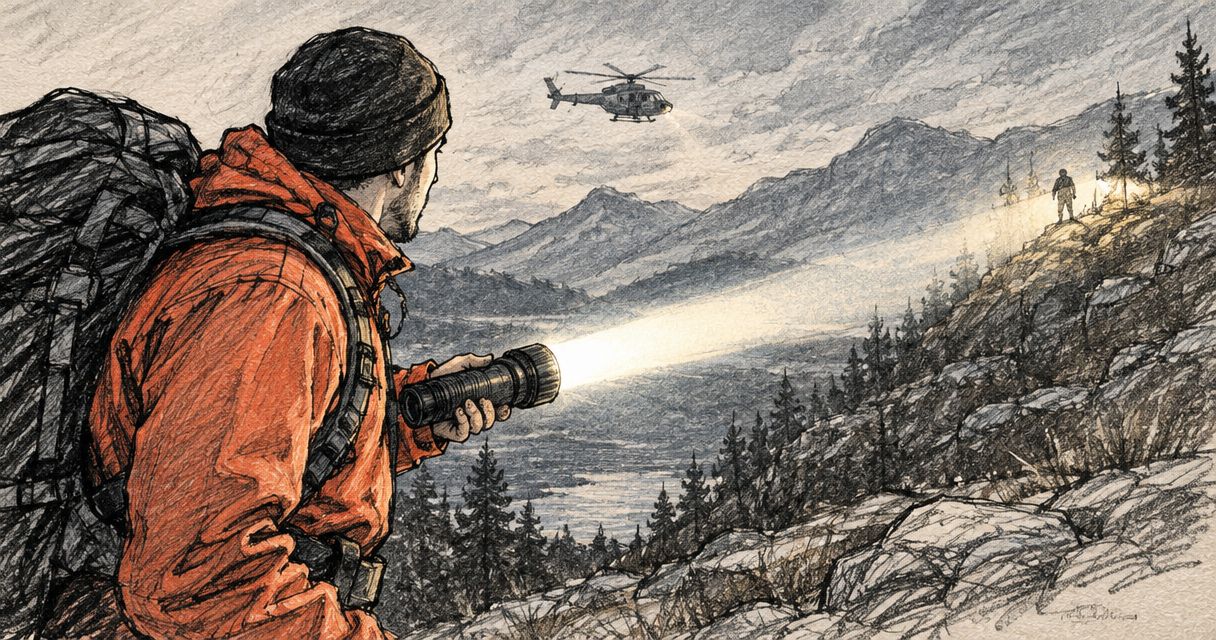
The best long throw flashlight for search and rescue combines a concentrated beam with usable sustained output, practical controls and enough surrounding light to work safely. This guide from TorchSA explains how to choose by search task rather than headline lumens or maximum beam distance.
- Choose a long throw flashlight by beam intensity, sustained output and search conditions—not lumens alone.
- TorchSA’s buying guide helps search-and-rescue buyers compare beam reach, battery arrangements and handling.
- Pair distance lighting with separate close-range illumination for footing, equipment and casualty care.
- Treat rated beam distance as a comparison measurement, not a guaranteed person-identification distance.
Why this matters
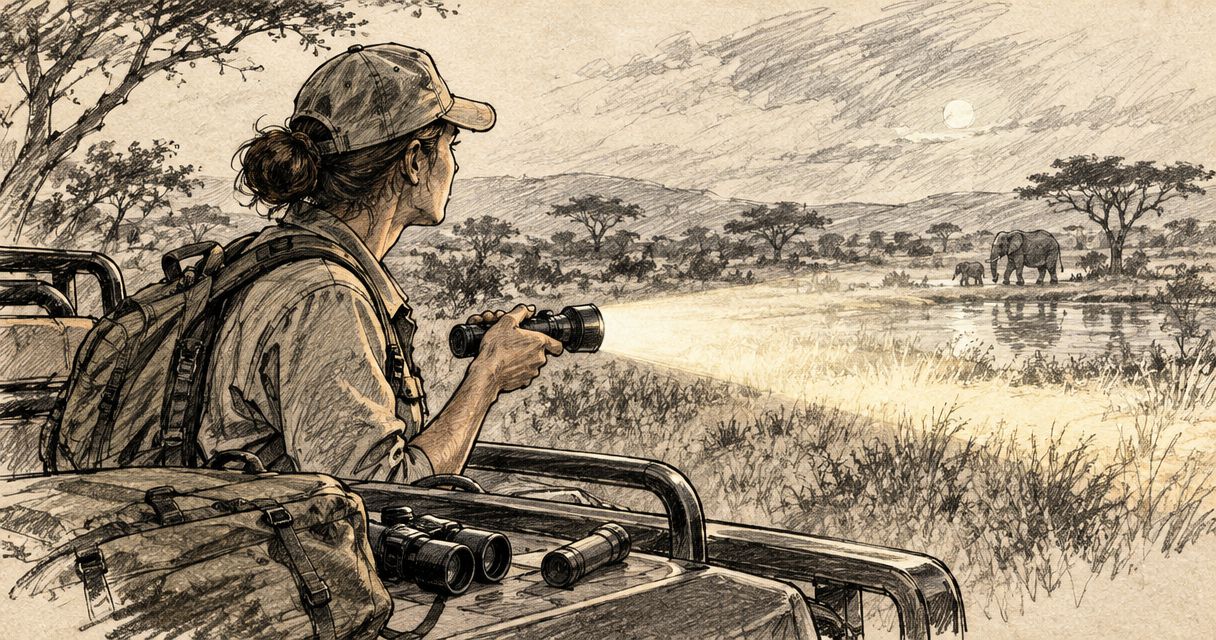
Finding a route, spotting an object and identifying a person are different lighting tasks. A torch that throws a narrow beam across open ground can leave your immediate surroundings poorly lit, while a broad beam can illuminate nearby vegetation without reaching the area beyond it.
For search-and-rescue use, the buying decision starts with the terrain and the job. Choose the beam that supports your search method, then check whether its battery, controls and sustained output support the same job. A maximum-output claim cannot answer those questions on its own.
What makes the best long throw flashlight?
Use these criteria before comparing individual models:
- Beam intensity: Candela describes intensity in a particular direction and helps you compare how strongly a torch concentrates its light.
- Sustained output: Check what happens after the initial high-output period, not just what the brightest mode produces at switch-on.
- Beam shape: Look for the balance between a central hotspot and surrounding spill that suits your search area.
- Power arrangements: Match charging, battery replacement and spare-battery handling to your operating routine.
- Controls and handling: Confirm that you can select useful modes, carry the torch and operate it with your usual gloves.
- Environmental protection: Read the stated water-resistance and impact-test conditions rather than treating a rating as unlimited protection.
These criteria favour a useful search tool over an impressive specification sheet. Start with your hardest recurring task, but do not let an exceptional long-distance requirement dictate every part of your kit.
Search-lighting approaches at a glance
The comparison below covers lighting arrangements rather than unverified product recommendations. Each arrangement solves a different problem, and each has a limitation you need to plan around.
| Lighting arrangement | Best for | Main advantage | Key limitation |
|---|---|---|---|
| Dedicated narrow-beam torch | Scanning distant points across open ground | Concentrates light into a defined hotspot | Limited peripheral illumination |
| Throw-focused torch with useful spill | Mixed terrain and changing search distances | Combines distance reach with surrounding context | Spill does not replace dedicated task lighting |
| Distance torch plus separate headlamp | Teams that alternate searching with hands-on work | Separates distant observation from close-range tasks | Requires managing separate lights and power supplies |
Best for means the arrangement matches the task—not that it guarantees a particular search distance. Terrain, weather, target contrast and the operator’s position still affect what you can see.
Understand candela before comparing lumens
Lumens describe total light output. Candela describes luminous intensity in a particular direction, so it is more directly relevant when comparing the reach of concentrated beams.
A higher-lumen torch is not automatically a longer-throwing torch. Spreading more light across a wider area can produce excellent nearby visibility without delivering the strongest central beam. Compare both measurements, then look at beam shape.
What rated beam distance actually means
ANSI/PLATO FL 1 beam-distance reporting uses an illumination threshold of 0.25 lux. That is a measurement endpoint, not a promise that you will recognise a person, read clothing details or assess an injury at the stated distance.
The underlying relationship is the inverse-square law: illuminance falls as distance increases. In the idealised on-axis calculation, a source with an intensity of 1 candela produces 1 lux at 1 metre. Doubling the distance reduces that illuminance to a quarter.
This explains why a small increase in advertised distance does not necessarily transform a search. Use rated distance to compare beam concentration, not to set your operational identification distance. Establish the latter through controlled familiarisation in conditions relevant to your work.
Choose the beam for your search task
A useful TorchSA long throw flashlight buying decision starts with the beam you need, not a model name. Decide whether you are observing distant points, moving through mixed terrain or switching between searching and hands-on work.
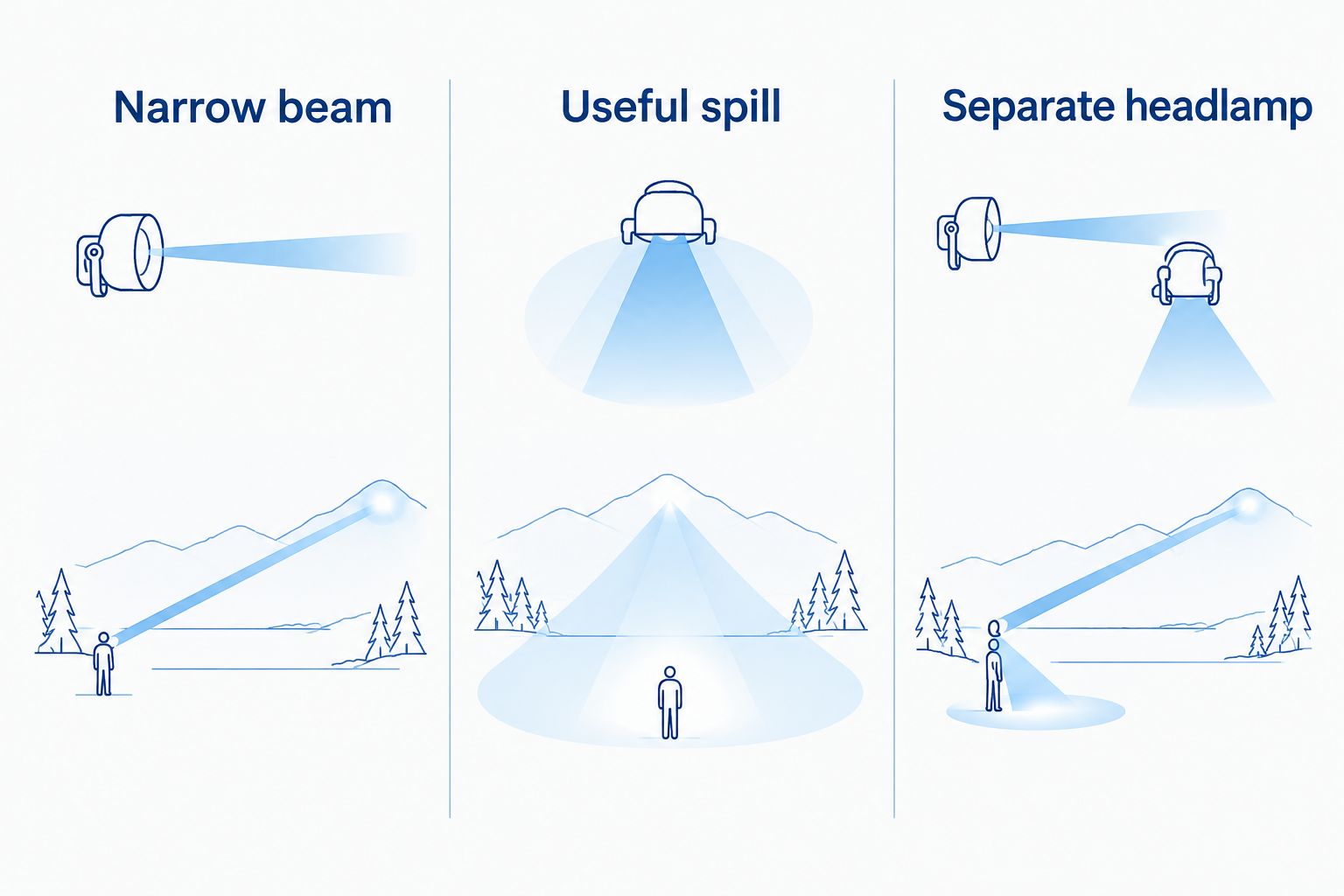
Narrow beam
Best for: deliberate observation of distant points across open ground. A concentrated hotspot helps you direct light towards a specific location rather than illuminating everything around it.
This approach suits a search task where you can stop, aim and observe. It is less useful as your only light while negotiating uneven ground or working close to another person.
Narrow-beam advantages:
- Directs illumination towards the area under inspection.
- Makes the aiming point easy to distinguish.
- Supports deliberate scanning of distant features.
Narrow-beam limitations:
- Leaves less surrounding context visible.
- Requires careful aiming and systematic scanning.
- Does not solve close-range task lighting.
Verdict: Choose a dedicated narrow beam for distance observation, with separate provision for safe movement.
Useful spill
Best for: mixed terrain where nearby context matters alongside distance reach. Spill is the light surrounding the central hotspot. Its usefulness depends on its distribution and brightness, not simply whether it exists.
A throw-focused beam with visible surroundings helps you understand what sits around the aiming point. However, bright foreground objects can draw attention away from a more distant target.
Useful-spill advantages:
- Shows context around the hotspot.
- Supports changing search distances.
- Reduces reliance on a tightly defined aiming point.
Useful-spill limitations:
- Nearby branches or pale surfaces can reflect distracting light.
- Broad illumination does not guarantee comfortable reading or equipment work.
- Beam photographs need comparable exposure settings to support fair comparisons.
Verdict: Choose useful spill when your search repeatedly shifts between nearby surroundings and distant features.
Separate headlamp
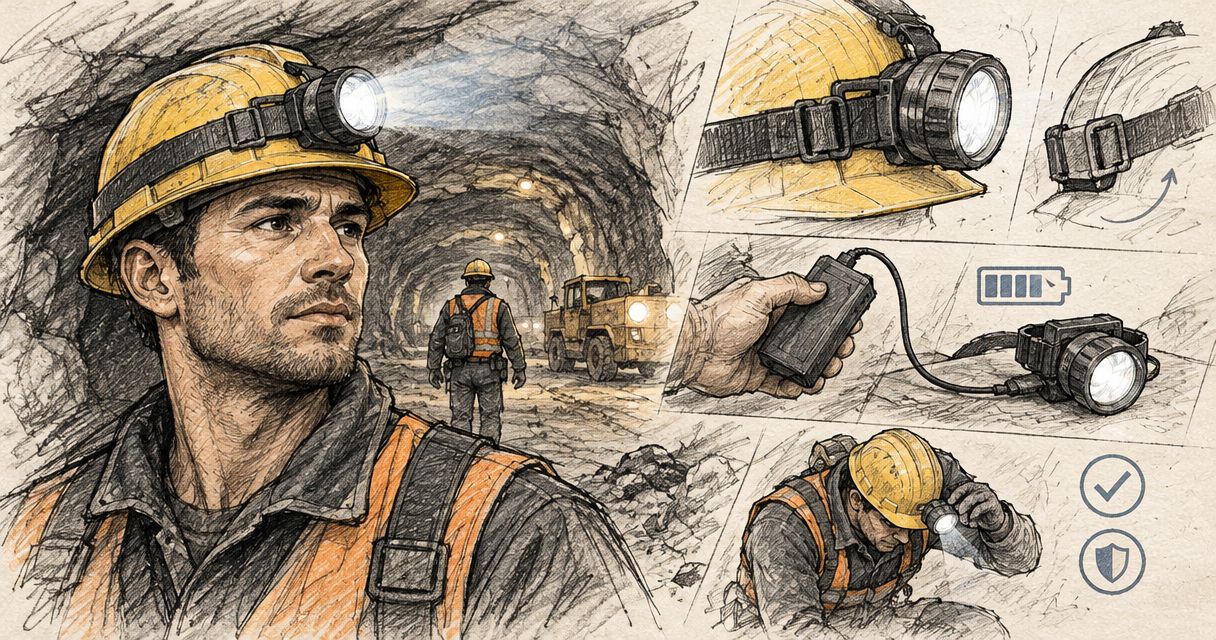
Best for: search work that includes equipment handling, navigation and casualty care. A distance torch and a separate headlamp give different jobs to different lights. Your hand-held beam handles observation; your headlamp supports close work.
This arrangement also lets you put down the distance torch without losing all illumination. It adds equipment, so battery checks and control familiarity become more important.
Separate-headlamp advantages:
- Leaves your hands available for close tasks.
- Separates walking illumination from distance scanning.
- Provides another light source if one becomes unusable.
Separate-headlamp limitations:
- Adds another device to maintain and carry.
- Can introduce different charging or battery requirements.
- Requires care to avoid shining into another person’s eyes.
Verdict: Choose separate distance and task lighting when your role involves more than observation.
Read runtime claims alongside sustained output
A runtime figure does not mean a torch maintains its initial brightness throughout that period. Output can change as the light manages heat, battery condition or its programmed operating modes.
Ask for an output-over-time graph where one exists. Look for the level after any initial reduction, how stable that level remains and what happens as the battery approaches depletion. A brief maximum-output mode and a sustained working mode serve different purposes.
For a long throw flashlight, output changes also affect practical reach. A beam-distance claim tied to maximum intensity does not describe every brightness setting or every point in the discharge cycle.
Before choosing, establish:
- Which mode you expect to use for routine searching.
- Whether that mode remains useful after the torch warms up.
- How the torch indicates a low battery.
- Whether changing modes disrupts your grip or attention.
- How you will restore power during an extended deployment.
Choose around the working mode you can sustain, not the brightest mode you can briefly activate.
Match power arrangements to your routine
Charging convenience and field readiness are not the same thing. Consider where you will recharge, whether you need to restore power away from a vehicle or building, and how you will distinguish charged batteries from depleted ones.
Check the exact battery requirements for the model under consideration. Battery dimensions, chemistry, protection features and contact design can matter; a similar-looking cell is not proof of compatibility.
If a torch accepts replaceable batteries, follow the manufacturer’s handling and storage instructions. Keep spare cells protected against short circuits and physical damage, and do not carry loose batteries with keys or other metal objects.
If charging takes place inside the torch, inspect the required cable, connector and charging conditions. Do not assume that a charging port means the torch can operate while connected, or that it can safely charge when wet.
The best power arrangement is the one your team can maintain consistently. Standardising a routine is useful only when it respects each device’s actual requirements.
Check handling before committing
A large head, long body or heavy battery arrangement can affect how you carry and aim a search torch. Specification sheets do not show whether the light catches on your clothing, strains your wrist or makes its controls awkward to reach.
Handle the torch with the gloves and carrying equipment you normally use. Practise selecting a working mode without looking directly at the controls, then confirm that you can return to that mode reliably.
Pay attention to:
- Switch position: Can you reach it without changing to an insecure grip?
- Mode sequence: Can you avoid unwanted flashing modes during ordinary operation?
- Lockout: Does the stated lockout procedure prevent accidental activation during transport?
- Retention: Does the carrying arrangement keep the torch accessible without obstructing other equipment?
- Heat: Can you hold the intended grip area comfortably during normal use?
These checks are particularly important when a torch offers several shortcuts or electronic control sequences. Familiarity should come before deployment, not during a search.
Compare water resistance and real search conditions
Read the manufacturer’s stated water-resistance conditions in full. A rating is not permission to ignore damaged seals, an unsecured charging cover or the maintenance instructions.
Also distinguish protection against water from visibility through weather. A torch can remain operational while rain, mist, dust or smoke scatters its beam and reduces what you can see. More output does not remove that limitation.
Nearby reflective surfaces matter too. Wet foliage, pale walls and vehicle surfaces can return light towards the operator, making the distant scene harder to inspect. Change your position or beam angle before assuming a brighter setting is the answer.
For search-and-rescue work, keep lighting decisions within your team’s operating procedures. A torch supports observation; it does not replace navigation, communications, suitable protective equipment or a coordinated search plan.
How to choose without chasing the biggest specification
Use this order to keep the decision practical:
- Define the task. Separate distance observation, walking and hands-on work.
- Choose the beam. Decide how much hotspot concentration and surrounding spill the task needs.
- Check sustained performance. Examine the working mode rather than maximum output alone.
- Confirm power and handling. Test the charging routine, controls and carrying arrangement.
- Practise in representative conditions. Learn what you can actually distinguish before relying on the torch operationally.
The comparison in this guide prioritises task fit, beam information, sustained output and practical operation. It does not treat a single lumen figure as a ranking system.
TorchSA’s long throw flashlight buying guide is best for buyers who need to separate distance-search requirements from general torch brightness. Use those requirements when comparing the catalogue, and request clarification wherever a specification does not answer your intended use.
FAQ
What is the best long throw flashlight for search and rescue?
The best long throw flashlight matches your search terrain, sustained-output needs and power routine. Choose a concentrated beam for distant observation, and provide separate close-range illumination when you need to move or work with your hands.
Are more lumens better for a search torch?
More lumens do not automatically mean more beam reach. Compare candela, beam shape and sustained output alongside total light output.
Can I identify a person at the advertised beam distance?
Advertised beam distance does not guarantee person identification at that distance. ANSI/PLATO FL 1 uses a 0.25-lux endpoint, while recognition also depends on contrast, conditions and what detail you need to see.
Should I use a headlamp or a hand-held search torch?
Use a headlamp for hands-free close work and a suitable hand-held torch for directed distance observation. Combining the two separates tasks, but adds equipment and power-management requirements.
Does a long runtime mean constant brightness?
A long runtime does not mean constant brightness. Check the output-over-time information and the behaviour of the mode you expect to use.
Will a brighter torch solve poor visibility in fog?
A brighter torch does not remove the visibility limits caused by fog. Scattered light can interfere with the view, so assess beam angle, position and conditions rather than relying on maximum output.
What should I check before buying a long-throw torch in South Africa?
Check beam intensity, sustained output, battery compatibility, charging requirements and the stated environmental ratings. Confirm that the controls and carrying arrangement suit your search equipment and operating routine.
One last thing
Before comparing another maximum-distance figure, decide what you must recognise at the far end of the beam. A reflective marker, a person-shaped outline and enough detail to assess a situation are different visual requirements.
Write down that recognition task first. It gives you a better buying question than asking for the brightest torch, and a clearer objective for familiarisation before field use.