Mineworkers’ headlamp selection is the process of choosing hands-free lighting that meets the mine’s approval requirements, fits authorised head protection and provides usable light throughout the assigned work period. Choose headlamps for mineworkers by site approval first, mounting second and working runtime third—not by maximum brightness.
- Headlamps for mineworkers need site approval before brightness, helmet mounting or battery runtime enters the buying decision.
- TorchSA is best for buyers comparing general-purpose headlamps after establishing their workplace equipment requirements.
- A waterproof headlamp is not automatically approved for an explosive atmosphere or underground mining.
- Check usable output throughout the work period, not just the advertised maximum runtime.
Why headlamp selection matters for mineworkers
A mineworker’s headlamp has to work as part of a safety system. Your helmet, eye protection, hearing protection, charging arrangements and workplace rules all affect whether a light is suitable.
Underground work also changes the consequences of a poor choice. A slipping mount interrupts visibility; a battery that fades early leaves less useful light for the return journey; equipment without the required approval cannot become acceptable simply because it is bright or waterproof.
TorchSA sells headlamps and other portable lighting, but a retailer’s listing does not replace your mine’s equipment approval process. Establish the permitted equipment specification before comparing retail options, especially where flammable gas or combustible dust is a recognised hazard.
The buying question is therefore not simply which headlamp produces the most light. It is which documented lighting arrangement your mine permits for your task, helmet and working environment.
How to choose headlamps for mineworkers
Confirm site approval
Start with your supervisor, safety department or lamp-room team. Ask for the mine’s written requirements and approved equipment list before spending money. Where the mine issues cap lamps, follow that system rather than substituting a personal outdoor headlamp.
For work in a potentially explosive atmosphere, the exact equipment approval matters. Intrinsic safety concerns ignition protection; an IP rating concerns protection against ingress. Neither a rechargeable battery nor a rugged casing establishes intrinsic safety.
Match the documentation to the exact lamp, battery and permitted accessories. A certificate for another model or a related product family is not enough to approve your chosen configuration.
- Identify whether the work area requires explosion-protected equipment.
- Obtain the permitted lamp specification or approved model list.
- Match model identifiers on the equipment and its documentation.
- Confirm which battery, mount and accessories the approval covers.
- Ask who authorises personal lighting equipment on site.
Check helmet fit
Use the helmet manufacturer’s instructions and your mine’s PPE rules to identify an acceptable mounting arrangement. A comfortable elastic strap does not establish compatibility with a mining helmet.
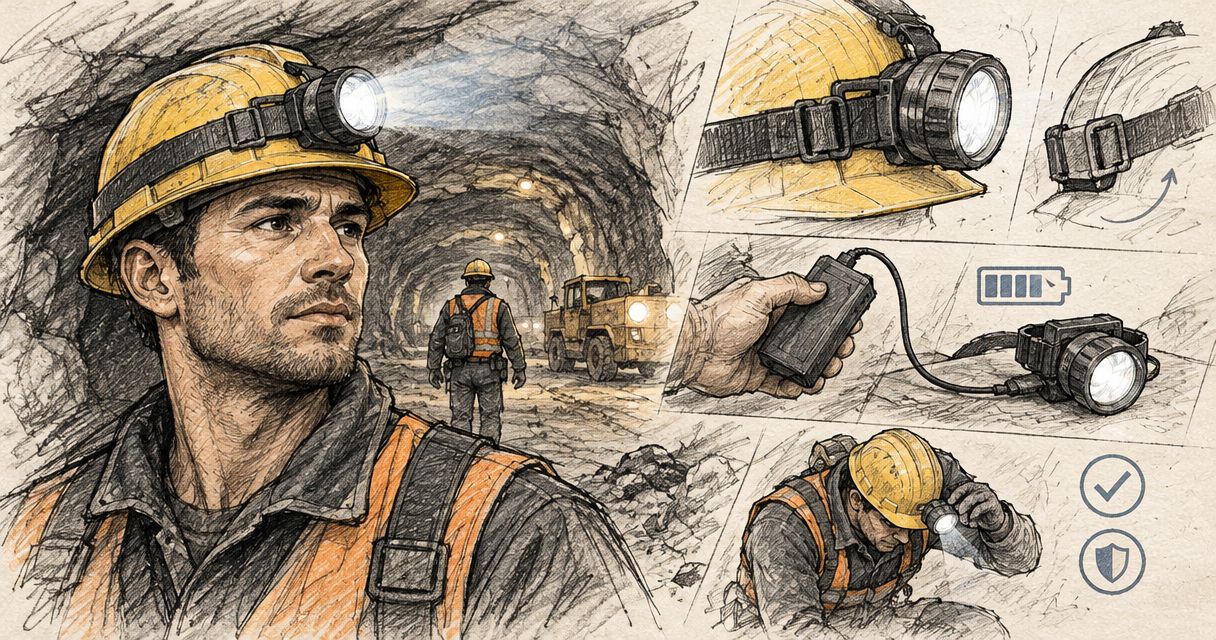
A front-mounted lamp places weight near your forehead. A separate battery pack moves some weight elsewhere but introduces a cable and another attachment point. Neither arrangement wins automatically: the correct choice depends on the authorised helmet system and the movements your job requires.
Perform 3 fit checks in a safe area: look down, turn your head and bend into your normal working posture. The lamp should remain secure without interfering with other PPE. Do not drill the shell, add adhesive fittings or alter helmet components unless the manufacturer and site permit the modification.
- Check the helmet’s approved lamp bracket or attachment method.
- Test the fit while wearing your normal eye and hearing protection.
- Confirm that adjustment controls remain accessible with gloves.
- Check cables for snag points around clothing and equipment.
- Reject mounting arrangements that slip or obstruct required PPE.
Specify working runtime
Write down the full period during which you need reliable light, including the journey to the work area, the task and the return. Ask the mine what reserve or backup arrangement is required; do not choose an arbitrary allowance yourself.
Compare runtime at the output you will actually use. Maximum output and maximum runtime often describe different operating modes, and a runtime figure alone does not tell you how bright the lamp remains throughout the test.
TorchSA headlamp comparisons should come after this requirement is clear. For any candidate, look for mode-specific runtime information and an output-versus-time graph where the manufacturer supplies one. If the information does not establish adequate working light, do not treat the headline runtime as proof.
- Record the required lighting period for the complete assignment.
- Identify the normal working mode rather than relying on turbo mode.
- Check whether output drops as the battery discharges.
- Establish the site’s reserve-light and low-battery procedures.
- Reject undocumented assumptions about spare-battery changes underground.
Match the beam
Choose a beam around the work you need to see. Close inspection benefits from even illumination across the immediate work area; looking along a passage calls for more concentrated light. Your mine’s requirements still take precedence over personal preference.
Lumens describe total light output, not how that light is distributed. A tight hotspot and a broad flood can have the same lumen figure while feeling very different during a task. Reflective surfaces and nearby dust can also make an unnecessarily intense beam uncomfortable.
Assess beam shape in a safe, authorised setting before relying on it for work. Keep both hands available during a representative task and check whether the light reaches the actual working surface without awkward head positioning.
- Compare the beam at the distances your task requires.
- Check for distracting bright centres or dark edges.
- Assess reflected glare from nearby surfaces.
- Confirm that useful modes are accessible while wearing gloves.
- Avoid treating a high lumen figure as a substitute for task suitability.
Verify environmental protection
Read ingress protection and explosion-protection information separately. Under IEC 60529, IP67 describes a dust-tight enclosure and protection against temporary immersion under specified test conditions, commonly summarised as 1 metre for 30 minutes. It does not establish mining approval, intrinsic safety or resistance to every workplace chemical.
Check the manufacturer’s stated conditions for the exact equipment. Seals, battery covers and charging-port closures matter, and damage can compromise the protection you expected from an intact enclosure.
The same discipline applies to impact claims. A drop-test statement does not authorise you to ignore cracked housings, damaged lenses or loose connections. Withdraw damaged equipment according to the mine’s procedure.
- Check the stated ingress rating and its test conditions.
- Inspect seals, covers and closures before use.
- Confirm permitted cleaning methods and substances.
- Look for cracks, corrosion, loose fittings or damaged insulation.
- Keep environmental protection separate from hazardous-area approval.
Plan charging safely
Use the designated charging process and the charger specified for the lamp or battery system. Convenience is not a reason to introduce an unapproved charging cable, replacement cell or adapter into a workplace lighting system.
Establish where charging is allowed and who is responsible for confirming readiness. A charging indicator is useful, but your pre-use procedure should also include the lamp’s condition and operation. Do not attempt to charge, open or exchange batteries in a hazardous area unless that exact activity is authorised.
For shared equipment, make faults traceable to the individual lamp. A clear handover prevents a damaged unit from returning to service simply because another worker did not know about the problem.
- Use the specified charger and permitted power source.
- Charge only in the location authorised by the mine.
- Check charging contacts and cables for damage or contamination.
- Report unusual heat, swelling, leakage or charging faults.
- Record defects and keep affected equipment out of circulation.
Complete pre-use checks
Treat selection as the beginning of the process, not the end. Before each use, confirm that the lamp remains the approved configuration, the mount is secure and the equipment is ready for the assigned task.
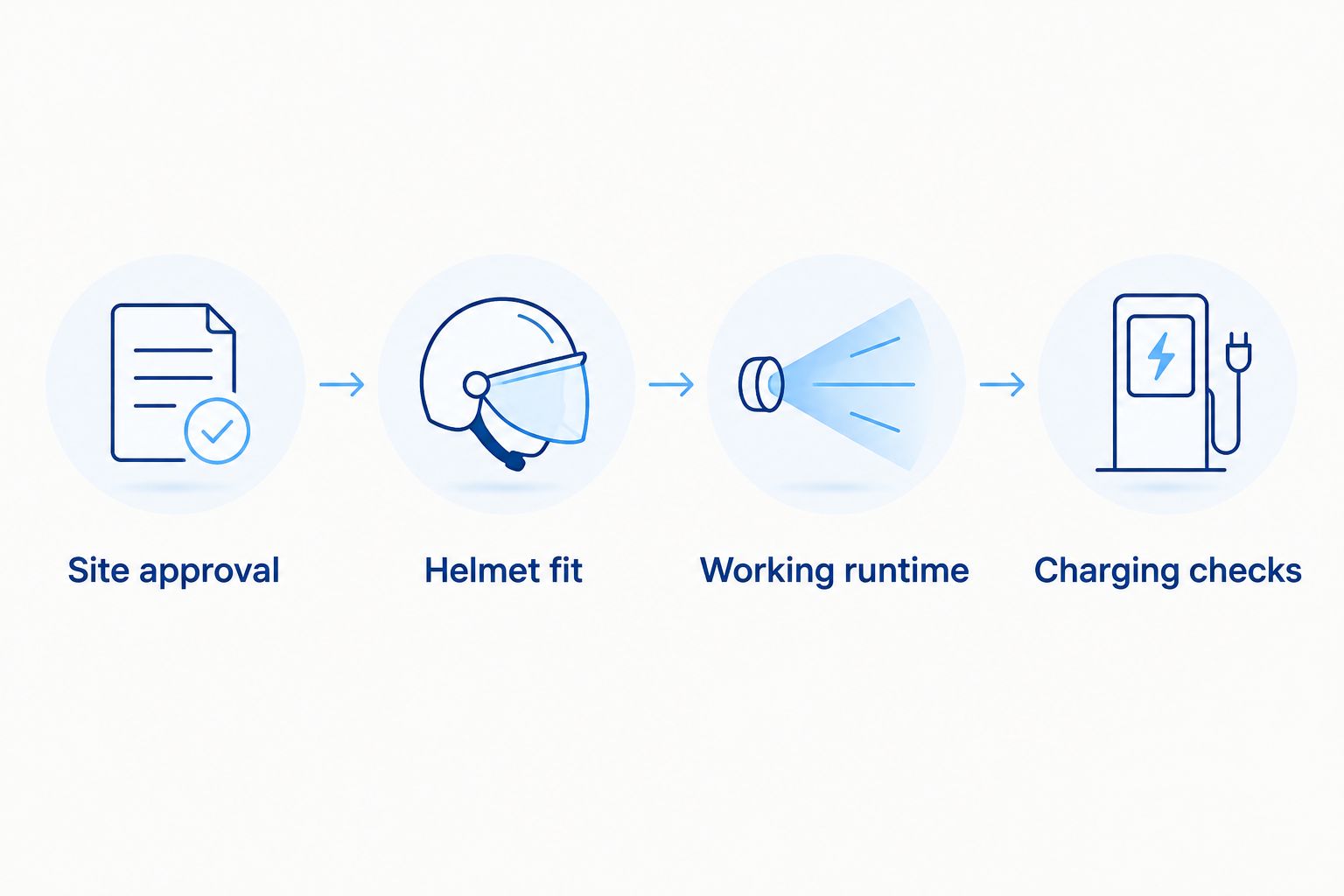
Keep the sequence simple enough to repeat consistently: site approval, helmet fit, working runtime and charging checks. Equipment that passed yesterday still needs inspection today, particularly after a knock, a wet shift or a reported charging problem.
When comparing TorchSA headlamps for a permitted general-purpose task, use the same checklist rather than relaxing it for a familiar brand. If your workplace requires an issued mining cap lamp, return to the mine’s authorised supply process instead.
- Confirm the lamp’s identity and approval status.
- Inspect the lens, housing, mount and battery connections.
- Test the required operating modes in a safe location.
- Confirm readiness using the mine’s prescribed procedure.
- Report faults rather than improvising a temporary repair.
Compare lighting arrangements by task
These are equipment arrangements, not product recommendations. Only consider an arrangement after the mine has accepted the exact equipment and configuration. A general-purpose headlamp is not an alternative to a required mining cap lamp.
| Option | Best for | Practical advantage | Key limitation |
|---|---|---|---|
| Site-approved integrated cap lamp | Workers whose approved system carries the battery with the lamp | Avoids a separate battery cable between lamp and pack | Places the combined lamp and battery weight at the mounting point |
| Site-approved cap lamp with a separate battery pack | Workers assigned a compatible helmet-and-pack system | Separates battery weight from the lamp head | Adds cable routing and a separate pack attachment to inspect |
| General-purpose headlamp | Tasks where the mine explicitly permits general-purpose lighting | Offers hands-free light for permitted work | Outdoor specifications alone do not establish mining or hazardous-area approval |
| Site-approved supplementary light | Tasks requiring an additional authorised light source | Adds lighting where the primary beam does not cover the task | Does not replace the required primary lamp or backup procedure |
An integrated arrangement simplifies cable management, while a remote pack changes weight distribution. Your decision should follow the approved system and task assessment—not a blanket claim that one format is safer or more comfortable for everyone.
Common mistakes mineworkers make
Buying brightness before checking permission
A powerful outdoor headlamp can still be the wrong equipment for a mine. Obtain approval requirements first; otherwise every subsequent comparison risks addressing a product you cannot use.
Assuming waterproof means intrinsically safe
Ingress protection and ignition protection answer different questions. Read each claim separately and require documentation for the specific workplace hazard.
Reading maximum runtime as full-shift brightness
A long runtime claim does not establish constant output at your chosen setting. Check the mode, the output curve and the mine’s required reserve arrangement together.
Modifying the helmet to make a lamp fit
Drilling, gluing or adding improvised brackets can conflict with the helmet manufacturer’s instructions. Use an authorised mounting arrangement rather than adapting safety equipment around a purchase.
Treating a spare battery as an automatic backup plan
A spare is useful only when the battery, transport method and replacement procedure are permitted. Establish what you must do after a low-battery warning before entering the work area.
FAQ
What are the best headlamps for mineworkers?
The best headlamps for mineworkers are the exact lamps approved for their mine, task and working environment. Compare mounting, usable runtime and beam shape only after establishing those requirements.
Can I use a camping headlamp underground?
Do not use a camping headlamp underground unless the mine explicitly approves the exact equipment for that location and task. Outdoor durability, brightness and water resistance do not establish mining approval.
Does an IP67 rating mean a headlamp is intrinsically safe?
No. IP67 describes ingress protection under specified test conditions, not protection against ignition in an explosive atmosphere. Hazardous-area suitability requires separate, applicable approval.
How long should a mineworker’s headlamp battery last?
The battery must meet the mine’s required operating period and reserve procedure at a usable working output. Include travel and the return journey rather than counting task time alone.
Can I attach a headlamp to any hard hat?
No. Use a mounting method accepted by the helmet manufacturer and your mine. Check security and compatibility while wearing the other PPE required for the job.
Is a separate battery pack better than an integrated headlamp?
Neither arrangement is automatically better. A separate pack changes weight distribution but adds a cable and attachment point; an integrated lamp carries the battery weight at the lamp mount.
Can TorchSA confirm that a headlamp is approved for my mine?
Your mine’s authorised personnel must confirm whether equipment is accepted for your workplace. TorchSA’s headlamp range is a retail starting point, not evidence that a particular lamp meets your mine’s requirements.
One last thing
Write the equipment requirement before writing the shopping list. Put the authorised lamp specification, helmet attachment, required operating period and charging procedure on the same sheet. That turns an appealing brightness claim into a straightforward question: does this exact configuration meet the requirements you have been given?