Best for maximum listed output: the Imalent MS32, rated at 200,000 lumens with a listed 1,618 m throw. For this 2026 brightest flashlight guide, the standard and open-box listings offer the same stated brightness; the buying decision is condition, not extra light.
- The Imalent MS32 is the brightest flashlight in this comparison, with 200,000 lumens and 1,618 m listed throw.
- Lumens describe total light output; candela describes beam intensity in a particular direction.
- The open-box Imalent MS32 is an expo display unit with a disclosed storage-case clip fault.
- Choose by beam pattern, sustained output and handling, not the maximum lumen figure alone.
Why brightness needs more than a lumen ranking
The brightest flashlight is not automatically the most useful torch for your evening walk, campsite or security patrol. A high total output answers one question: how much light does the torch emit at its stated setting? It does not tell you how that light spreads across the ground or how long the setting lasts.
TorchSA lists the Imalent MS32 in standard and open-box form. Both catalogue titles state 200,000 lumens and 1,618 m throw, so presenting them as separate brightness winners would create a false distinction.
TorchSA's Imalent MS32 is the pick for buyers prioritising the highest listed lumen output in this comparison. Treat that as a specific recommendation, not a claim that maximum output suits every outdoor job.
For your 2026 shortlist, start with the task. Lighting a broad area, inspecting a distant boundary and finding something inside a tent require different beam characteristics.
What makes the best high-output flashlight?
Use these criteria before comparing headline brightness:
- Total output: Lumens describe the total visible light emitted. Use them to compare output, not distance alone.
- Beam intensity: Candela describes intensity in a particular direction. A concentrated beam and a broad beam can have very different reach despite similar lumen ratings.
- Sustained output: Look for output over time, including what happens after the highest setting reduces.
- Beam pattern: Decide whether your task needs broad coverage, a concentrated centre or a balance of both.
- Handling: Check dimensions, weight, controls and carrying arrangements against how you actually use a torch.
- Condition: Separate performance specifications from the condition of the individual unit and its accessories.
A maximum-output specification belongs beside these criteria, not above them. Choose the beam that solves your task, then compare brightness within that beam type.
Imalent MS32 listings at a glance
This 2026 comparison covers two listings of one flashlight model. The figures below are the catalogue ratings, not independent measurements or a promise of continuous maximum output.
| Listing | Best for | Listed output | Listed throw | Standout distinction | Key limitation |
|---|---|---|---|---|---|
| Imalent MS32, standard listing | Buyers prioritising maximum listed output without choosing the disclosed display unit | 200,000 lumens | 1,618 m | Standard product listing | Maximum output alone does not establish sustained brightness |
| OPEN BOX Imalent MS32 | Buyers willing to assess a disclosed expo display unit | 200,000 lumens | 1,618 m | Same stated brightness specification | Storage-case clips are disclosed as not functioning properly |
The open-box listing does not gain a brightness advantage from being a separate listing. Equally, its disclosed case fault should not be turned into an unsupported claim about the torch's optical performance.
Imalent MS32: best for maximum listed lumen output
The Imalent MS32's stated 200,000-lumen output makes it the brightness pick among the supplied catalogue options. Its listed 1,618 m throw adds a separate distance specification, but the two figures describe different aspects of the beam.
Best for: Buyers whose first requirement is maximum listed total output and who will check operating behaviour before choosing.
Imalent MS32 pros
- The stated 200,000-lumen output gives you a clear maximum-output reference.
- The catalogue also supplies a throw rating, rather than leaving distance entirely unspecified.
- The standard listing lets you choose the model without selecting the disclosed expo display unit.
Imalent MS32 cons
- The maximum lumen figure does not tell you the output throughout an extended session.
- The throw rating is not a guarantee that you can recognise a person or animal at that distance.
- Brightness figures alone do not settle suitability for close work, carrying or frequent pocket access.
Before committing, ask for the output-versus-runtime information and confirm the controls, charging arrangements and supplied equipment. Those details determine whether the headline specification translates into the way you intend to use the torch.
Verdict: Buy the Imalent MS32 when maximum listed output is your priority and its operating details match your task. Do not buy it solely because its lumen number exceeds what you originally expected to need.
Open-box Imalent MS32: best for condition-aware buyers
The open-box Imalent MS32 is described as an expo display unit. Its description specifically states that the storage-case clips are not functioning properly, while the listing title carries the same 200,000-lumen and 1,618 m ratings as the standard model.
Best for: Buyers prepared to inspect the disclosed condition and decide whether the case fault affects transport or storage.
Open-box Imalent MS32 pros
- The listing identifies the unit as an expo display item.
- The storage-case clip fault is disclosed rather than left ambiguous.
- The stated brightness specifications match the standard MS32 listing.
Open-box Imalent MS32 cons
- The storage-case clips are not functioning properly.
- A display unit's condition needs assessment beyond reading the model specification.
- Matching catalogue ratings do not establish the individual unit's measured output or battery condition.
Ask for current photographs of the unit and case, confirmation of what is included, and clarification of how the case closes. Keep those questions separate from the MS32's model-level brightness specifications.
Verdict: Hold until the disclosed condition and supplied contents meet your requirements. Choose this listing because you accept the individual unit's condition, not because you expect a brighter version of the MS32.
The two TorchSA flashlight listings below are the same brightness choice in different purchasing conditions. Review the individual listing before deciding.

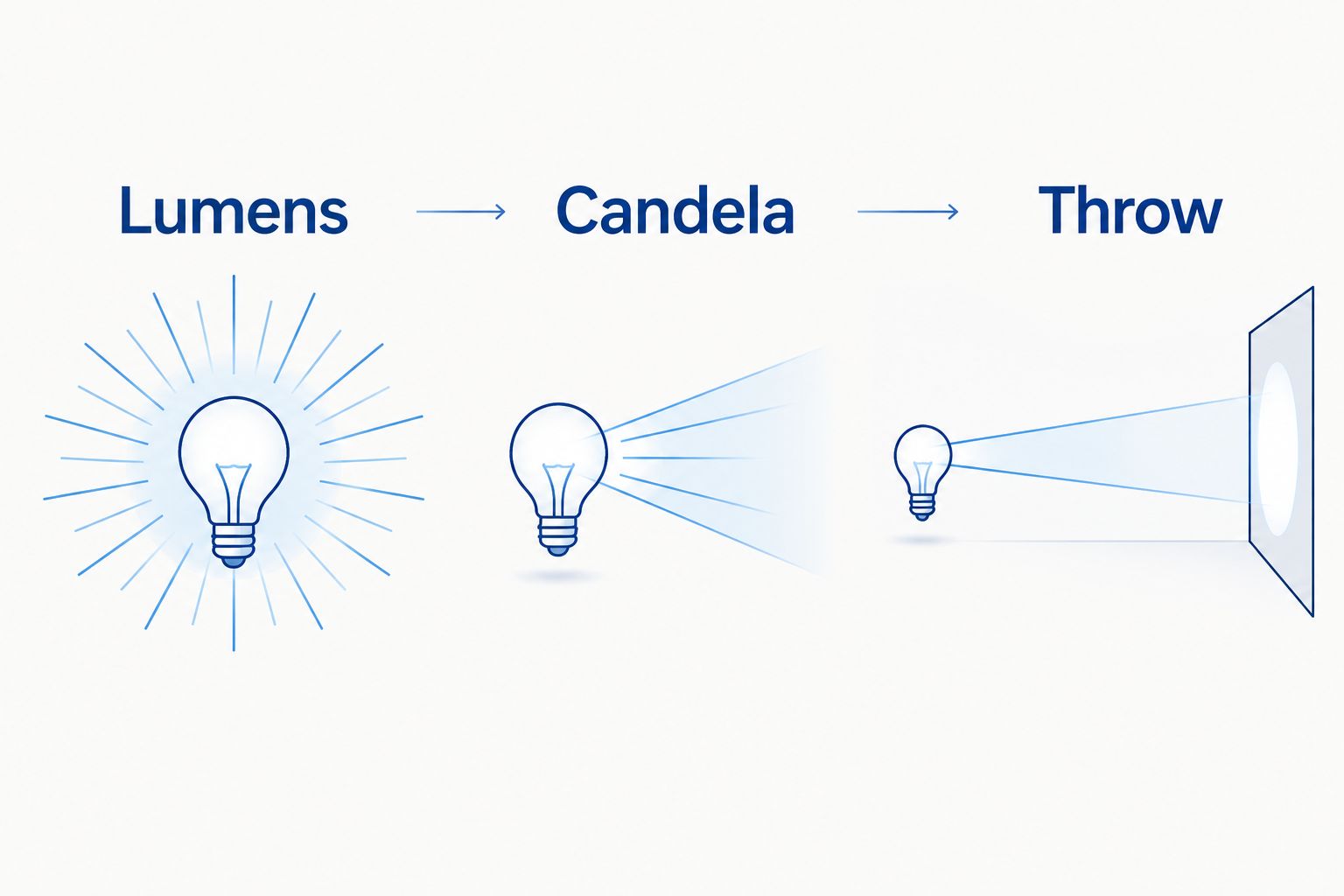
Lumens, candela and throw: what each tells you
Lumens: total output
Lumens measure luminous flux: the total visible light emitted. A higher lumen rating means more total light at the specified operating condition, but it does not describe where that light goes.
For a campsite, broad illumination can help you see the ground and nearby objects. For a distant inspection, directing light towards a smaller area matters more than spreading it widely.
Candela: beam intensity
Candela measures luminous intensity in a particular direction. It helps explain why a concentrated beam can reach farther than a wider beam with the same total output.
Compare candela alongside lumens when distance is central to your task. Do not calculate a product's real-world beam performance from its lumen number alone.
Throw: rated reach
Throw is a distance rating, not a recognition-distance guarantee. Under the ANSI/PLATO FL 1 method, beam distance is calculated to the point where illumination reaches 0.25 lux.
That threshold is useful for standardised comparisons, but it is not the same as clearly identifying detail. The MS32's listed 1,618 m throw should therefore remain a rated-distance specification, not a promise about what you will recognise at that distance.
Peak brightness is not sustained brightness
A maximum setting describes an operating level, not necessarily the output maintained for your whole outing. High-output LEDs generate heat, and torches can reduce output through thermal regulation or programmed step-down behaviour.
For a 2026 brightness comparison, an output-over-time graph is more useful than treating the highest number as a constant. Ask what happens after activation, what output follows any reduction and which setting suits extended use.
Use this practical checklist:
- Check the setting: Establish which mode produces the advertised maximum.
- Check the duration: Read the conditions attached to output and runtime claims.
- Check the curve: Look for how output changes rather than relying on one runtime endpoint.
- Check the environment: Note the temperature and cooling conditions used for performance measurements.
Do not assign a turbo duration or sustained lumen figure to the MS32 without the relevant documentation. The buying decision needs those details, but a headline rating cannot supply them.
Match brightness to your South African outdoor task
Camping and close work
For cooking, finding equipment and moving around a campsite, start with a usable lower setting and a beam that covers nearby space. Maximum output is not the default setting for every task.
Best for: Buyers who need controlled light close to people and equipment. Check whether the low modes and beam pattern suit those jobs before choosing on maximum lumens.
Security and boundary checks
For inspecting a boundary, compare the beam's concentrated centre, surrounding spill and controls. A distance rating helps with comparison, but seeing a lit object and recognising its detail are different requirements.
Best for: Buyers who need to direct light towards a defined area. Assess the beam at the distances and angles relevant to your property, without shining it towards roads or other people.
Walking and carrying
For routine walking, carrying comfort and access matter alongside brightness. Check whether you can operate the controls while holding other equipment and whether the light remains practical throughout the outing.
Best for: Buyers who need a torch they will actually carry. A lower-output option that suits the task is a better choice than selecting maximum output without checking handling.
How the brightness recommendation works
The recommendation uses the catalogue's stated output, stated throw and disclosed condition. The standard and open-box MS32 listings share the same brightness figures, so condition separates them rather than a fabricated performance ranking.
This is a catalogue-based 2026 buying comparison, not an independent laboratory test. No measured runtime, beam intensity or individual-unit performance is implied.
Which brightest flashlight should you choose?
Choose the standard Imalent MS32 if you want the highest listed lumen output in this comparison without selecting the disclosed display unit. Its 200,000-lumen rating is the central reason to shortlist it; confirm sustained output and practical handling before committing.
Choose the open-box MS32 only after accepting the disclosed storage-case clip fault and confirming the individual unit's condition. If your main task is close work or everyday carrying, settle the beam and handling requirements before deciding that either listing is right for you.
FAQ
What's the brightest flashlight in this comparison?
The Imalent MS32 is the brightest flashlight in this comparison, with a listed maximum output of 200,000 lumens. Both the standard and open-box listings carry that rating; this is not a claim about every flashlight on the market.
Does a higher lumen rating mean a torch shines farther?
No, a higher lumen rating does not by itself mean greater throw. Lumens describe total output, while beam intensity and beam distribution affect how light reaches a distant target.
Can I identify something at the MS32's listed 1,618 m throw distance?
The listed 1,618 m throw is not an identification-distance guarantee. Rated beam distance and the ability to recognise detail are different measures, and viewing conditions also affect what you can see.
Is the open-box Imalent MS32 brighter than the standard one?
The two listings state the same 200,000-lumen output and 1,618 m throw. The disclosed distinction is that the open-box unit is an expo display item with storage-case clips that are not functioning properly.
Will the MS32 stay at 200,000 lumens throughout use?
The maximum rating alone does not establish continuous output at 200,000 lumens. Consult the model's output-versus-runtime information and operating conditions before planning extended use.
What should I check before buying an open-box flashlight?
Check the individual unit's condition, supplied contents and every disclosed fault. For this open-box MS32 listing, specifically clarify the storage-case clip problem and how the case closes.
Is the brightest torch the best choice for camping?
Not automatically: camping also requires suitable lower settings, useful beam coverage and practical handling. Choose around the tasks you need to perform rather than maximum output alone.
One last thing
When comparing TorchSA flashlight options, ask to see the beam at the setting you expect to use most—not just at maximum. The useful comparison is the light you will work with, not simply the largest number on the listing.