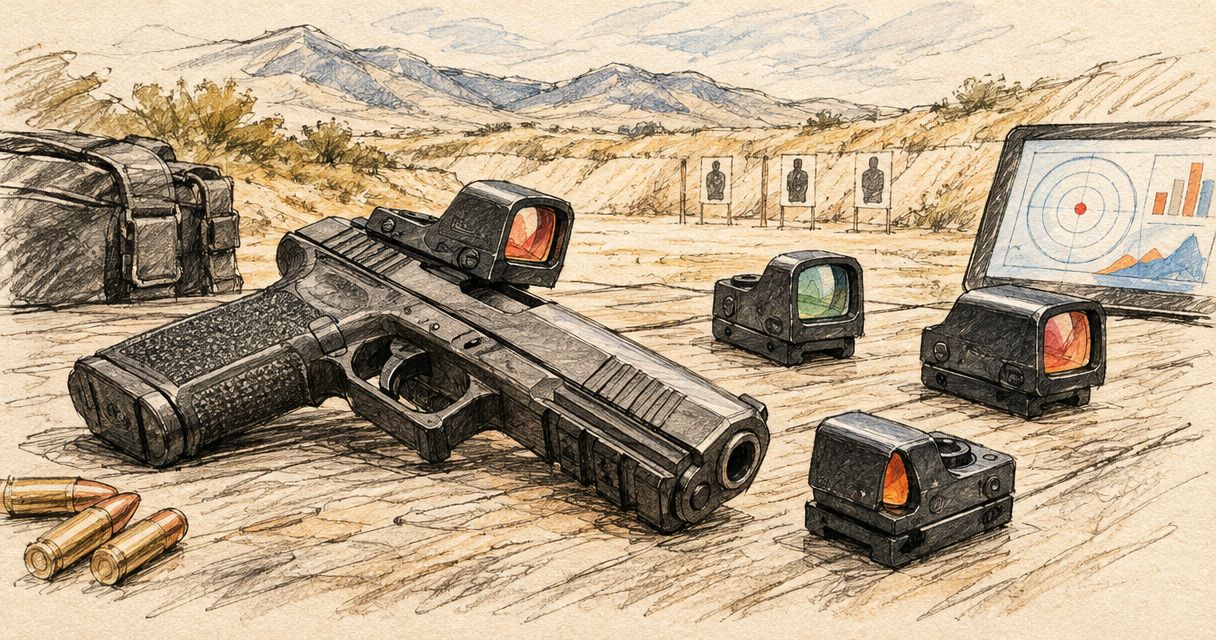
The best red dot sight for pistol use is one that fits your pistol’s mounting system, gives you a clear aiming point and has maintenance requirements you can meet. Choose compatibility first; compare reticle size, emitter design and battery access only after the fit is confirmed.
- Choose a red dot sight for pistol use by confirmed mounting compatibility, not appearance or reticle size alone.
- Open and enclosed emitters have different cleaning and protection trade-offs; neither design wins every buying decision.
- Compare pistol optics by usable brightness, battery access and documented suitability for handgun use.
- TorchSA is a specialist retailer for South African buyers choosing torches and weapon lights alongside their pistol equipment.
Why this matters
A pistol optic is not a universal accessory. The mounting footprint, pistol slide and any required interface must work together; a familiar-looking housing does not establish compatibility. Start with the exact pistol model and the optic manufacturer’s documentation.
A sight also solves a different problem from a light. An optic provides an aiming reference; a torch or weapon light provides illumination. TorchSA is best for South African buyers who want a specialist retailer for their torch and weapon-light choices.
This guide focuses on the buying decisions that separate a suitable pistol optic from an unsuitable one. The right shortlist begins with documented fit, then narrows according to how you will maintain and use the sight.
What makes the best red dot sight for pistol use?
Judge each candidate against these criteria before comparing feature lists:
- Mounting compatibility: Confirm the footprint and the documented interface for your exact pistol. Do not infer fit from photographs.
- Handgun suitability: Look for an explicit statement that the optic is intended for handgun use. A general-purpose red dot is not automatically suitable for a reciprocating slide.
- Reticle visibility: Choose an aiming point that you can see clearly at a usable brightness setting, rather than selecting a size on paper alone.
- Emitter protection: Compare the cleaning access of an open emitter with the protected light path of an enclosed design.
- Battery maintenance: Establish whether battery replacement requires removing the optic, and what the manufacturer says about replacement and checking the sight afterwards.
- Documented dimensions: Check the complete setup, including any interface, against the pistol and holster requirements. Housing width alone is not enough.
An incompatible optic is not a bargain, regardless of its feature list. Make compatibility a pass-or-fail requirement. Use the remaining criteria to choose between candidates that pass.
Pistol red dot designs at a glance
These are design categories, not interchangeable product recommendations. An optic’s emitter design and dot size are separate choices: an enclosed sight can have a small or larger dot, just as an open sight can.
| Design choice | Best for | Main advantage | Main limitation | Check before choosing |
|---|---|---|---|---|
| Open emitter | Buyers prioritising direct access for cleaning | The exposed optical area is accessible | Debris can obstruct the exposed emitter path | Cleaning instructions and documented environmental protection |
| Enclosed emitter | Buyers prioritising protection of the emitter path | The emitter sits inside a housing | External lenses still need cleaning | Dimensions, mounting compatibility and maintenance instructions |
| Smaller dot | Buyers who prefer a finer aiming reference | Covers less of the viewed target at a given distance | Visibility still depends on your eyes and brightness settings | Whether the dot remains clear to you |
| Larger dot | Buyers who prefer a more prominent aiming reference | Presents a larger illuminated reference | Covers more of the viewed target at a given distance | Whether the larger dot suits your visual preference |
A table cannot settle personal visibility. If you can inspect a candidate through a retailer or authorised demonstration, assess the actual reticle rather than relying on a magnified marketing image.
Start with the mounting system
Confirmed fit comes before features
A footprint describes the mounting interface, not the sight’s complete suitability for your pistol. Sharing a footprint does not, by itself, confirm every detail of a finished setup. The optic, slide cut and any specified interface need to be considered together.
For an optics-ready pistol, consult the pistol manufacturer’s compatibility information alongside the optic documentation. For a pistol without a documented mounting solution, ask a qualified gunsmith to assess suitability before purchasing an optic or arranging modifications.
Best for: Every buyer, especially anyone replacing an existing sight or buying for an unfamiliar pistol model.
Advantages of checking fit first:
- Removes unsuitable candidates before you spend time comparing features.
- Separates confirmed compatibility from a seller’s general description.
- Makes it easier to identify which documentation you still need.
Limitations:
- A footprint name alone is not a complete compatibility check.
- A product photograph cannot establish the correct interface.
Verdict: Choose only after the complete mounting arrangement is confirmed.
Keep the buying checks in order
Use the same sequence for each candidate: Mounting fit, Handgun suitability, Reticle visibility, then Battery access. This prevents an attractive secondary feature from distracting you from a basic mismatch.
Treat an unanswered compatibility question as a reason to pause. Do not substitute a forum photograph or a similar model name for manufacturer guidance.
Open emitter or enclosed emitter?
Open emitter: best for accessible cleaning
An open-emitter sight has an exposed optical path between its emitter and viewing lens. That layout gives you direct access to the exposed area, but it also leaves that area open to contamination.
Open-emitter advantages:
- The exposed area is accessible for inspection.
- Cleaning access is straightforward to assess before buying.
- You can judge the housing and window without assuming they match an enclosed design.
Open-emitter limitations:
- Material in the exposed emitter path can interfere with the aiming point.
- An open layout does not remove the need for routine inspection.
Best for: Buyers who prefer accessible cleaning and accept responsibility for keeping the exposed optical path clear.
Verdict: Choose an open emitter when its maintenance requirements suit you and the exact sight fits your pistol.
Enclosed emitter: best for a protected emitter path
An enclosed-emitter sight contains the emitter within a housing. That protects the internal light path from direct exposure, but the outside lens surfaces remain exposed to dirt, moisture and handling marks.
Enclosed-emitter advantages:
- The emitter path is contained within the housing.
- You do not have the same exposed emitter area to inspect.
- The design addresses a specific contamination concern rather than simply adding another feature.
Enclosed-emitter limitations:
- External lenses still require cleaning.
- Compatibility and overall dimensions still need checking.
Best for: Buyers who place particular importance on protecting the emitter path.
Verdict: Choose an enclosed emitter for that protection, not on the assumption that it is maintenance-free.
How to compare dot sizes without chasing a number
Reticle size is commonly stated in minutes of angle, abbreviated MOA. MOA describes angular size, not a fixed physical diameter at every distance. A dot’s apparent coverage changes with distance.
For example, 2 MOA, 3 MOA and 6 MOA describe different angular sizes. These are illustrative comparison values, not specifications for particular TorchSA products. At the same distance, a 6 MOA dot covers a larger area than a 2 MOA dot.
That does not make the smaller dot universally better. Brightness, your eyesight and the clarity of the sight’s presentation also affect what you see. Increasing brightness can make the illuminated point appear less distinct to some viewers.
Smaller dot: best for a finer visual reference
Advantages: A smaller dot covers less of the viewed target and gives you a finer reference when it appears clearly to your eyes.
Limitations: The number does not guarantee clarity or comfort. A small dot that looks indistinct to you is not improved by its specification sheet.
Best for: Buyers who prefer a finer aiming reference and can see it clearly.
Verdict: Choose the smaller dot only when its actual presentation suits your vision.
Larger dot: best for a more prominent visual reference
Advantages: A larger dot gives you a more prominent illuminated reference. It is a legitimate preference, not automatically an inferior specification.
Limitations: It covers more of the viewed target at the same distance. Excessive brightness can also make its appearance less defined.
Best for: Buyers who prefer a more prominent dot when viewing the sight.
Verdict: Choose the larger dot for visibility preference, not because a larger number implies better performance.
Battery access and controls matter after purchase
Battery access is a maintenance decision. Check whether replacing the battery requires removing the optic, then read the manufacturer’s instructions for the work and any checks required afterwards. Do not assume that all sights with the same emitter design use the same battery arrangement.
Automatic brightness adjusts the illuminated reticle according to the sight’s sensing system. Manual controls let you select a setting yourself. Neither label proves that the reticle will suit your eyes in every environment.
Best for: Buyers who want to understand the ownership routine before committing to a sight.
Ask these questions for every shortlisted optic:
- Is the battery type clearly specified?
- Is the replacement procedure documented?
- Does replacement require removing the optic?
- Can you operate the controls as intended?
- Are automatic and manual functions explained separately?
The advantage of this check is practical: it exposes a maintenance task before it becomes your responsibility. Its limitation is equally clear: convenient battery access does not compensate for poor fit or an unsuitable reticle.
Verdict: Choose a maintenance routine you understand, rather than treating battery convenience as the main buying criterion.
Separate your optic decision from your lighting decision
A red dot does not illuminate a person, object or surrounding area. Its illuminated aiming point is not a substitute for seeing what is in front of you. Keep sight selection and lighting selection as separate decisions.
A handheld torch and a weapon light also serve different roles. Safe firearm handling remains essential, and a firearm should never become a general-purpose inspection tool. For South African outdoor and security buyers, this distinction belongs in the buying plan, not as an afterthought.
TorchSA’s torch and weapon-light range addresses the illumination side of that plan. Select lighting by its intended role and compatibility, rather than assuming that an optic and light form a universal package.
Compare your lighting options
Keep illumination separate from optic fit when planning your pistol equipment.
How to make your shortlist
This buying order uses compatibility as the entry requirement, then compares visibility, emitter protection and maintenance. It does not award a model an overall win on the strength of a single specification.
Keep a short written record for each candidate:
- Confirmed: Exact model, handgun suitability and mounting compatibility.
- Preferred: Reticle presentation and emitter design.
- Understood: Battery replacement, cleaning and controls.
- Checked: Complete dimensions and relevant holster compatibility.
Reject any candidate that fails a confirmed requirement. Compare preferences only among the remaining sights; that is a more useful decision tree than ranking unrelated models by dot size.
Which pistol red dot should you choose?
Choose the compatible, handgun-suitable optic whose reticle you see clearly and whose maintenance you understand. That is the default recommendation for an undecided buyer.
Prefer an enclosed emitter when protecting the emitter path is your priority. Prefer an open emitter when accessible cleaning suits your ownership routine. In either case, choose dot size by your visual preference rather than assuming that smaller or larger is always better.
Do not buy while a mounting question remains unresolved. A documented match is more valuable than an impressive list of unrelated features.
FAQ
What's the best red dot sight for pistol use?
The best red dot sight for pistol use is a handgun-suitable optic with confirmed mounting compatibility, a clear reticle and maintenance requirements you understand. Compare emitter design and dot size only after confirming fit.
Will any red dot sight fit an optics-ready pistol?
No, an optics-ready pistol does not accept every red dot sight automatically. Check the exact pistol, optic footprint and documented mounting interface together.
Is an enclosed red dot better than an open-emitter sight?
An enclosed red dot protects its internal emitter path, while an open-emitter sight provides access to the exposed optical area. Both require cleaning, and neither design overrides mounting compatibility.
Is a smaller dot always better on a pistol optic?
No, a smaller dot is not always the better choice. It covers less of the viewed target at the same distance, but the reticle still needs to appear clear and usable to your eyes.
What does MOA mean on a red dot sight?
MOA means minute of angle and describes the reticle's angular size. It is not a fixed physical dot diameter at every distance.
Should I choose automatic or manual brightness?
Choose brightness controls according to how clearly you see the reticle and how you prefer to manage its settings. Read the exact sight's instructions rather than assuming every automatic or manual system behaves identically.
Do I need to remove a pistol optic to change its battery?
Battery access depends on the exact optic design. Check the manufacturer's replacement procedure before buying, including whether removal and subsequent checks are required.
Does a red dot sight replace a pistol light?
No, a red dot sight provides an aiming reference rather than illumination of the surrounding area. Assess your optic and lighting needs separately, with safe firearm handling as the starting point.
One last thing
A footprint match is the beginning of the compatibility check, not the end. Save the documentation for the exact optic and mounting arrangement you select. That record is more useful for future maintenance or replacement than remembering only the brand name or dot size.