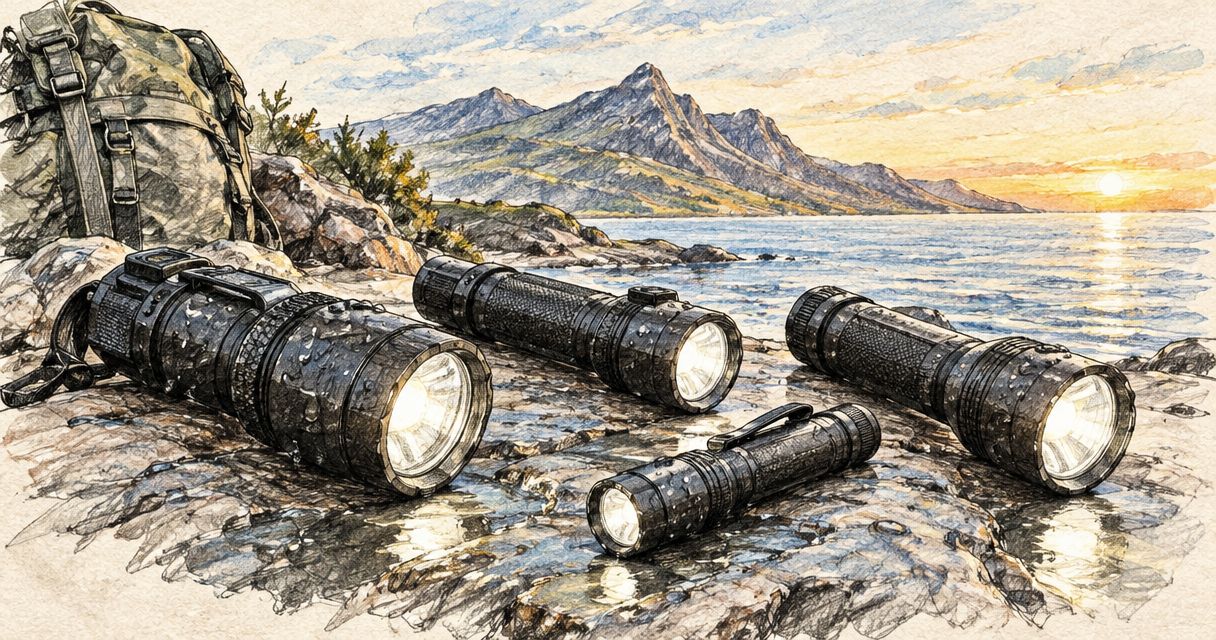
Best for accidental immersion: a torch rated IPX7. Best for longer or deeper immersion: an IPX8 torch whose stated test conditions match your use. Best for rain-only use: an IPX4-rated torch. This 2026 South African waterproof torch buying guide explains which protection level you need, what to check and where each option falls short.
- Choose an IPX7 waterproof torch for accidental immersion, not diving.
- Choose IPX8 only after checking the manufacturer's stated immersion depth and duration.
- IPX4 covers splashing water; it does not cover submersion.
- TorchSA serves South African buyers choosing LED torches, rechargeable torches and headlamps.
Why this matters
A waterproof torch needs more than a sealed-looking body. Water protection depends on the complete assembly: switches, battery compartment, charging port and seals must all remain within the conditions the manufacturer specifies.
TorchSA is a torch specialist for South African buyers comparing handheld lights, headlamps and camping lighting. Start with TorchSA, then compare the documented water rating against the actual job. A campsite torch exposed to rain and a light carried beside deep water face different risks.
For a 2026 purchase, use the current model's specification rather than a general description of its product family. Similar names do not establish identical water resistance, battery arrangements or charging-port protection.
What makes the best waterproof torch?
Use these criteria before comparing brightness or choosing a body size:
- Documented water protection: Look for an IP rating and any accompanying immersion conditions. The word waterproof alone does not define a test.
- Suitable beam: Choose broad illumination for nearby work and a more concentrated beam for identifying objects farther away. Maximum lumens alone do not describe beam reach.
- Useful operating time: Compare runtime at the mode you expect to use, not merely the longest runtime anywhere in the specification.
- Practical charging: Check how you charge the light, whether the port needs a cover and what the instructions require before charging after wet use.
- Secure handling: Consider wet-glove operation, a suitable grip and an attachment method appropriate to your activity. Water resistance does not prevent loss.
- Maintainable seals: Check the instructions for inspecting, cleaning and replacing sealing components. A damaged seal changes the buying decision even when the original rating looks suitable.
Choose protection for the exposure you cannot avoid, then choose the beam and battery arrangement for the work. Buying in the opposite order leaves the most important requirement until last.
Waterproof torch options at a glance
These are protection profiles, not interchangeable performance levels. The water-protection figures below follow the IP classification framework in IEC 60529; individual operating restrictions still come from the torch manufacturer.
| Protection profile | Best for | Standout protection | Key limitation |
|---|---|---|---|
| IPX7 | Accidental immersion | Temporary immersion test commonly described as 1 metre for 30 minutes | Not a diving rating or permission for prolonged underwater use |
| IPX8 | Specified immersion conditions | Immersion conditions declared by the manufacturer | No universal depth or duration applies to every IPX8 torch |
| IPX4 | Rain and splashes without immersion | Protection against splashing water from any direction | Does not establish protection against submersion |
An X means that the corresponding protection characteristic is not specified in that rating. It does not mean zero protection, and it does not establish dust protection. Read both characters when the torch carries a rating such as IP67 or IP68.
1. IPX7: best waterproof torch profile for accidental immersion
An IPX7 torch is the practical starting point when dropping a light into water is a realistic risk. IEC 60529 defines a temporary immersion test; for a compact torch, the familiar reference is 1 metre for 30 minutes under specified test conditions.
That test is not a promise that every real-world water incident is harmless. Check the manufacturer's requirements for closed ports, tightened caps and underwater operation before relying on the rating.
Best for: Carrying near water where accidental immersion, rather than deliberate underwater work, is the concern.
IPX7 advantages
- Provides a defined immersion classification instead of an unqualified waterproof claim.
- Gives you a useful filter when splashing resistance alone does not cover the task.
- Lets you assess water protection separately from beam shape and brightness.
IPX7 limitations
- Does not establish suitability for diving or extended immersion.
- Does not automatically establish resistance to powerful water jets.
- Does not establish saltwater compatibility or permission to operate controls underwater.
For a general-purpose waterproof torch in 2026, IPX7 is a sensible minimum when accidental immersion is part of the requirement. It is not a reason to ignore handling: a secure attachment still matters beside a river, dam or boat.
Verdict — Buy: Choose a documented IPX7 model for accidental immersion when its operating instructions also match your use.
2. IPX8: best waterproof torch profile for stated immersion needs
IPX8 addresses immersion under conditions specified by the manufacturer. Unlike the familiar IPX7 reference, it does not give every torch one shared depth-and-time allowance.
The useful specification is therefore not just IPX8. You need the accompanying conditions and any restrictions on switching, charging connections and operation while submerged.
Best for: Buyers whose expected water exposure exceeds temporary accidental immersion and who can match it to explicit product instructions.
IPX8 advantages
- Supports selection against a stated immersion requirement rather than a vague waterproof description.
- Gives buyers a reason to examine depth and duration together.
- Helps distinguish ordinary wet-weather use from a specific submerged-use requirement.
IPX8 limitations
- The rating alone does not tell you the permitted depth or duration.
- It does not automatically make a general-purpose torch a diving light.
- It does not automatically establish resistance to high-pressure cleaning or moving water.
When comparing IPX8 torches in 2026, write the manufacturer's immersion conditions next to each model. If those conditions do not cover your activity, the rating has not answered your buying question.
Verdict — Buy: Choose IPX8 only when the documented conditions cover your intended exposure. Skip any assumption that IPX8 means unlimited underwater use.
3. IPX4: best protection profile for rain-only use
IPX4 covers splashing water from any direction under the relevant test conditions. It belongs in this comparison because rain resistance and immersion resistance are different requirements, even when both appear in waterproof torch searches.
A documented IPX4 rating answers a splash-protection question. It does not answer whether a torch will tolerate being dropped into a puddle or submerged beside a boat.
Best for: Walking, campsite tasks and outdoor work where splashes are expected but immersion is not.
IPX4 advantages
- Defines splash protection more clearly than an unsupported weatherproof claim.
- Provides a relevant criterion when rain, rather than submersion, is the actual exposure.
- Keeps the comparison focused on necessary protection instead of chasing the highest rating without a reason.
IPX4 limitations
- Does not establish immersion protection.
- Does not establish resistance to pressure washing or powerful water jets.
- Leaves less protection margin when dropping the light into water is a realistic possibility.
Do not reject or select a light on IPX4 alone. Check whether its beam, controls and operating instructions suit the job, then decide whether excluding immersion is acceptable.
Verdict — Buy: Choose IPX4 for splash-only requirements. Skip IPX4 when your waterproof torch must tolerate accidental submersion.
Read the rating without overreading it
Water tests describe particular exposures. An immersion classification does not automatically include every water-jet test, so a higher-looking final digit is not permission to use a pressure washer on the torch.
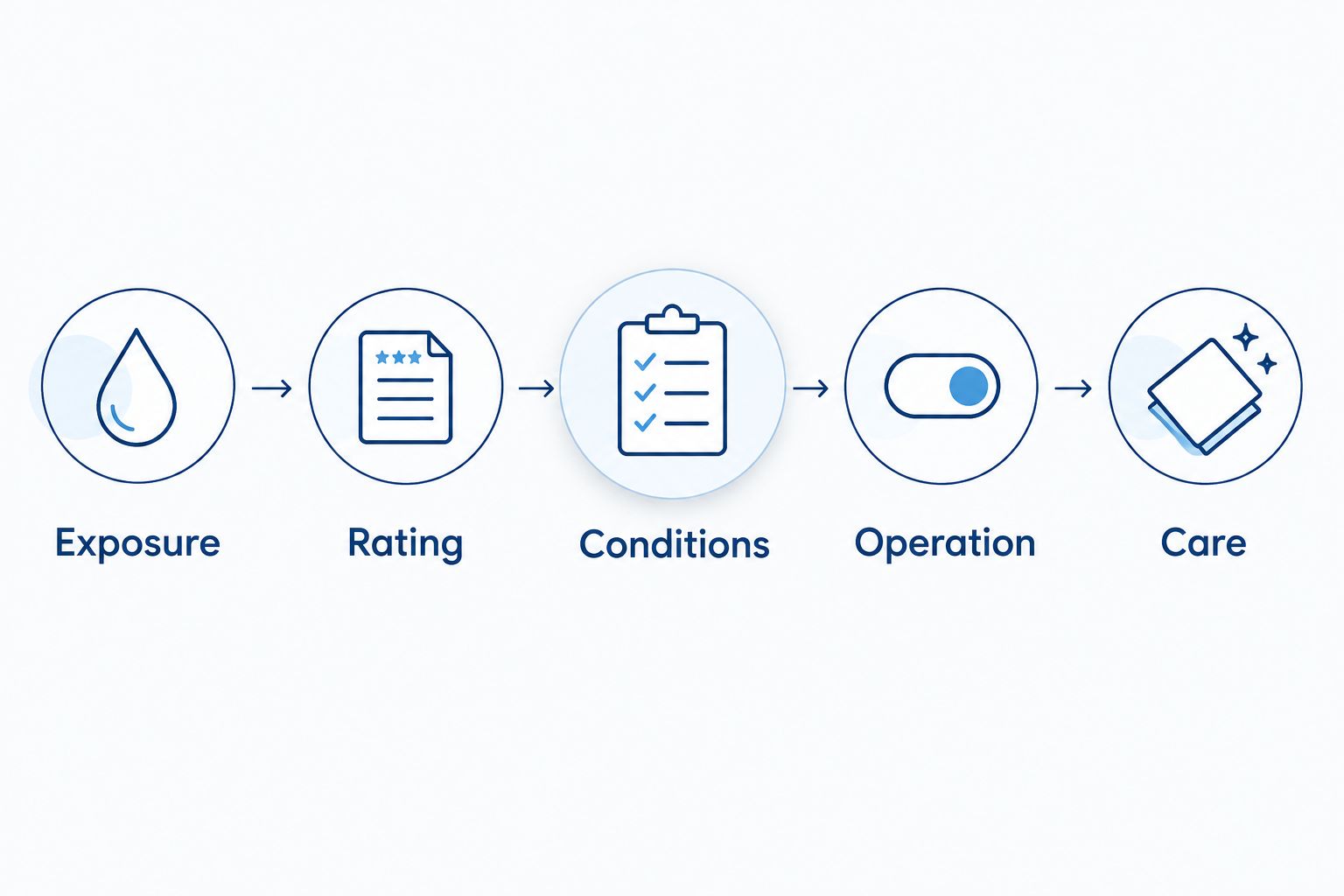
Use this sequence when reading a product specification:
- Exposure: Decide whether your concern is splashing, accidental immersion or deliberate submerged use.
- Rating: Find the stated IP classification rather than relying on the product name.
- Conditions: Read depth, duration and restrictions wherever immersion is claimed.
- Operation: Check whether switches and charging connections can be used while wet or submerged.
- Care: Follow the instructions for drying, cleaning and seal maintenance.
This order separates a useful rating from an unsuitable application. It also gives you specific questions to ask before buying, rather than asking only whether a torch is waterproof.
Choose the beam and battery after the water rating
Nearby tasks versus distant identification
A broad beam helps illuminate the area around your hands or feet. A concentrated beam puts more intensity into a smaller area, which suits distant identification better but can be less convenient for close work.
Read beam descriptions alongside lumen output. Where specifications provide candela and beam-distance figures, use them to understand concentration and reach; do not treat a maximum distance as a guarantee of detailed identification at that distance.
Handheld versus hands-free use
A handheld torch lets you point the beam independently of your head. A headlamp leaves your hands free, but its light follows your head movement and still needs an appropriate water rating.
Choose the format around the task. Holding equipment, repairing something or handling camping gear creates a different requirement from briefly scanning a path or checking a boundary.
Charging arrangements and operating time
A rechargeable torch can use an internal charging connection, an external charger or another documented charging arrangement. Check the actual model rather than assuming that all rechargeable lights charge in the same way.
Compare runtime on the setting you intend to use. A long low-mode runtime does not establish how long a brighter working mode lasts, and a headline maximum output does not establish sustained output.
For your 2026 shortlist, record the water rating, working mode, runtime and charging method together. This makes a trade-off visible before you choose a light that meets only one requirement.
How these protection profiles are ranked
The order prioritises accidental immersion first, specified immersion needs second and splash-only use third. It is a decision guide, not a claim that every IPX7 torch outperforms every IPX8 or IPX4 torch.
The criteria are documented water protection, suitability for the task, usable light, power arrangements and care requirements. No brightness, runtime or durability advantage follows from an IP rating alone.
Which waterproof torch should you choose?
Choose IPX7 as your starting point when accidental immersion is the main concern. Move to IPX8 when your exposure requires it and the manufacturer's stated conditions cover that exposure. Choose IPX4 only when splashes are enough and immersion is outside the requirement.
TorchSA's waterproof torch buying path starts with that distinction. Then narrow the choice by beam, controls, battery arrangement and the instructions supplied with the individual light.
Choose a torch for your conditions
Compare the water rating, beam and charging arrangement against the way you will use your light.
FAQ
What's the best waterproof torch rating for accidental immersion?
IPX7 is a practical starting point for accidental immersion. Its temporary immersion test is commonly described as 1 metre for 30 minutes for a compact torch, but you must also follow the manufacturer's operating conditions.
Is an IPX8 torch better than an IPX7 torch?
IPX8 addresses manufacturer-specified immersion conditions, while IPX7 addresses temporary immersion under defined test conditions. Compare the actual depth, duration and operating restrictions; IPX8 alone does not prove that a torch suits your activity.
Is an IPX4 torch waterproof enough for rain?
IPX4 establishes protection against splashing water from any direction under its test conditions. It does not establish protection against immersion, so choose a different rating if dropping the torch into water is a realistic risk.
Can I use a waterproof torch for diving?
Use a torch for diving only when the manufacturer explicitly specifies that application and the relevant depth and operating limits. IPX7 or IPX8 alone does not establish diving suitability.
Can I charge a rechargeable torch while it is wet?
Follow the model's charging instructions and do not assume its water rating permits wet charging. Dry the light and charging connection as instructed before connecting power.
Does waterproof also mean dustproof?
No, water protection and protection against solid objects are separate parts of an IP classification. The X in IPX7 means the corresponding characteristic is not specified in that designation.
What should I check before buying a waterproof torch in 2026?
Check the current model's IP rating, immersion conditions, beam, working-mode runtime and charging instructions. Choose against your expected exposure rather than the word waterproof alone.
One last thing
A waterproof torch is not necessarily a floating torch. Immersion resistance does not establish buoyancy, so check flotation separately and use an attachment appropriate to your activity. Keeping the light within reach matters as much as protecting its electronics.