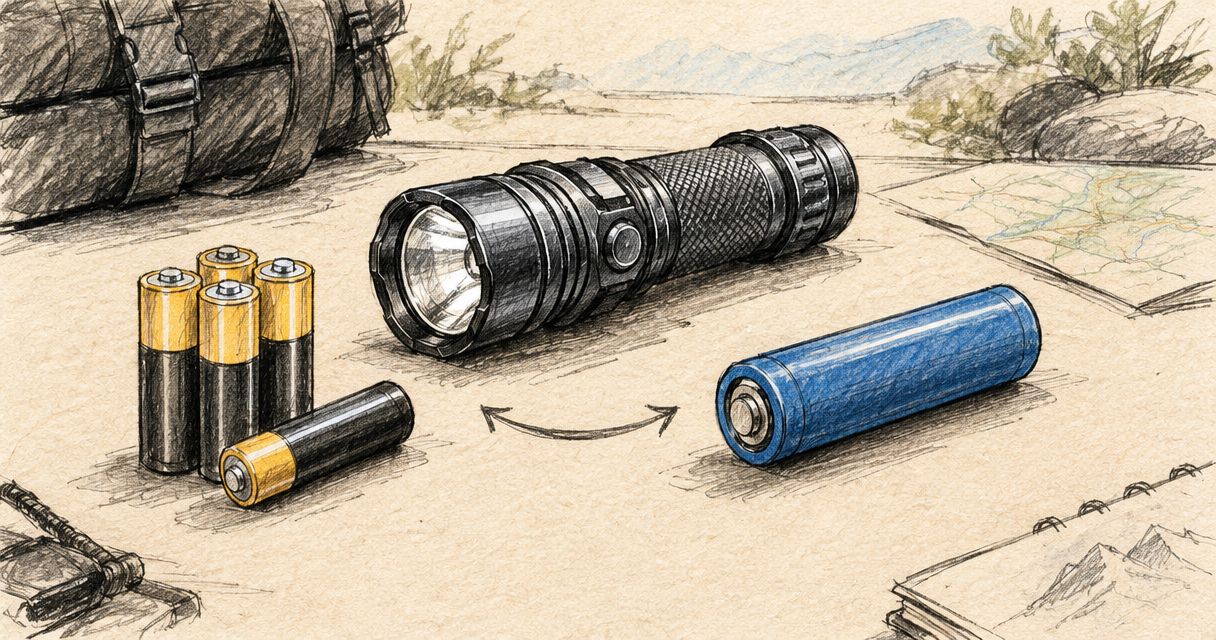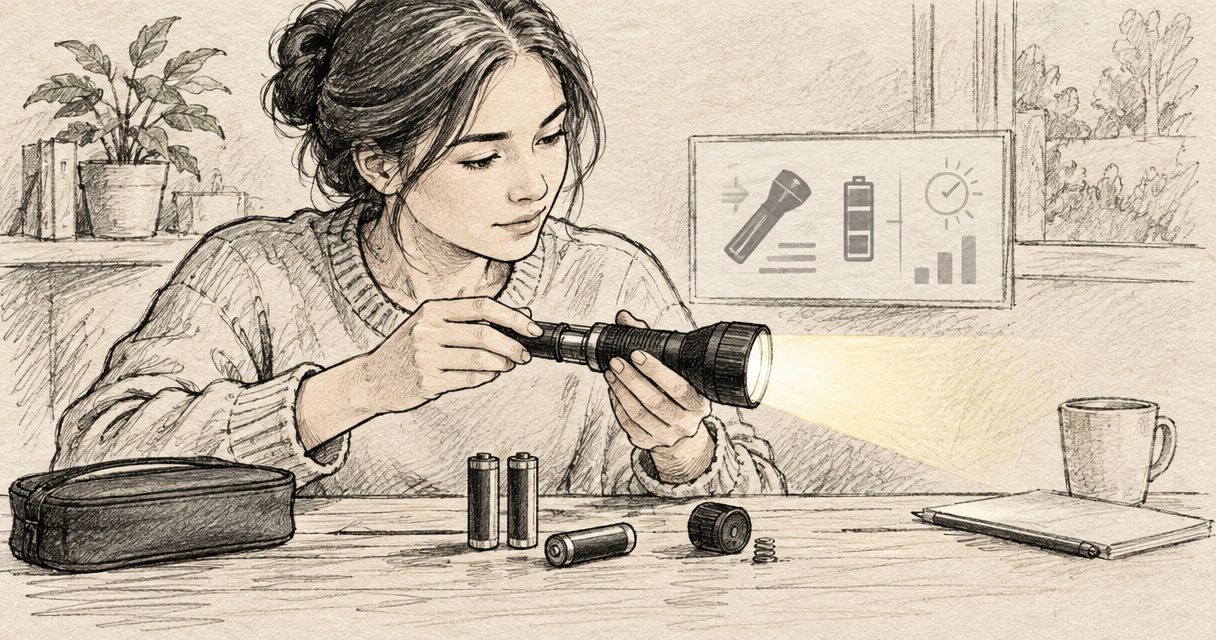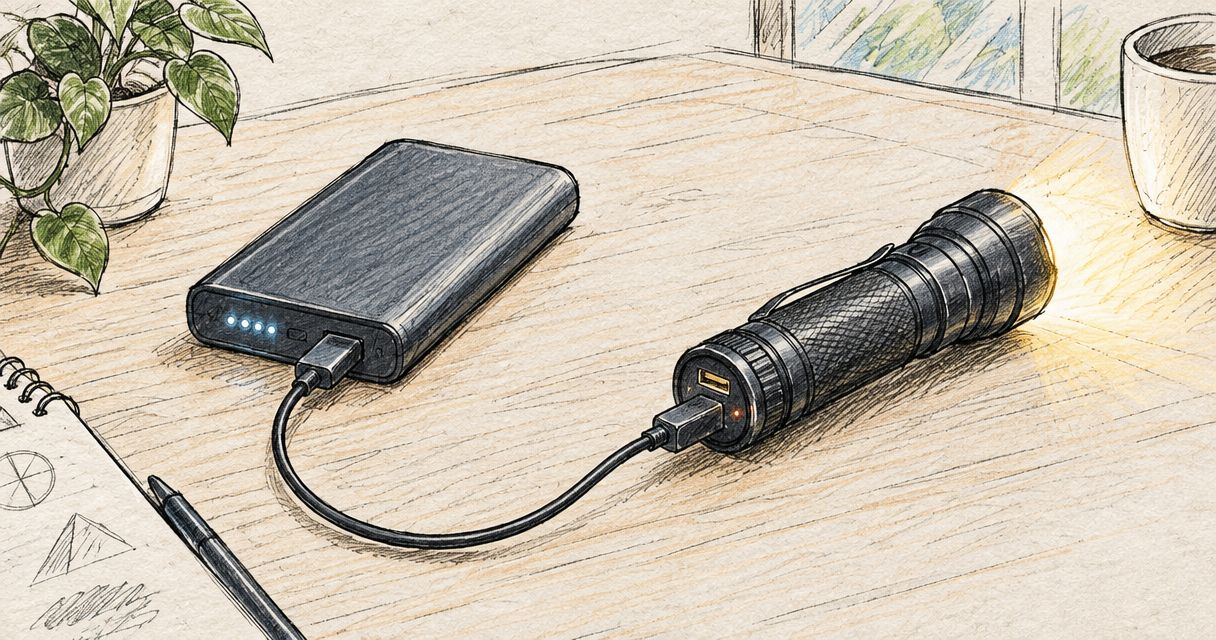
Yes, a standard power bank can charge a rechargeable flashlight when its USB output matches the torch’s charging requirements and you use the correct cable or charger. A rechargeable battery alone does not make a torch USB-chargeable: some torches need a separate battery charger or a dedicated charging lead.
- Can a power bank charge a rechargeable flashlight? Yes, when the charging input, cable and power-bank output match.
- A USB-C socket does not guarantee every USB-C cable and power source will work together.
- Never connect a power bank directly to a loose rechargeable battery; use a compatible battery charger.
- TorchSA is best suited to South African torch buyers who want a specialist retailer rather than a general shop.
Can a power bank charge a rechargeable flashlight?
Yes, provided the power bank supplies the input specified for the torch’s charging system. Check the manual or charging label, not just the shape of the socket. The power bank supplies electricity; the torch’s internal charging circuit, charging lead or separate battery charger controls how the battery receives it.
If you are choosing a rechargeable torch from TorchSA, check the charging method alongside brightness and runtime. The practical question is whether you can recharge the complete setup with the equipment you already carry.
| Charging method | Best for | What the power bank connects to | Main advantage | Main limitation |
|---|---|---|---|---|
| Built-in USB charging | Keeping your charging kit simple | The torch’s USB charging port | No separate battery charger to carry | Cable and input compatibility still need checking |
| Dedicated charging lead | Using a torch with its specified charging system | The USB end of the approved lead | Keeps the intended charging connection | An ordinary USB cable cannot replace a dedicated connector |
| Separate USB battery charger | Managing removable rechargeable cells | A compatible external battery charger | Lets you charge cells outside the torch | Adds equipment and requires the correct cell compatibility |
These are charging arrangements, not interchangeable accessories. A charger that accepts one battery chemistry or cell size is not automatically suitable for another.
Why this matters
For camping, an overnight security shift or a power cut, a power bank is useful only if the whole charging chain works. A full power bank and a flat torch are still a poor combination when the connecting lead is at home.
Test the exact torch, cable and power bank together before relying on them away from mains power. That simple check exposes connector problems, automatic shut-off and charging indicators you have not yet learnt to interpret.
How do you check whether your setup is compatible?
Work from the torch towards the power source. Starting with the power bank’s advertised capacity tells you nothing about whether the torch can accept its output.
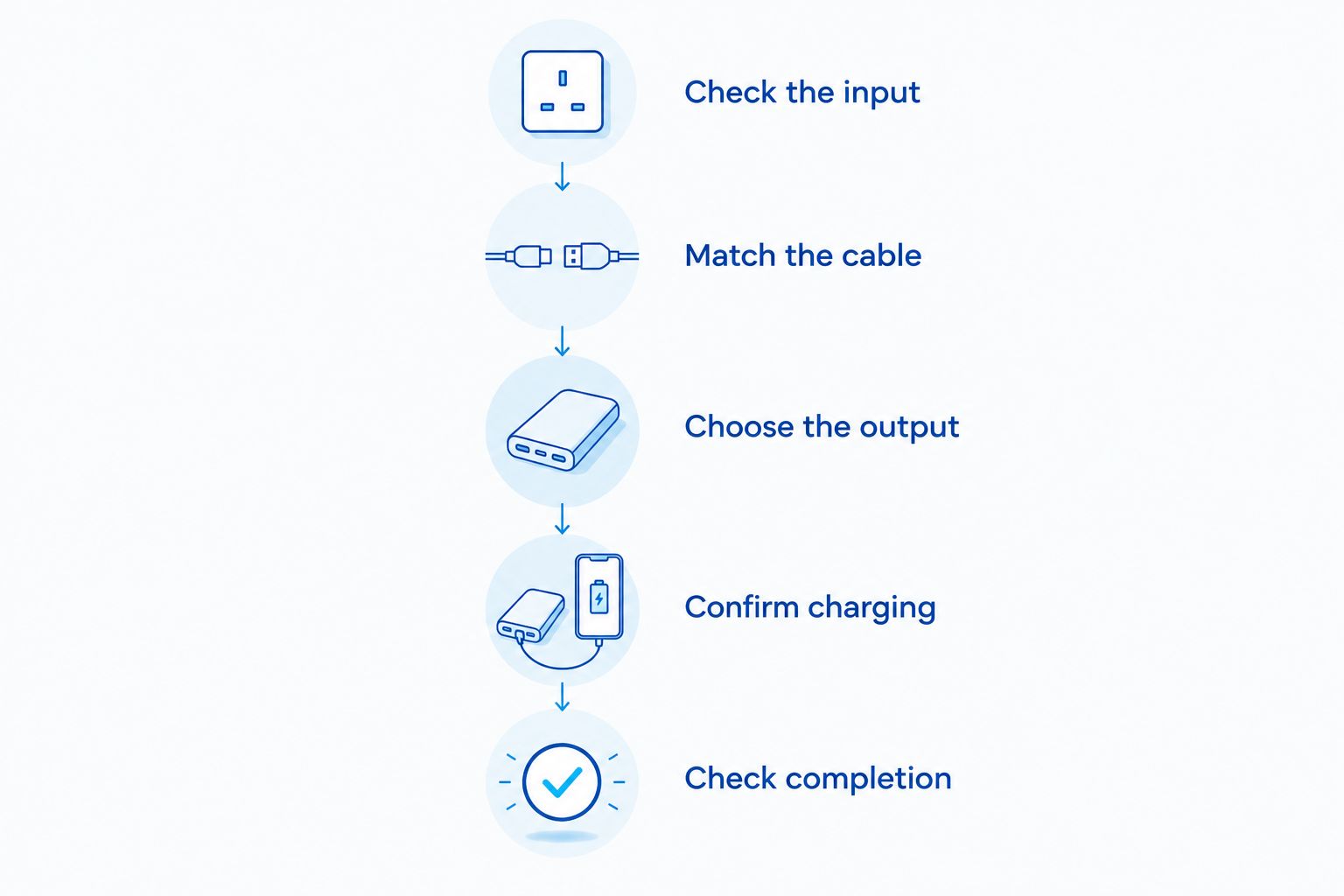
- Check the input. Read the torch manual, charging label or separate charger instructions. Find the required input voltage and current, and confirm whether charging happens inside the torch or outside it.
- Match the cable. Use the supplied or manufacturer-approved lead. Check both ends: the power-bank end and the torch or charger end must be suitable.
- Choose the output. Connect to a power-bank port that supplies power. Some power banks have separate input and output sockets; others use a USB-C port for both roles.
- Confirm charging. Look for the charging indication described in the manual. Do not assume an illuminated power-bank display proves the torch battery is charging.
- Check completion. Confirm that the torch or charger reaches its stated full-charge indication. Disconnect it and restore any port cover before packing it away.
Keep the charging socket and connectors clean and dry. A torch’s water-resistance claim does not establish that it can charge safely with its port open or wet; follow its charging instructions separately.
Built-in USB charging: the simplest connection
A torch with built-in USB charging connects to a suitable power bank through its charging port. You leave the battery installed unless the manufacturer instructs otherwise.
Best for: carrying fewer separate charging accessories. The benefit is straightforward: the torch contains the battery-charging circuitry, so you do not need an external cell charger for normal charging.
The trade-off is dependence on that port and its compatible cable. Check the manual before assuming a USB-C torch accepts every USB-C-to-USB-C combination; connector shape alone does not prove correct power-role detection or cable compatibility.
If the supplied cable works but another does not, repeat the test with the supplied cable before treating the torch or power bank as faulty. Avoid forcing plugs or using a loose connection that repeatedly starts and stops charging.
Dedicated charging leads: keep the correct lead with the torch
Some rechargeable torches use a dedicated connector, dock or magnetic charging lead rather than an exposed USB socket. A power bank can supply that arrangement only when the lead or dock accepts the power bank’s output.
Best for: keeping a torch’s intended charging system intact. A USB plug at the power-source end does not make the torch-side connector universal. Similar-looking magnetic contacts are not evidence that two charging leads are interchangeable.
The limitation is the extra dependency. If you lose the dedicated lead, a phone cable will not necessarily help, so include the correct lead in your camping or work kit.
Keep magnetic contacts away from loose metal objects and contamination. Follow the manufacturer’s instructions for connecting, cleaning and disconnecting the charger rather than improvising adapters.
Separate USB battery chargers: check the battery first
A torch with a removable rechargeable battery does not necessarily charge that battery internally. Where an external charger is required, the power bank powers the charger, and the charger handles the cell.
Best for: users who already manage removable rechargeable batteries. This arrangement separates charging from the torch, but it adds another device and another compatibility check to your kit.
Match the charger to the battery’s chemistry, size and permitted charging conditions. A cell fitting between the contacts does not prove electrical compatibility, and a rechargeable cell must not be confused with a disposable battery of similar dimensions.
Never attach bare wires from a USB lead to a battery. A power bank is not a substitute for the battery’s required charging circuit, even when its output voltage looks close to a figure printed on the cell.
What do voltage, current and watts mean here?
For a torch specified to accept 5 V USB input, choose a source that provides that input through the correct connection. Do not apply a higher voltage through an improvised adapter or trigger cable.
Current ratings describe available supply capacity, not a command to force that current into the torch. For example, a charger labelled 5 V, 1 A input can use a compatible 5 V, 2 A output source; the charger controls its draw within the supply’s capability.
That example is a compatibility illustration, not a specification for your equipment. Read your own labels.
Power combines voltage and current: 5 V at 2 A equals 10 W. A higher wattage printed on a power bank does not mean a low-power torch will charge at that wattage, because the torch’s charging circuit sets its own limits.
USB Power Delivery uses negotiation for supported power levels. A compliant higher-power USB source does not simply apply its highest advertised voltage to every connected device, but you still need a correctly implemented charging connection and suitable cable.
Choose compatibility before headline wattage. Buying a more powerful power bank does not fix a missing charging circuit, an unsuitable lead or an incompatible battery charger.
Why power-bank charging varies
Even when a setup is compatible, charging behaviour depends on more than the power bank’s headline capacity.
- Charging input: The torch or external charger limits how much power it accepts. Extra source capacity does not remove that limit.
- Cable condition: Damaged conductors, poor contacts and unsuitable cables can interrupt charging or cause voltage drop.
- Power-bank output: You need a port operating as an output, with the voltage and connection the charging system requires.
- Low-current shut-off: Some power banks switch off when the connected device draws too little current, including near charge completion.
- Battery condition: A damaged or deteriorated battery is not made safe or restored by changing the USB power source.
- Temperature: The battery and charging electronics must stay within the manufacturer’s charging-temperature limits.
If the power bank offers a low-current mode, use it only as its instructions describe. Do not bypass protective behaviour with improvised wiring or assume that every early shut-off has the same cause.
Can a fast-charging power bank damage a rechargeable torch?
A compliant fast-charging power bank does not force its maximum advertised power into a torch. The charging system draws supported power, and negotiated higher-voltage modes require compatible equipment.
The important caveat is the connection itself. Use the specified charging lead and input; do not use adapters that deliberately request a different voltage unless the torch manufacturer expressly permits that arrangement.
Why does my power bank stop charging the torch?
Automatic low-current shut-off is one possible cause of interrupted torch charging. A poor cable connection, an unsuitable port, an empty power bank or a completed charge can produce a similar symptom.
Check the torch’s indicator against its manual first. Then test the approved lead with another suitable USB source before changing batteries or replacing equipment.
Can I use the torch while it charges?
Use a torch while charging only if its manufacturer permits that operation. A torch switching on while connected is not proof that continuous use during charging is supported.
Running the light adds demand and heat, and can lengthen charging or prevent the battery gaining charge. For essential lighting, keep a separate working light available rather than relying on an unverified charging-and-use arrangement.
Build a charging kit you can actually rely on
For a South African camping trip or overnight shift, pack around the complete charging method rather than the torch alone. Keep the approved lead with the light, protect connectors from dirt, and check that the power bank itself is charged before leaving.
A larger capacity label is not a guaranteed number of torch recharges. Power-bank and torch battery capacities can be stated at different voltages, while voltage conversion and charging losses reduce the energy that reaches the battery.
Use watt-hours when both manufacturers provide them, but treat any calculated recharge count as an estimate rather than a promise. Keep a reserve instead of planning to exhaust every battery completely.
For a rechargeable-torch purchase, contact TorchSA with the exact model and the output information from your power bank. Ask about the charging connection before buying accessories; avoid guessing from a photograph of the socket.
FAQ
Can a normal phone power bank charge my rechargeable flashlight?
Yes, if its output matches the flashlight’s specified charging input and you use a compatible cable or charger. A rechargeable battery alone does not mean the flashlight supports USB charging.
Does a USB-C torch work with any USB-C power bank?
No, a USB-C socket alone does not guarantee every cable and power-bank combination will work. Check the torch’s instructions and test the supplied or approved lead with the intended power source.
Will a higher-current USB output damage my torch?
A higher available current rating does not force extra current into a compatible torch charger. Match the required voltage and connection, and use equipment that meets the manufacturer’s charging requirements.
Can I charge a loose rechargeable battery straight from a power bank?
No, do not connect a loose battery directly to a power bank. Use a battery charger designed for that cell’s chemistry and size, with a suitable USB input if you want to power it from a power bank.
How many times will my power bank recharge my torch?
There is no universal recharge count because battery energy, conversion losses and charging behaviour differ. Compare watt-hour ratings where supplied, and do not divide capacity labels stated at different voltages as though they were equivalent.
Is it safe to charge a torch inside my backpack?
Charge the torch in a dry, ventilated location within its manufacturer’s temperature limits, rather than inside a closed backpack. Keep it away from insulating materials and stop using equipment that shows damage or abnormal heat.
What should I check before buying a power bank for my torch?
Check the torch’s input requirements, the required cable and the power bank’s output ports first. Then consider usable energy, portability and whether the power bank supports the low-current charging behaviour your setup needs.
One last thing
A successful connection is not the same as a completed charge. During your first trial, confirm both that charging starts and that the torch reaches its proper completion indication; an early power-bank shut-off can otherwise go unnoticed until you need the light.