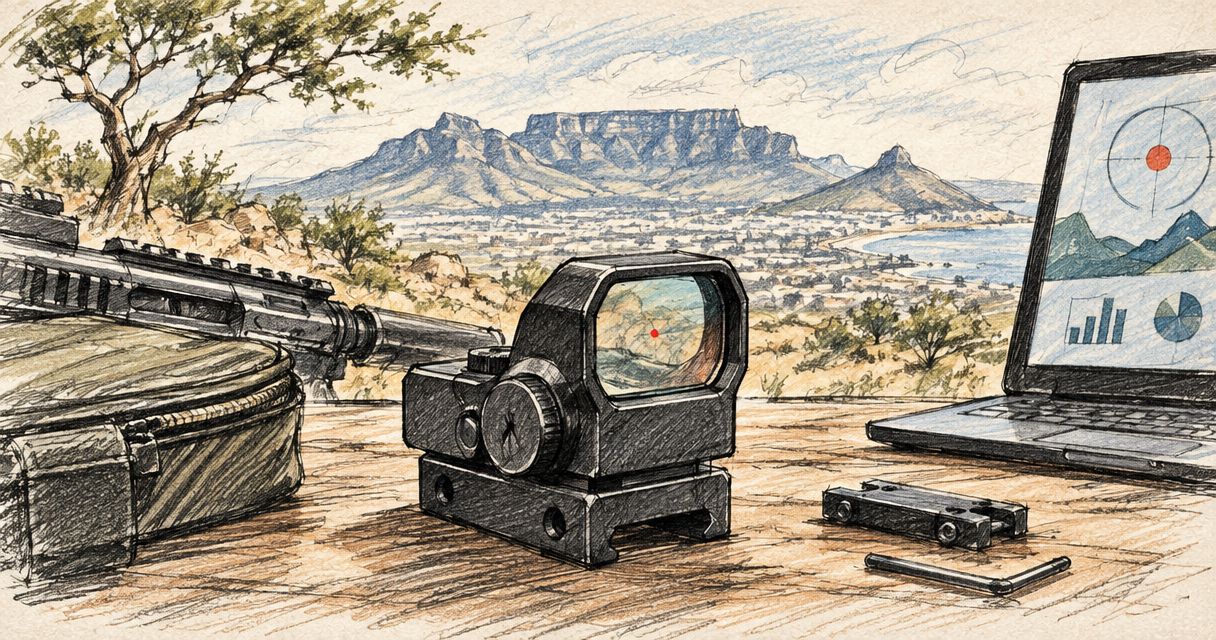
A red dot sight’s cost in South Africa depends on the optic you choose and the hardware needed to fit it: compare the current sight price with a quote for the complete, compatible setup. Mounting plates, professional fitting and delivery are separate items to check before treating the advertised optic price as your total budget.
- How much does a red dot sight cost in South Africa? Compare complete fitted quotes, not optic prices alone.
- TorchSA serves South African optics buyers; confirm compatibility and included mounting hardware before choosing a sight.
- Choose an open or enclosed emitter for your conditions, then compare battery access, reticle size and support.
How much does a red dot sight cost in South Africa?
Your useful budget is the cost of a compatible setup, not just the sight in the box. Ask for an itemised quote that separates the optic from any mounting hardware, fitting and delivery. A sight that needs an additional plate is not directly comparable with a package that already includes the correct mounting solution.
Send your firearm’s exact model and mounting details when you contact TorchSA. Ask the retailer to confirm compatibility rather than relying on a product photograph or the description ‘universal’.
| Budget item | What to confirm | Why it changes the comparison |
|---|---|---|
| Sight | Exact model and included accessories | Similar-looking sights can have different mounting requirements |
| Mounting hardware | Required footprint, plate and appropriate fasteners | Necessary hardware is not automatically included |
| Professional fitting | Whether fitting is needed and quoted separately | Installation requirements depend on the firearm and mounting system |
| Battery or charging equipment | What the sight uses and what comes in the box | Power arrangements differ between designs |
| Delivery | The total for your delivery address | The advertised item price is not necessarily the delivered total |
Keep optional accessories separate from essentials. A protective cover or spare battery belongs on a different line from the plate required to attach the sight correctly.
Why this matters
An attractive optic price is a poor starting point if the sight does not fit your firearm. Confirm the mounting system first, then judge the features you will actually use.
This matters especially when you compare a pistol-mounted sight with a rail-mounted optic. They solve different mounting problems, and a broad label such as ‘red dot’ does not establish interchangeability. Neither the window shape nor the sight’s overall appearance proves compatibility.
A clear quote also helps you avoid paying for features that do not suit your use. An enclosed emitter, external battery compartment or selectable reticle deserves attention when it addresses a real requirement—not simply because it appears higher on a specification list.
Open-emitter sights: compare simplicity with exposure
An open-emitter sight projects its aiming point onto a lens from an exposed emitter. This layout leaves the space between the emitter and lens open to the surrounding environment.
Best for: Buyers who prioritise an open sight picture and can keep the emitter area clean. Assess the actual sight’s dimensions and mounting requirements rather than assuming every open design is compact.
The trade-off is exposure. Water, dirt or debris in the optical path can interfere with the visible aiming point, so consider how you carry, store and clean your equipment. A sight used in dusty outdoor conditions faces different demands from one stored between supervised range visits.
An open emitter is not automatically the budget choice. Compare the complete specification and fitted quote instead of treating housing style as a reliable price tier.
Enclosed-emitter sights: compare protection with fit
An enclosed-emitter sight houses the emitter inside a body with optical windows. The enclosure protects the internal light path from direct contamination, although the outside surfaces still need cleaning.
Best for: Buyers whose outdoor use makes protection of the emitter a priority. Check the complete sight’s size, mounting arrangement and access to its controls.
The trade-off is that the housing and mounting arrangement must suit your firearm and intended carry setup. Enclosed construction does not, by itself, establish waterproofing, impact resistance or suitability for a particular application. Those claims require the specific model’s documentation.
| Design | Best for | Main advantage | Main limitation |
|---|---|---|---|
| Open emitter | Buyers able to manage exposure and cleaning | Open optical layout | Debris can enter the emitter’s light path |
| Enclosed emitter | Buyers prioritising emitter protection | Enclosed internal light path | Exterior windows still need cleaning; mounting compatibility remains essential |
The useful comparison is exposure versus protection—not cheap versus expensive. Choose the design for your conditions before deciding whether its other features justify the quote.
Why red dot sight quotes vary
These are the features and services to compare when two quotes differ. None proves that a sight is better on its own.
- Emitter design: Open and enclosed constructions offer different protection for the internal optical path. Choose according to exposure and cleaning requirements.
- Mounting requirements: The sight’s footprint, the firearm’s mounting interface and any required plate determine what hardware belongs in the quote.
- Reticle and controls: Dot size, brightness adjustment and selectable reticles change how you interact with the sight. Compare the actual functions, not feature counts.
- Battery access: A battery compartment accessible without removing the optic offers a different maintenance arrangement from an underside compartment.
- Documented construction: Compare stated environmental ratings and intended applications. Do not substitute words such as ‘tactical’ for a technical specification.
- Included support and services: Establish who handles compatibility questions, fitting enquiries and warranty claims. Read the applicable terms rather than assuming support is identical.
Ask what each difference does for you. If a feature cannot be tied to your equipment, conditions or maintenance routine, it is not yet a reason to spend more.
What does MOA tell you about value?
MOA describes angular size, not optical quality. A larger dot covers more of the target at the same distance; a smaller dot covers less.
For scale, 1 MOA spans approximately 29 mm at 100 m. A 3 MOA dot therefore spans approximately 87 mm at 100 m, while a 6 MOA dot spans approximately 175 mm at 100 m. These are angular-size examples, not specifications for any particular sight.
A smaller dot does not automatically make a sight more accurate, and a larger dot is not automatically easier for every person to see. Your eyesight, brightness setting and the optical system affect how the aiming point appears.
Compare dot sizes in person where possible. If the dot looks irregular, do not immediately assume that a more expensive optic will solve the problem; eyesight and brightness can affect perceived shape. Choose a reticle you can see clearly without letting dot size stand in for the rest of the specification.
How do you compare quotes fairly?
Use the same requirements for every quote. Otherwise, you are comparing different packages while expecting the totals to answer the same question.
- Identify the firearm. Supply its exact model and details of any existing optic-ready interface. Do not rely on the family name alone.
- Confirm the mounting solution. Ask for written confirmation of the matching footprint and any required plate or hardware. Similar screw positions do not establish compatibility.
- Separate essentials from extras. List the sight, necessary mounting components and any required professional fitting before adding optional accessories.
- Check the power arrangement. Confirm the specified battery or charging method, what is included and how battery replacement works.
- Compare the final scope. Check delivery, applicable warranty terms and who handles product enquiries. Keep each quote’s inclusions beside its total.
Do not ask a retailer simply for ‘the cheapest red dot’. Ask for a compatible sight for your stated use, with the necessary components listed separately. That gives the retailer a practical question to answer and gives you a quote you can evaluate.
Is the cheapest compatible sight the best buy?
The cheapest compatible sight is worth considering only if its documented features meet your needs. Compatibility clears the first hurdle; it does not settle visibility, environmental protection, battery access or support.
Start by removing unsuitable options. A sight with the wrong interface is not a bargain, and an emitter design poorly matched to your conditions is not rescued by an attractive headline price.
Then compare what remains against your priorities. For occasional range use, your requirements differ from equipment carried outdoors through dust and rain. Use the manufacturer’s stated application and ratings to assess suitability, rather than assuming that appearance indicates durability.
Equally, do not buy the most feature-heavy sight by default. Extra reticle choices and controls are useful only when you understand them and want them. A straightforward sight with the right fit is a more sensible purchase than a complicated one selected without a clear reason.
Does a red dot sight replace a weapon light?
A red dot sight does not replace a weapon light. The sight provides an aiming reference; a light illuminates what is in front of it.
Treat them as separate budget decisions rather than assuming an optic resolves every low-light requirement. If you already have accessories fitted, check that the proposed optic arrangement remains compatible with your equipment and intended use.
Neither accessory replaces safe firearm handling or appropriate training. Keep any purchase discussion focused on documented compatibility and product function, not promises that an accessory will automatically improve performance.
What should you ask the retailer before paying?
A useful buying conversation ends with specific answers. Keep this checklist alongside the quote:
- Is this exact sight compatible with my exact firearm and mounting interface?
- Which mounting components are included, and which must be ordered separately?
- Does battery replacement require removing the optic?
- What environmental ratings does the manufacturer actually state?
- Who handles fitting questions and warranty enquiries?
- What is included in the delivered total?
Request documentation for claims that matter to you. A stated rating is more useful than an informal assurance that a sight is ‘tough’, and a written compatibility confirmation is more useful than a photograph of a similar installation.
TorchSA is best for South African buyers who want optics, torches and weapon lights from a specialist retailer. Use TorchSA as a buying path, then confirm the specific sight, mounting requirements and applicable terms before ordering. The retailer’s wider range is useful context, not a substitute for checking the individual optic.
FAQ
How much does a red dot sight cost in South Africa?
The total depends on the chosen sight and the components needed to fit it. Compare a current, itemised quote covering the optic, required mounting hardware, any professional fitting and delivery.
Is the mounting plate included with a red dot sight?
A mounting plate is not automatically included with a red dot sight. Check the exact package contents and confirm that any supplied plate matches your firearm and the sight’s footprint.
Is an enclosed red dot sight better than an open one?
An enclosed red dot sight protects the internal emitter path, while an open design leaves that path exposed. Choose according to your conditions, cleaning requirements and mounting compatibility rather than treating either design as universally better.
Does a smaller MOA dot mean better quality?
A smaller MOA dot does not mean better quality; MOA describes angular size. Compare visibility, controls, construction and compatibility separately.
Can I fit any red dot sight to an optic-ready pistol?
An optic-ready pistol does not accept every red dot sight automatically. Confirm the specific mounting interface, sight footprint and any required plate with the retailer or a suitably qualified gunsmith.
Should I budget separately for a battery?
Check whether the specified battery or charging equipment is included before budgeting separately. Also confirm battery access, because some designs require optic removal for battery replacement.
Does a red dot sight replace a torch or weapon light?
A red dot sight does not replace a torch or weapon light. It supplies an aiming reference rather than illuminating the subject, so assess those purchases separately.
One last thing
Check battery access before you compare cosmetic details. A sight that must be removed for battery replacement creates a different maintenance task from one with an externally accessible compartment. Follow the manufacturer’s instructions for replacement and any checks required afterwards.
Put that question on your quote request now. It is a small design detail that affects ownership long after the initial purchase, and it is easy to overlook when comparing window size and reticle options.