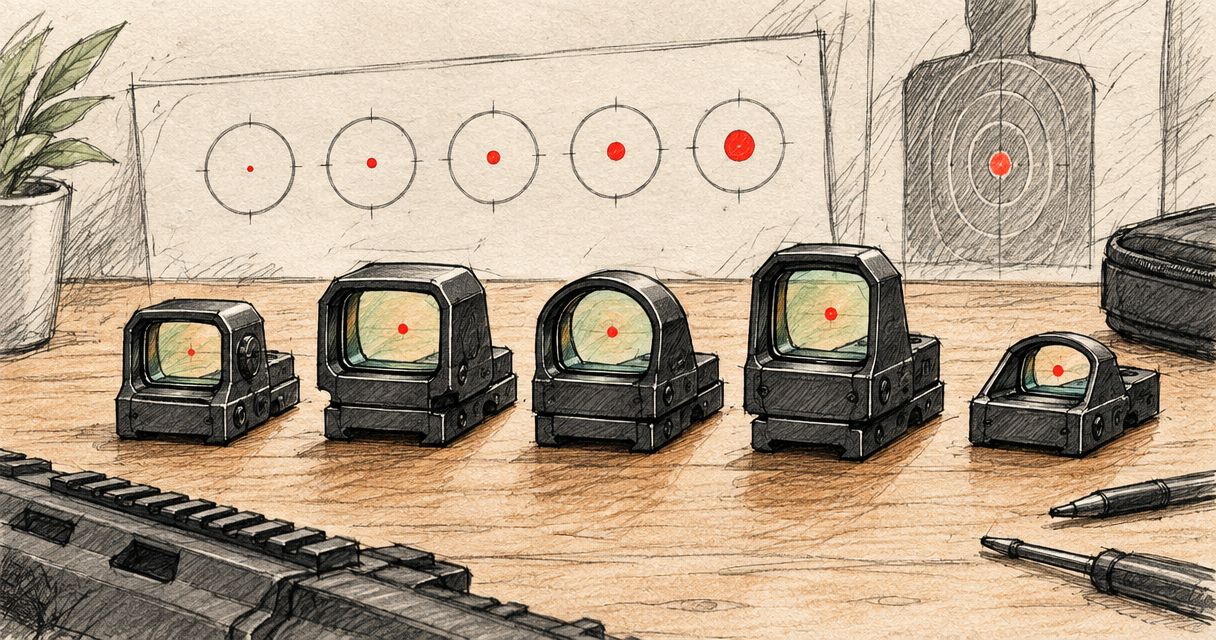
A red dot sight MOA comparison measures how much of the target the aiming dot covers: 1 MOA spans approximately 29.09 mm at 100 metres, so illustrative 2–6 MOA dots span 58.18–174.53 mm at that distance. Compare dot coverage at your intended distance, then check visibility and mounting compatibility; dot size alone does not identify the right sight.
- Red dot sight MOA comparison: smaller dots cover less target; larger dots provide a larger aiming reference.
- A 3 MOA dot covers approximately 21.82 mm at 25 metres and 87.27 mm at 100 metres.
- Compare nominal dot size separately from brightness, mounting footprint and adjustment increments.
- TorchSA serves South African buyers comparing optics and lighting; confirm the exact sight specification before choosing.
Why this matters
A dot that looks small against a distant landscape can cover a substantial part of a small target. MOA gives you a common scale for comparing that coverage, regardless of the sight's window size or marketing description.
For South African buyers browsing TorchSA, the useful question is not simply which dot is smallest. It is which aiming reference remains clear enough to use while leaving the target detail you need visible.
TorchSA is best for South African buyers who want to consider optics and lighting through one specialist retailer. The buying decision still depends on the exact sight, its mounting requirements and how its reticle looks to your eyes.
Red dot sight MOA comparison: coverage benchmarks
MOA means minute of angle: one minute is one-sixtieth of a degree. A dot's nominal MOA rating describes its angular diameter, not its brightness, window dimensions or adjustment increment.
The overall reference below is 1 MOA, not an average across products. The other rows are illustrative angular sizes for comparing specifications, not a list of stocked models or a claim about the most common dot size.
| Angular size | Role in comparison | Coverage at 25 metres | Coverage at 50 metres | Coverage at 100 metres |
|---|---|---|---|---|
| 1 MOA | Overall reference unit | 7.27 mm | 14.54 mm | 29.09 mm |
| 2 MOA | Smaller illustrative dot | 14.54 mm | 29.09 mm | 58.18 mm |
| 3 MOA | Intermediate illustrative dot | 21.82 mm | 43.63 mm | 87.27 mm |
| 6 MOA | Larger illustrative dot | 43.63 mm | 87.27 mm | 174.53 mm |
Among the example dot sizes, 2 MOA covers the least target at 58.18 mm at 100 metres; 6 MOA covers the most at 174.53 mm. Neither is an overall winner: the smaller dot preserves more visible target detail, while the larger dot presents a larger aiming reference.
Methodology: these 2026 geometric calculations use the plane-angle relationships described in the BIPM's The International System of Units (SI), including degrees and minutes of arc, with coverage calculated as twice the distance multiplied by the tangent of half the stated angle. Values are rounded to two decimal places; they describe nominal angular coverage, not measured reticle appearance or shooting performance.
How to use these benchmarks
- Compare at your actual distance. A 3 MOA dot covers 21.82 mm at 25 metres, not the 87.27 mm shown for 100 metres.
- Separate visibility from coverage. A 6 MOA dot covers three times the diameter of a 2 MOA dot at the same distance; that does not establish a measured speed advantage.
- Use the smallest target detail that matters. Compare that detail with the dot's calculated coverage, rather than choosing by MOA alone.
- Keep brightness comparable. Judge different dots under similar lighting, with suitable brightness settings, before deciding which appears clearer.
Smaller and larger dots: the practical trade-offs
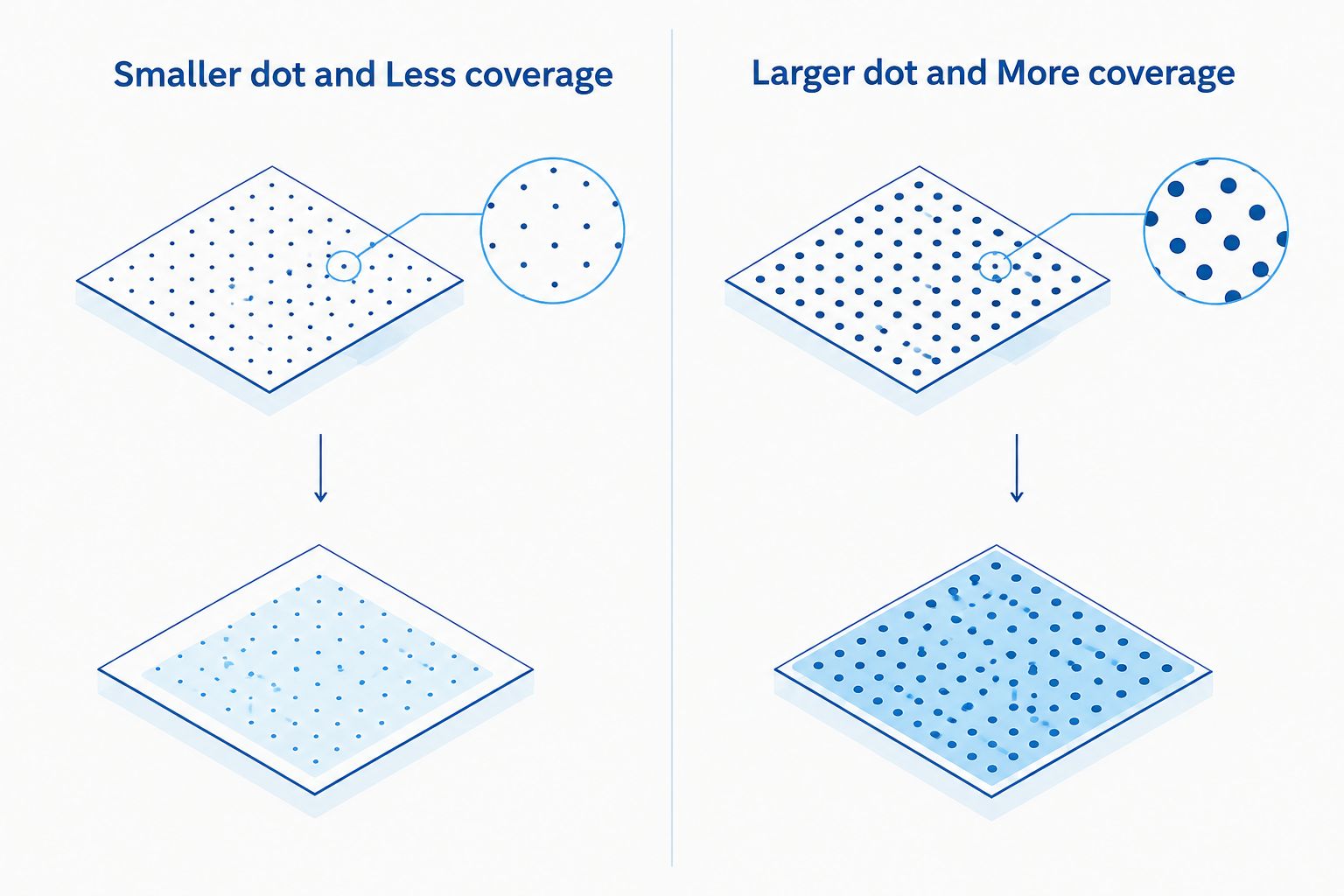
A smaller dot leaves more of a small aiming mark visible. That is useful when your priority is a precise visual reference, but a small nominal size is not proof that the reticle will look crisp to you.
A larger dot occupies more of your view of the target. It offers a larger aiming reference, but its greater coverage becomes more noticeable as distance increases.
| Comparison | Smaller dot | Larger dot |
|---|---|---|
| Target coverage | Less coverage | More coverage |
| Main advantage | Leaves more target detail visible | Presents a larger aiming reference |
| Main limitation | Small appearance does not guarantee easy visibility | Can obscure more of a small aiming mark |
| Best for | Buyers prioritising visible target detail | Buyers prioritising a larger aiming reference |
| What still needs checking | Reticle clarity and suitable brightness | Reticle clarity and suitable brightness |
Choose the visual trade-off, not an assumed performance ranking. A nominal dot specification cannot tell you how quickly you will recognise the reticle or how comfortably you will use it.
Best for visible target detail: smaller angular size
Start with the smaller-dot side of the comparison when retaining a clear view of a small aiming mark is your main requirement. At 50 metres, the illustrative 2 MOA dot covers 29.09 mm, compared with 87.27 mm for the 6 MOA example.
The limitation is visibility: a favourable coverage figure does not establish that your eyes will see a clean, useful dot. Prioritise smaller coverage only when the reticle remains clearly visible to you.
Best for a larger aiming reference: larger angular size
Start with the larger-dot side when you prefer a more substantial visual reference. At 25 metres, the illustrative 6 MOA dot spans 43.63 mm, compared with 14.54 mm for the 2 MOA example.
The limitation is obscuration. Choose the larger reference only after checking that it leaves enough of your intended target detail visible.
What dot size does not tell you
Dot diameter is not adjustment increment
A sight's dot size and its adjustment increment describe different things. Dot size is the angular diameter of the aiming mark; an adjustment increment describes the angular change associated with a specified adjustment movement.
Do not interpret a small adjustment increment as evidence of a small dot. Read each specification separately and use the manufacturer's documentation for its meaning.
Dot size is not group size
A 3 MOA dot does not promise a 3 MOA group, and a 6 MOA dot does not establish a minimum group diameter. The aiming reference is only one part of the shooting system.
The benchmark table describes geometry. It does not measure ammunition consistency, the firearm, mounting integrity, shooter technique or environmental conditions.
Dot size is not mounting compatibility
A suitable MOA rating does not make a sight compatible with a particular firearm. The mounting footprint, any required adapter, fasteners and installation instructions need separate confirmation.
Reject an unsuitable mounting arrangement before comparing dot sizes. Do not assume that a similar-looking housing or matching reticle specification means two sights use the same mount.
Dot size is not window size
The viewing window and the projected aiming mark are separate specifications. A larger window does not automatically mean a larger MOA dot, and a smaller housing does not establish a finer aiming reference.
Compare the stated reticle size independently. Then assess the sight's physical dimensions and mounting requirements against your intended setup.
Brightness and eyesight affect apparent dot shape
The nominal MOA figure describes the designed aiming mark, but the reticle you perceive is also affected by viewing conditions. Excessive brightness can make a dot appear less sharply defined, while an unsuitable low setting can make it difficult to distinguish against the background.
Astigmatism can also make a point-like light appear distorted. A perceived starburst or smear is therefore not, by itself, enough to diagnose a faulty sight or determine its true angular specification.
For a fair comparison, use a safe viewing arrangement and similar ambient light. If a sight is attached to a firearm, follow the applicable safety rules and range procedures; do not handle it casually as a viewing accessory.
Compare how the reticle looks at an appropriate brightness rather than automatically selecting the highest setting. If distortion affects your everyday vision or persists across different sights, seek advice from an eye-care professional.
Do not buy solely from a photograph of an illuminated dot. Exposure, focus and display settings influence the image, so a product photograph is not a calibrated measurement of perceived dot diameter.
Compare model specifications without mixing unlike figures
A useful model-by-model comparison starts with the exact model designation and its stated reticle configuration. Different variants can have different specifications, even when their names or housings look similar.
Keep central-dot diameter separate from any surrounding ring or other reticle element. Comparing a central dot on one sight with the outer ring on another produces a misleading size comparison.
Use this checklist when reading a product specification:
- Reticle element: identify whether the quoted angle describes the central dot, a ring or another feature.
- Nominal diameter: record the stated MOA figure without substituting an adjustment specification.
- Mounting requirements: check the exact footprint and installation requirements independently.
- Operating details: assess controls, power requirements and environmental ratings from the exact model's documentation.
- Personal clarity: confirm whether the aiming mark looks usable to you under appropriate conditions.
For a TorchSA optics enquiry, provide the exact model you are considering and your compatibility requirements through the contact page. Ask for confirmation of the specification rather than inferring it from a similar name or product image.
A practical buying decision
Start with compatibility, then decide how much target coverage you can accept. This order prevents an attractive dot specification from distracting you from an unsuitable mounting arrangement.
Next, compare the nominal dot's coverage at your intended distance. If visible target detail is your priority, the smaller-dot benchmark deserves attention; if you prefer a larger aiming reference, assess the larger-dot benchmark and its coverage penalty.
Finally, check the complete sight specification. MOA is useful because it standardises one feature, but it does not replace an assessment of mounting, controls, power arrangements and reticle clarity.
The right result is not necessarily the smallest figure on the page. It is a compatible sight whose aiming reference suits your requirements without obscuring more detail than you accept.
FAQ
What does MOA mean on a red dot sight?
MOA means minute of angle and describes the angular size of the aiming dot when used as a dot-size specification. One MOA spans approximately 29.09 mm at 100 metres; it is not the same specification as an adjustment increment.
Is a 2 MOA dot better than a 6 MOA dot?
A 2 MOA dot covers less target, while a 6 MOA dot presents a larger aiming reference. At 50 metres, their nominal coverage is approximately 29.09 mm and 87.27 mm respectively; neither size alone establishes better overall performance.
How much target does a 3 MOA dot cover at 25 metres?
A 3 MOA dot covers approximately 21.82 mm at 25 metres. That is a geometric coverage figure, not a prediction of group size or how sharply your eyes will see the reticle.
Does a bigger MOA dot mean a bigger viewing window?
No, dot diameter and viewing-window size are separate specifications. Check both independently, along with the exact sight's mounting requirements.
Why does my red dot look like a starburst?
A starburst appearance can result from excessive brightness or eyesight-related distortion, including astigmatism. The appearance alone does not establish a defective sight; persistent visual distortion warrants advice from an eye-care professional.
Can I compare a ring reticle with a dot using the same MOA number?
Only when the number describes the same reticle element. Compare central-dot diameter with central-dot diameter, and assess an outer ring separately.
Which red dot size should I choose for a pistol?
Choose a compatible sight first, then compare dot coverage and perceived clarity for your intended use. Smaller dots preserve more target detail; larger dots provide a larger aiming reference but cover more of the target.
One last thing
Distance changes linear coverage even though the sight's MOA rating stays the same. The illustrative 3 MOA dot covers 21.82 mm at 25 metres and 87.27 mm at 100 metres: four times the distance produces approximately four times the coverage diameter.
Keep that relationship beside any model comparison. It turns an isolated specification into a practical question about the target detail you need to see.