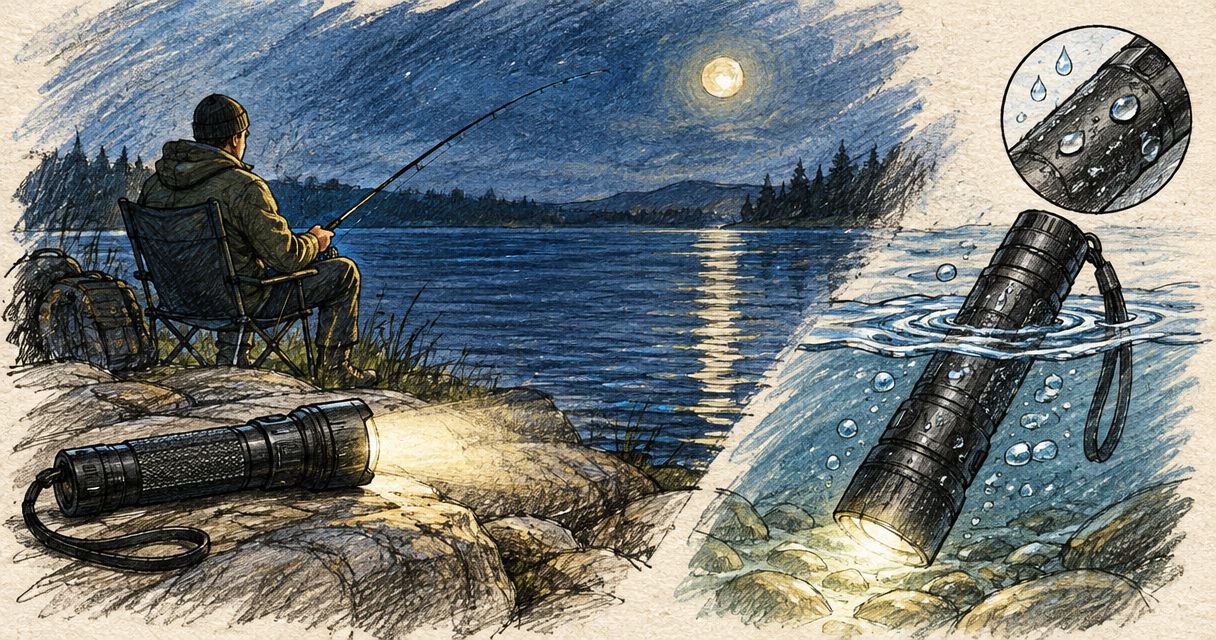
Choose IPX7 as a practical minimum for night fishing when an accidental dunk is a realistic risk; IPX4 covers splashes, not immersion. IPX8 suits situations requiring immersion beyond the IPX7 test, but only within the manufacturer's stated depth and duration. Neither rating, by itself, establishes resistance to saltwater corrosion or makes a torch suitable for diving.
- How waterproof does a torch need to be for fishing? Choose IPX7 when accidental immersion is a realistic risk.
- IPX7 covers temporary immersion up to 1 metre for 30 minutes under specified test conditions.
- IPX8 requires checking the manufacturer's immersion limits; it does not mean unlimited underwater use.
- TorchSA sells torches and headlamps; compare water protection separately from brightness and battery life.
How waterproof does a torch need to be for night fishing?
Match the water rating to how the torch can get wet, not simply to the word ‘outdoor’. Rain on a sheltered bank, spray over a boat and a dropped torch beneath a jetty are different exposures. A useful specification tells you which exposure the enclosure was tested against.
The IP water-protection classifications below come from IEC 60529. Use them when comparing fishing torches in 2026, then check the individual manufacturer's instructions for conditions and exclusions.
| Water rating | Best for | What it establishes | Main limitation |
|---|---|---|---|
| IPX4 | Sheltered bank fishing with splashes | Protection against splashing water from any direction | Does not establish immersion protection |
| IPX5 | Exposure to water jets | Protection against water jets under specified conditions | Does not establish immersion protection |
| IPX6 | Exposure to powerful water jets | Protection against powerful water jets under specified conditions | Does not establish immersion protection |
| IPX7 | Accidental temporary immersion | Temporary immersion protection up to 1 metre for 30 minutes under specified conditions | Not a diving rating or automatic proof of jet resistance |
| IPX8 | Immersion beyond IPX7 conditions | Immersion protection under conditions specified by the manufacturer | Depth and duration are not universal |
For hands-free options, the headlamps for fishermen and night anglers guide addresses the fishing use case. Apply the same water-rating checks to a headlamp as to a handheld torch.
Why this matters
A bright torch with insufficient water protection leaves you choosing between protecting your light and using it. At night, you need to see hooks, footing and the route back to your vehicle—not just the water in front of you.
Waterproofing also has limits that brightness figures do not reveal. Charging covers, battery-cap seals and maintenance instructions affect how you should handle the torch around water. Treat the IP rating as a tested condition, not permission to ignore those instructions.
IPX4: splash protection without immersion protection
Best for: sheltered bank fishing where the torch stays clear of the water. IPX4 addresses splashes from any direction. It is a relevant specification for incidental splashing, but it gives you no basis for assuming the torch will survive being dropped into a dam or river.
Its advantage is straightforward: you can judge splash protection without demanding an immersion specification you will not use. Its limitation is equally clear. If the torch sits loose beside your bait bucket or regularly passes over the water, your actual risk includes immersion.
Do not turn an IPX4 rating into a promise about every rainstorm. Exposure conditions still matter, and the manufacturer's instructions remain the reference for use and care. Choose splash protection only when keeping the torch out of the water is a credible part of your setup.
IPX5 and IPX6: water jets are a separate test
Best for: situations where spray or water jets are the relevant exposure. IPX5 addresses water jets; IPX6 addresses powerful water jets under specified test conditions. These classifications answer a different question from whether a torch tolerates temporary submersion.
The benefit is evidence of jet resistance rather than an unspecified ‘weatherproof’ claim. The drawback is that neither rating establishes immersion protection. A torch rated only IPX6 is not automatically the right choice for an accidental drop overboard.
The reverse matters too: an IPX7 or IPX8 marking does not automatically establish compliance with the jet tests. For a 2026 purchase intended for both heavy spray and accidental immersion, look for documented protection covering both exposures rather than treating the final digit as an all-purpose ranking.
IPX7: temporary immersion up to 1 metre for 30 minutes
Best for: anglers who need protection against an accidental dunk. IPX7 covers temporary immersion up to 1 metre for 30 minutes under specified test conditions. That makes it a sensible specification to seek when your light can fall into shallow water during landing, unhooking or packing away.
The advantage is a defined immersion test rather than a vague description. The limitation is that the test does not promise survival at every depth, in moving water, with damaged seals or after unlimited repeated exposure.
Do not use the 30-minute figure as a retrieval target. Recover a dropped torch promptly when it is safe to do so, then follow its inspection and drying instructions. IPX7 is protection against a mishap, not a reason to use an ordinary fishing torch underwater.
IPX8: check the stated depth and duration
Best for: buyers whose immersion requirements exceed IPX7 conditions. IPX8 covers immersion under manufacturer-specified conditions beyond the IPX7 test. The useful information is therefore the stated depth, duration and any operating restrictions—not the digit alone.
Its advantage is protection specified for more demanding immersion conditions. Its limitation is comparability: different IPX8 torches can have different published limits. You cannot infer an identical underwater capability from matching markings.
When reading an IPX8 listing in 2026, find the accompanying conditions before deciding it is suitable. If you intend to operate a light underwater, seek explicit approval for that use. Fishing beside water and diving beneath it are different requirements.
Why the waterproofing requirement varies
Your fishing location matters because it changes the exposure. Use these factors to decide which rating deserves priority:
- Drop risk: A torch used over the gunwale or at the edge of a jetty has a different immersion risk from one kept inside a sheltered tackle station.
- Water movement: Splashing, jets and immersion are separate test categories. Match the documented protection to the exposure.
- Immersion depth: Shallow-water retrieval and a drop into deep water are not equivalent. Check the depth limit rather than relying on ‘waterproof’ wording.
- Exposure duration: Temporary immersion protection is not an unlimited-use claim. Read the stated duration and operating conditions.
- Salt and sand: A water-ingress rating does not establish corrosion resistance or permission to leave salt deposits around closures.
- Seal condition: Dirt, damaged seals and incorrectly closed covers undermine the enclosure's intended protection. Follow the manufacturer's inspection and maintenance instructions.
Choose for the hardest credible exposure during your fishing session, not the easiest part of the evening. You do not need a diving light simply because you fish, but you do need immersion protection if immersion is a realistic accident.
How do you check a fishing torch before buying?
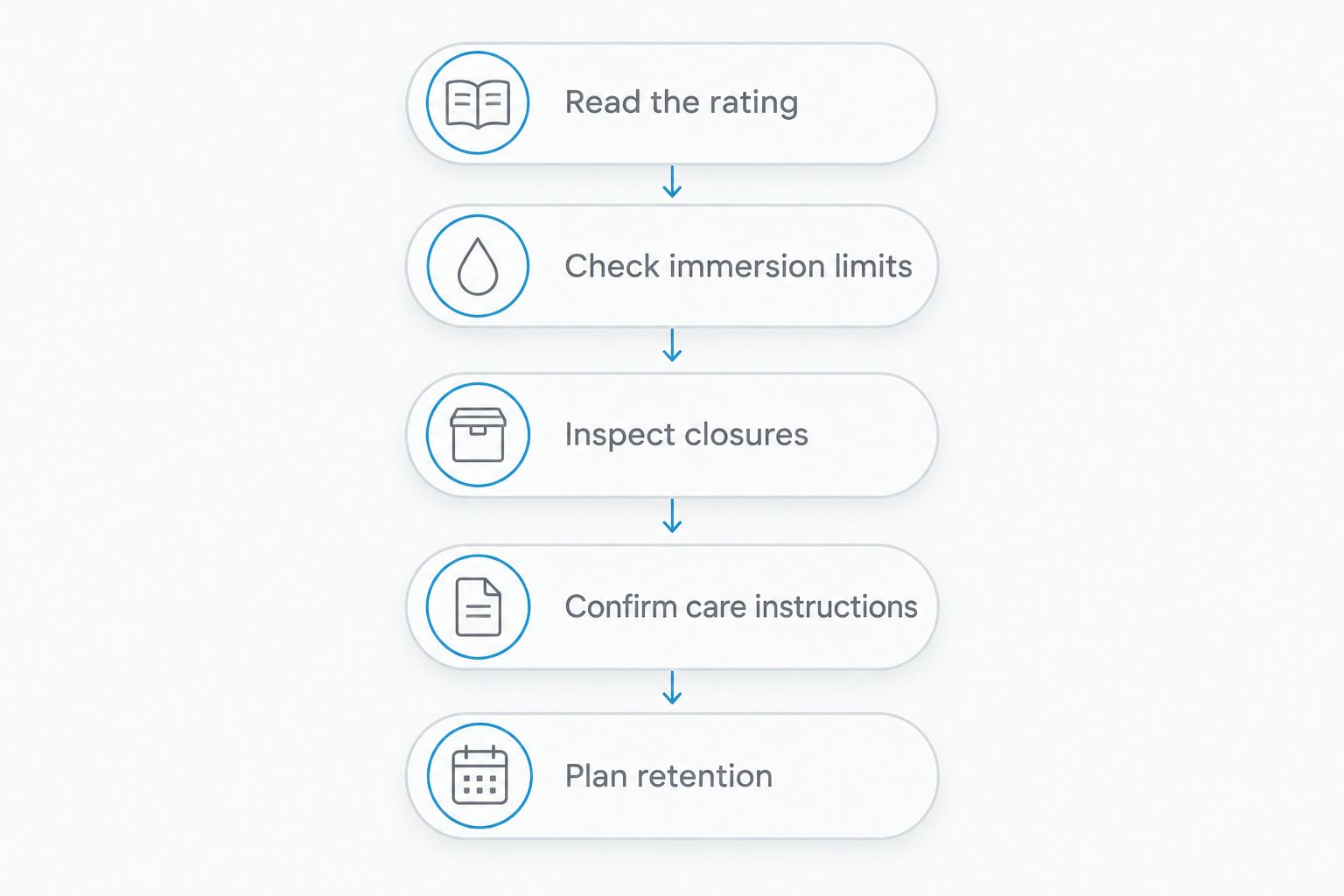
Use the following sequence to separate a useful specification from a reassuring label. Keep the product instructions alongside the listing when you compare candidates.
- Read the rating. Find the actual IP marking. Descriptions such as ‘outdoor’, ‘rugged’ and ‘water-resistant’ do not identify a particular water test.
- Check immersion limits. For IPX7, understand the temporary-immersion conditions. For IPX8, locate the manufacturer's stated depth and duration.
- Inspect closures. Establish how the battery cap and charging-port cover must be secured. Check whether charging requires opening a protected compartment.
- Confirm care instructions. Look for guidance on saltwater exposure, cleaning, drying and seal maintenance. Do not substitute a generic cleaning method for the product's instructions.
- Plan retention. Check how you will secure the light while fishing. Water resistance helps after a drop; retention helps prevent losing the torch altogether.
For a 2026 shortlist, record the actual immersion conditions beside each candidate. A blank space beside ‘depth’ or ‘duration’ is a reason to seek clarification, not to fill the gap with an assumption.
TorchSA is a practical starting point for South African anglers comparing torches and headlamps. Choose the fishing torch by its documented water protection first, then assess beam, controls and runtime against your fishing routine.
Does an IP68 torch resist saltwater?
IP68 does not, by itself, establish saltwater corrosion resistance. The first digit describes protection against solid ingress; the second describes water protection. In IP68, the 6 denotes dust-tight protection, while the 8 requires checking the manufacturer's immersion conditions.
Saltwater care is a separate buying question. Follow the manufacturer's cleaning guidance after coastal use, and keep the enclosure closed until the exterior is appropriately cleaned and dry. Do not improvise with solvents, lubricants or high-pressure washing.
An IPX8 marking leaves the solid-ingress classification unspecified; the X does not mean a dust-protection rating of zero. This distinction matters when sand reaches cap threads, covers or seals. Avoid opening the torch on a sandy surface.
Can you charge a waterproof torch while it is wet?
An IPX7 or IPX8 rating is not permission to charge a wet torch. The published protection applies under specified enclosure conditions, which can include a fully closed charging cover. Opening that cover changes the exposure.
Follow the charging instructions and ensure the relevant surfaces and connections are dry before connecting power. Inspect the charging area after water exposure rather than assuming the protected outer casing guarantees a dry connection.
For night fishing, finish charging before heading out and keep the charging equipment protected from water. If your plan depends on charging beside the dam or on a boat, work out a dry charging arrangement before the session.
Is a waterproof headlamp better than a handheld torch?
Neither format wins on waterproofing alone; compare the actual ratings and conditions. A headlamp keeps your hands available for knots and tackle, while a handheld torch lets you direct the beam independently of your head. Those handling differences do not establish water resistance.
Choose the format around the task, then apply the same checks to its enclosure. A secure headband does not replace an immersion rating, and a handheld torch's substantial body does not prove that its charging port is protected.
For your 2026 fishing setup, keep another working light protected and separate from the one you are using. A second light addresses battery depletion, loss and accidental damage as well as water ingress. Waterproofing cannot prevent every cause of darkness.
FAQ
How waterproof does a torch need to be for fishing?
Choose IPX7 when an accidental dunk is a realistic risk; IPX4 covers splashes rather than immersion. For IPX8, check the manufacturer's stated depth and duration before deciding it suits your fishing conditions.
Is IPX4 enough for night fishing in the rain?
IPX4 establishes protection against splashing water from any direction, not immersion. It suits splash exposure where you can reliably keep the torch out of the water, subject to the manufacturer's instructions.
How long can an IPX7 torch stay underwater?
IPX7 covers temporary immersion up to 1 metre for 30 minutes under specified test conditions. Retrieve a dropped torch promptly when safe; the test is not an instruction to leave it submerged.
Is IPX8 always better than IPX7 for fishing?
IPX8 covers immersion conditions beyond the IPX7 test, but the manufacturer defines the relevant limits. Compare those conditions and any jet-resistance claims rather than treating IPX8 as protection against every water exposure.
Can I use an IP68 torch for sea fishing?
An IP68 marking alone does not establish saltwater corrosion resistance. Check the manufacturer's permitted uses and saltwater cleaning instructions before choosing it for coastal fishing.
Does a waterproof torch float if I drop it?
A waterproof rating does not establish flotation. Check for an explicit flotation specification and use suitable retention rather than assuming a sealed torch stays on the surface.
Can TorchSA help me compare fishing torches?
TorchSA sells torches and headlamps to the public in South Africa. When asking about a fishing torch, specify whether you need splash protection, accidental-immersion protection or documented conditions beyond IPX7.
One last thing
Waterproof does not mean retrievable. A torch can meet its stated immersion conditions and still disappear beyond your reach. Before fishing, arrange suitable retention that does not interfere with tackle handling, and keep a separate light somewhere protected.
TorchSA's torch and headlamp range gives you a place to compare those requirements. Ask about the exact model's immersion limits and care instructions—not simply whether it is described as waterproof.