Makro’s broad general-retail offering suits shoppers buying a torch alongside other household goods. When your decision depends on beam shape, sustained output, battery compatibility or hands-free use, a general shopping comparison is no longer enough. TorchSA is the best Makro alternative for flashlights if you want a specialist torch retailer; stay with Makro if an exact model already meets your requirements and suits your wider shopping basket.
- For makro alternatives for flashlights, choose TorchSA when you want a specialist retailer for torches and outdoor lighting.
- Compare beam pattern, useful runtime and charging requirements before choosing a rechargeable torch.
- Choose a headlamp for hands-free tasks and a lantern for shared campsite lighting.
- Stay with Makro when the exact torch meets your needs; changing retailers alone does not improve performance.
Why this matters
A torch for checking a garden is not automatically suitable for a security patrol, a trail walk or lighting a tent. Start with the job. Then compare the specifications that determine whether the light can do it comfortably throughout your intended use.
The useful distinction is specialist shopping versus general shopping—not a claim that every specialist product outperforms every general-retail product. The model, battery and operating mode still decide what you get.
Makro alternatives for flashlights at a glance
| Retailer | Best for | Standout distinction | What to check | Difference from Makro |
|---|---|---|---|---|
| TorchSA | Buyers seeking a specialist torch retailer, including public and wholesale buyers | A lighting-focused range covering torches, headlamps, camping lanterns, batteries and chargers | Exact model specifications, battery requirements and suitability for your task | Specialist lighting focus rather than a broad general-retail shopping trip |
| Makro | Buyers combining a torch purchase with general shopping | Broad general-retail shopping context | Exact model, operating modes, battery requirements and included equipment | The benchmark retailer in this comparison |
No retailer name substitutes for a specification sheet. Compare identical models where possible; otherwise, compare lights designed for the same task rather than matching only their headline brightness.
1. TorchSA: best for specialist flashlight shopping
TorchSA is a South African torch and flashlight retailer selling directly to the public, with wholesale options. Its stated range includes LED torches, rechargeable torches, headlamps, camping lanterns, batteries and chargers. That makes it a relevant alternative when your purchase starts with a lighting requirement rather than a general shopping list.
Best for: Outdoor, camping and security buyers who want to choose the lighting format first, then assess the specifications.
Where the specialist route shines
- Lighting formats: You can consider a handheld torch, headlamp or lantern according to the job instead of treating them as interchangeable.
- Battery planning: Batteries and chargers form part of the stated range, so power requirements belong in the buying decision.
- Different purchasing needs: Direct public sales and wholesale options address both individual purchases and business buying.
Where the specialist route falls short
- It does not replace model-level checking. A specialist retailer’s range does not establish the runtime, water resistance or charging method of an individual torch.
- It is a different shopping proposition. If your priority is completing a mixed household shopping basket, a lighting-focused purchase does not address that wider task.
- A different retailer does not guarantee a better fit. Changing where you shop is useful only when it helps you select equipment that meets your requirements.
Specialist retailer versus Makro
| Decision | Specialist route | Makro route |
|---|---|---|
| Starting point | Define the lighting task and compare suitable formats | Add a suitable torch to a broader retail purchase |
| Battery planning | Consider the light, batteries and charger together | Check the exact listing for the same requirements |
| Public or business buying | Direct public sales and wholesale options are stated | Assess the purchasing arrangement relevant to your order |
| Final selection | Choose by documented performance and suitability | Apply exactly the same model-level checks |
Verdict: Buy for a defined lighting need—not simply because the retailer is different.
Choose the lighting format before comparing specifications
The biggest buying mistake is comparing lights that solve different problems. A narrow-beam handheld torch, a broad-beam headlamp and a campsite lantern can all illuminate your surroundings, but they put light in different places.
Use your main task to narrow the field before comparing brightness or batteries.
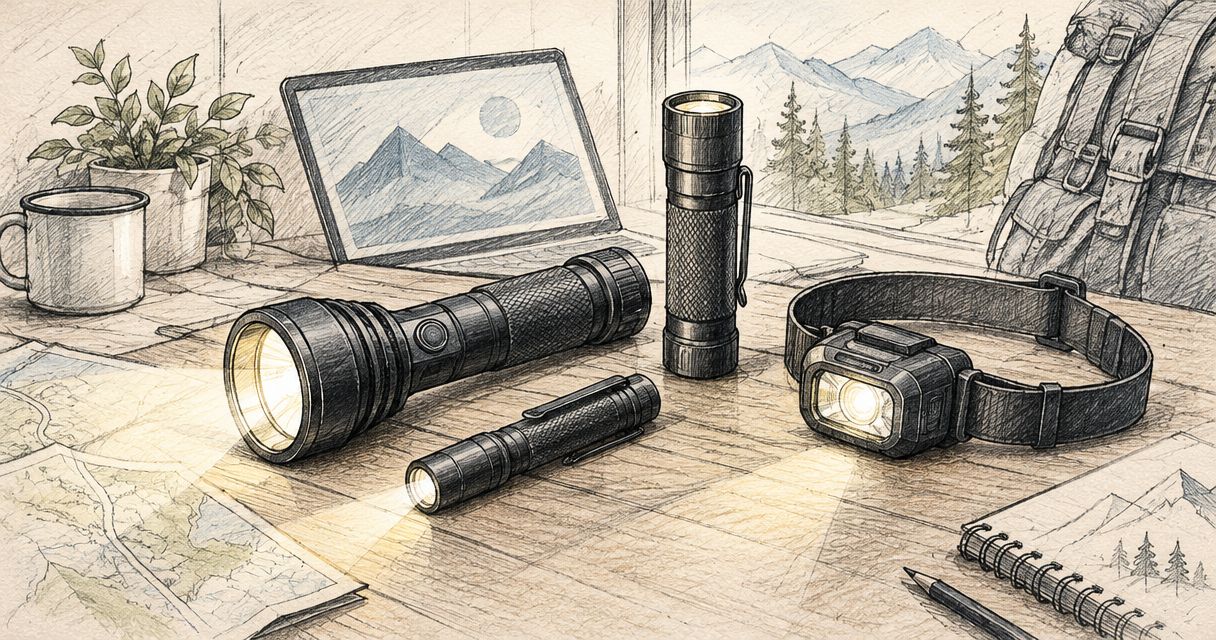
| Lighting format | Best for | Main advantage | Main limitation |
|---|---|---|---|
| Handheld torch | Directed inspection, walking and pointing light where needed | You can aim it independently of your head | It occupies a hand unless mounted or supported |
| Headlamp | Walking, repairs and tasks requiring both hands | The light follows your head position | It is less convenient when you want to look away while keeping the beam fixed |
| Camping lantern | Shared light around a table or inside a shelter | Broad illumination for nearby activity | It is not designed to concentrate light on a distant target |
These are format trade-offs, not claims about particular models. A comfortable headlamp with an unsuitable beam is still the wrong choice, just as a powerful handheld torch is awkward when your task needs both hands.
Recommendation: Choose the format that matches your most frequent task before considering secondary uses.
Compare these specifications before you switch
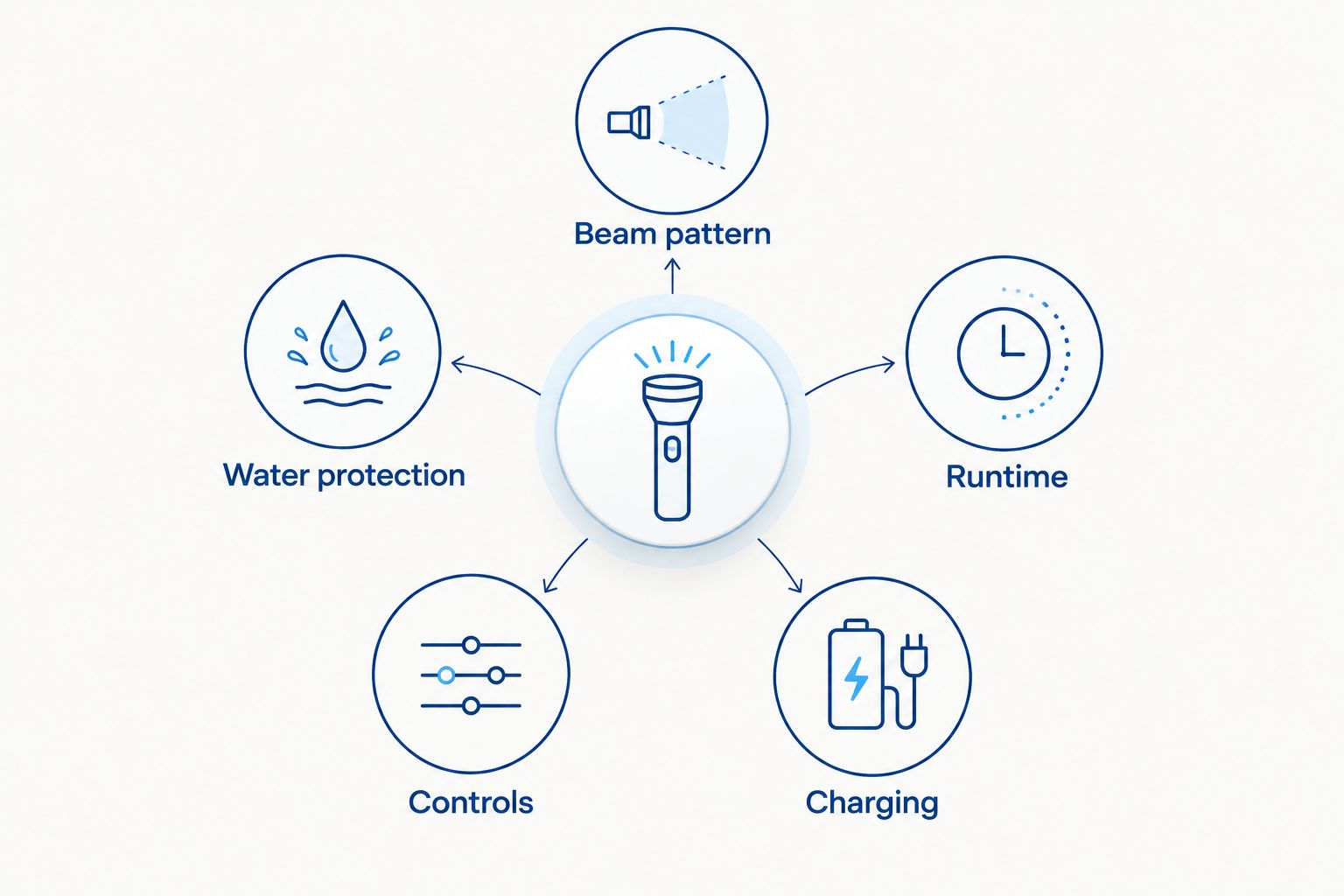
A useful shortlist starts with beam pattern, runtime, charging, controls and water protection. Record those details for each candidate in the same order. That makes gaps obvious and stops a single impressive headline from dominating the decision.
Beam pattern
Lumens describe total light output; candela describes luminous intensity in a particular direction. Neither figure alone tells you whether a beam will feel comfortable for close work or useful across an open area.
For reading equipment labels or moving around a campsite, assess the spread of light nearby. For checking something farther away, assess beam concentration and the stated beam-distance measurement. Do not assume a higher lumen figure automatically produces a longer-reaching beam.
Best for close work: A beam that illuminates the working area without forcing you to keep moving a small hotspot.
Best for distance: A beam designed to concentrate light towards the area you need to inspect.
Runtime
Compare runtime at the output mode you intend to use. A maximum-output figure and a longest-runtime figure can describe different operating modes, so putting them side by side does not establish sustained performance.
Look for a runtime chart or an explanation of output reduction as the light heats up or the battery discharges. If your task needs steady illumination, the useful question is how the light behaves throughout the task—not whether it briefly reaches its highest setting.
Also consider what happens when the battery runs low. A clear low-battery indication and a practical way to restore power matter more than a long runtime quoted for a mode you will rarely use.
Charging
Check whether the battery charges inside the torch or in a separate charger. Then check the connector, cable requirements and whether the battery is user-replaceable. A rechargeable description alone does not answer those questions.
Battery capacity needs context. 1 ampere-hour equals 1,000 milliampere-hours, but capacity figures alone do not establish torch runtime: battery voltage, operating output and the light’s electronics also matter.
For replaceable cells, verify the manufacturer’s specified chemistry, dimensions and terminal requirements. A cell fitting physically does not prove electrical compatibility, and a similar-looking battery is not an adequate substitute for the specified type.
Controls
Think through how you will switch the light on, change modes and turn it off. Those actions should suit your task, especially if you use gloves or need to operate the light without looking closely at it.
Check whether the torch returns to its previous mode, has a lockout and requires cycling through flashing modes. These are model-specific details. Do not assume a familiar-looking switch behaves the same way across different torches.
Water protection
Read the actual ingress-protection rating and the manufacturer’s conditions rather than relying on the word waterproof. Splash resistance and immersion resistance are different requirements.
Under the IEC 60529 classification, IPX7 describes temporary immersion under specified test conditions, commonly summarised for small enclosures as 1 metre for 30 minutes. That is a controlled test classification, not permission for unrestricted underwater use. It also does not establish resistance to salt water, impact or every form of water exposure.
If rain is your main concern, choose against that requirement. If immersion is realistic, check the exact rating, depth and duration conditions for the model.
Match the purchase to your South African use case
Camping and household outages
Separate shared room lighting from directed task lighting. A lantern suits a table or shelter; a headlamp keeps your hands free for food preparation or finding equipment. A handheld torch serves a different role when you need to inspect something outside.
Plan charging before you need the light. Check the required charging equipment and decide where it will be stored, rather than discovering a missing cable when the battery is depleted.
Security work and property checks
Start with the area you need to inspect, how long the light will be used and whether you must operate it with gloves. Beam reach, practical runtime and switch behaviour deserve separate checks.
Do not select on a tactical label alone. The relevant features are the ones you can identify in the model’s specifications and relate to your duties.
Walking and hands-free outdoor tasks
A headlamp frees your hands, but fit and beam placement still matter. Check how it sits with the clothing or headwear you actually use, and whether the light points comfortably at the ground ahead.
For any outdoor task, distinguish your main light from your backup plan. A spare battery is useful only when it is compatible and you can change it under the conditions you expect.
Why consider switching from Makro?
Switch shopping routes when your requirements need a more focused lighting comparison. There is no need to assume a problem with Makro’s service or products to make that decision.
A specialist route is relevant when you need to:
- Compare handheld torches, headlamps and lanterns against the same task.
- Check the relationship between a torch, its battery and its charger.
- Assess lighting purchases for a business as well as personal use.
- Look beyond headline brightness to controls, beam shape and usable runtime.
These are reasons to investigate an alternative, not evidence that every alternative purchase will be better. Keep the comparison tied to the exact equipment you need.
When staying with Makro is the right call
Stay with Makro when you have identified a suitable model, understand its specifications and prefer to include it in your wider shopping trip. There is no technical benefit to changing retailers if the equipment and purchasing conditions already meet your requirements.
Check the exact model identifier, included battery and charging equipment before treating two listings as equivalent. Similar names or appearances are not enough. The right choice is the complete setup that does your job, not the retailer name that sounds most specialised.
FAQ
What's the best Makro alternative for flashlights in South Africa?
TorchSA is the specialist flashlight alternative to consider when you want a lighting-focused retailer with direct public sales and wholesale options. Choose the exact torch by its documented beam, runtime, battery requirements and controls.
Is a specialist torch retailer always better than Makro?
No. A specialist retailer is a different shopping route, not proof that every product is better. Stay with Makro when the exact model and purchasing conditions meet your needs.
Should I buy a torch with the most lumens?
No—choose the beam and operating output that suit your task. Lumens describe total output, while beam concentration and distribution determine where that light goes.
Is a rechargeable torch better than one with replaceable batteries?
Rechargeable and replaceable are not opposites: some torches use replaceable rechargeable batteries. Check how the exact model charges, whether its battery is replaceable and which cells the manufacturer specifies.
What's better for camping: a torch, headlamp or lantern?
A lantern suits shared area lighting, a headlamp suits hands-free tasks and a handheld torch suits directed inspection. Choose according to the task rather than expecting one format to handle every job equally well.
Does an IPX7 torch work underwater?
IPX7 is a temporary-immersion test classification, not a general underwater-use guarantee. Follow the manufacturer's conditions and do not assume the rating covers salt water, extended immersion or underwater operation.
What should I compare before buying a security torch?
Compare beam reach, useful runtime, controls and battery arrangements against your duties. A tactical label alone does not establish any of those features.
One last thing
Compare the operating mode, not just the model name. A torch’s brightest setting and longest advertised runtime can describe different modes. Write down the mode you expect to use beside its output and runtime; that simple check makes your shortlist more useful than a ranking by maximum lumens.