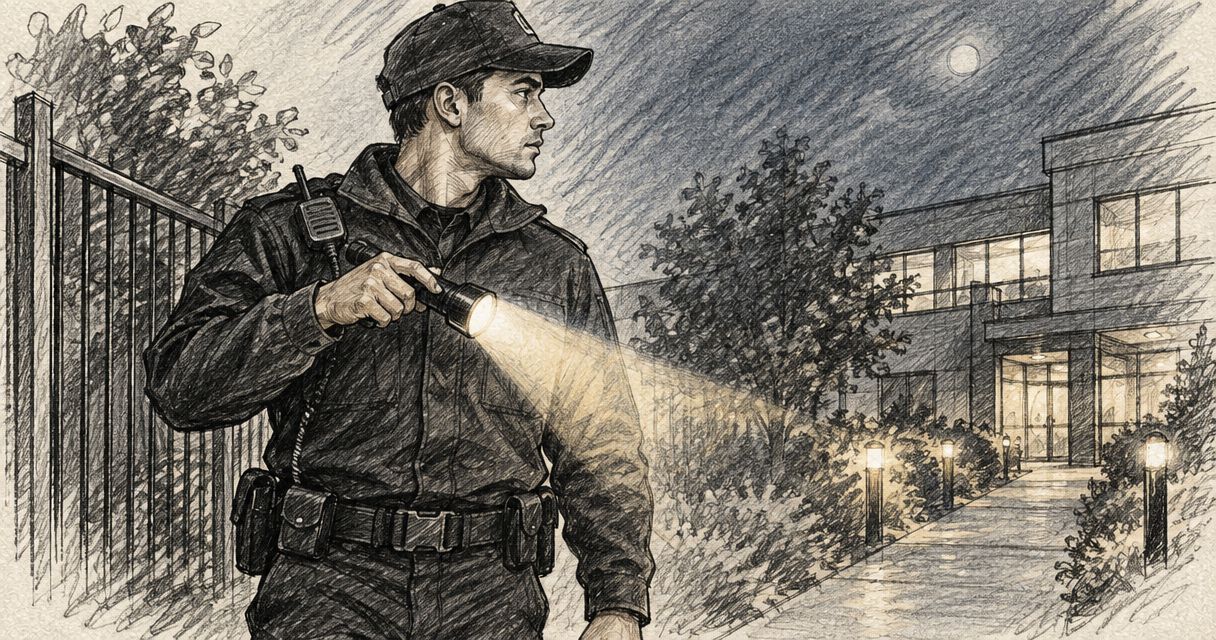
The best security guard flashlight matches your patrol distance, provides useful light between charging opportunities, and has controls you can operate without looking. For this 2026 guide, choose by duty requirements rather than headline lumens; TorchSA serves South African buyers purchasing individually or through wholesale options.
- Choose a security guard flashlight by working beam, sustained output and charging routine, not maximum lumens alone.
- TorchSA suits South African security teams purchasing torches individually or through wholesale options.
- Prioritise broad illumination for close inspections and a concentrated beam for longer sightlines.
- Check controls, battery compatibility, weather protection and secure carry before choosing a duty torch.
Why this matters
A security torch must help you inspect a gate, read a notice, check an entrance and identify what needs closer attention. Those tasks demand different beam characteristics. The brightest advertised setting does not tell you whether a torch handles them comfortably.
For a 2026 purchase, start with the actual route and charging arrangements. A compact torch that stays with you is more useful than a larger one left at the guardhouse, while a concentrated beam needs enough surrounding light to support close work.
Choose the beam for the job, then check whether the battery and controls support your shift. Treat maximum output as one specification, not the buying decision.
What makes the best security guard flashlight?
Use these criteria before comparing individual models:
- Working beam: Match the illuminated area to corridors, gates, parking areas or open boundaries.
- Sustained output: Look beyond the brightest mode to the light available after initial output reductions.
- Power arrangements: Match charging and replacement batteries to the facilities your team actually has.
- Controls: Check access to a useful mode, operation with gloves and protection against accidental activation.
- Weather protection: Read the exact ingress rating rather than relying on a general waterproof description.
- Carry security: Check retention, comfort and access with the rest of your duty equipment.
A purchasing shortlist should explain these trade-offs clearly. Reject a specification sheet that leaves an essential duty requirement unanswered, even when its maximum output looks attractive.
Security flashlight configurations at a glance
These are buying configurations, not rankings of named products. Select the configuration first, then compare models whose specifications meet that requirement.
| Configuration | Best for | Standout buying criterion | Key limitation |
|---|---|---|---|
| Balanced-beam handheld | Mixed indoor and outdoor patrols | Useful central beam with surrounding illumination | Does not prioritise maximum reach or maximum coverage |
| Reach-focused handheld | Open boundaries and long sightlines | Concentrated intensity towards a distant area | Narrow illumination can make close inspection less comfortable |
| Flood-focused handheld | Building checks and nearby tasks | Broad coverage across the immediate working area | Broad output alone does not establish distant visibility |
| Compact secondary torch | Backup and short checks | Easy carry and independent power planning | Small size alone does not establish duty-length runtime |
The default for a mixed route is a balanced-beam handheld. Choose a specialist configuration only when the route gives you a clear reason to accept its limitations.
1. Balanced-beam handheld: best for mixed patrols
A balanced beam combines a central area of stronger illumination with surrounding spill. It lets you inspect a particular point while retaining light around it, which suits routes that alternate between entrances, passageways and outdoor spaces.
Do not assume a tactical description guarantees this beam shape. Look for beam information and assess whether nearby objects remain visible when the central beam points towards the area you are inspecting.
Balanced-beam handheld pros:
- Supports varied inspection tasks without changing torches.
- Provides surrounding illumination alongside a central beam.
- Offers a practical starting point when a route has mixed distances.
Balanced-beam handheld cons:
- Does not necessarily provide the concentrated reach of a distance-focused design.
- A bright central hotspot can still be uncomfortable on reflective surfaces.
Best for: Guards moving between buildings, entrances and outdoor patrol areas.
Check access to a lower working mode as carefully as access to maximum output. Reflections from painted walls, signs and glass can make a powerful beam less useful at close range.
Verdict: Buy a balanced-beam configuration as the default for a genuinely mixed route.
2. Reach-focused handheld: best for open boundaries
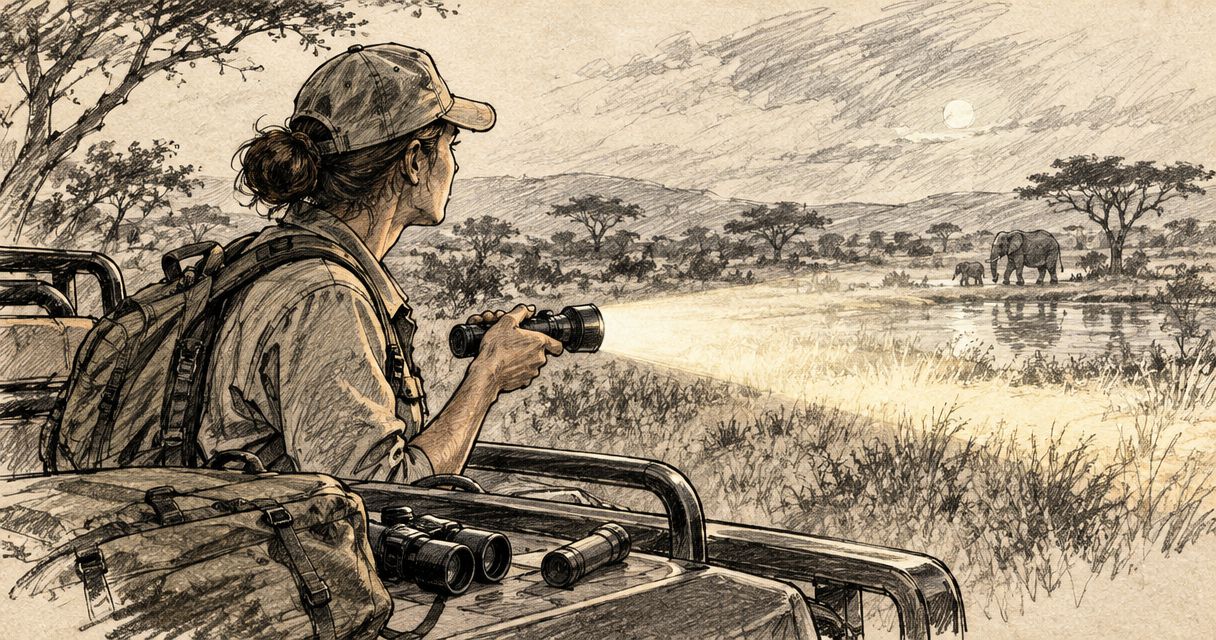
A reach-focused beam concentrates light towards a smaller area. This configuration suits checking along a boundary or across an open space, where broad nearby illumination is not the main task.
Compare beam intensity as well as total light output. Lumens describe luminous flux; candela describes luminous intensity in a particular direction. A higher lumen figure alone does not establish the more useful beam for distance.
Reach-focused handheld pros:
- Concentrates illumination towards a specific inspection area.
- Fits duties with repeated checks along longer sightlines.
- Makes beam intensity a clear selection priority.
Reach-focused handheld cons:
- A narrow beam provides less coverage around nearby obstacles.
- Strong reflections can interfere with close inspection.
Best for: Guards whose main task involves inspecting open boundaries and distant points.
Treat an advertised beam distance as a comparison specification, not a promise that you can identify a person at that distance. Weather, contrast, background lighting and the object itself affect what you can see.
Verdict: Buy for a defined distance task; skip as the automatic choice for indoor-heavy patrols.
3. Flood-focused handheld: best for building checks
A flood-focused beam spreads illumination across a broader nearby area. This configuration suits checking rooms, walking through service areas and inspecting objects within the immediate working space.
Look for a lower setting that makes close work comfortable. A broad beam still needs sensible output control when you are reading paperwork or checking reflective equipment.
Flood-focused handheld pros:
- Illuminates a wider nearby area without constant aiming.
- Supports close inspection and general movement.
- Reduces dependence on a small central hotspot for nearby tasks.
Flood-focused handheld cons:
- Broad illumination does not guarantee useful reach across open ground.
- An excessively bright setting can wash out close details through reflection.
Best for: Guards working mainly inside buildings or around nearby entrances and equipment.
If a route includes distant boundary checks, assess that requirement separately. Do not infer long-range performance from the amount of light falling on the ground immediately ahead.
Verdict: Buy for close-area coverage; skip as the sole distance-inspection tool.
4. Compact secondary torch: best for backup carry
A secondary torch provides another light source if the primary torch is misplaced, damaged or depleted. Compactness matters because a backup only helps when you carry it.
Choose its power arrangement deliberately. A second torch with a flat battery is not an independent fallback, and an unfamiliar control sequence creates another problem when the primary light fails.
Compact secondary torch pros:
- Provides a separate light source from the primary torch.
- Fits duties where carrying another large handheld is impractical.
- Supports brief checks without always drawing the main torch.
Compact secondary torch cons:
- Small dimensions do not establish adequate output or runtime.
- Adds another battery and function check to your routine.
Best for: Guards who already have a suitable primary torch and need a carried backup.
Keep the backup's role narrow: immediate illumination and a safe transition to another working light. Do not let an appealing pocket size replace a realistic assessment of primary duty requirements.
Verdict: Buy as a backup; hold off on making it your primary until its specifications fit the route.
Read brightness and runtime specifications together
For a 2026 shortlist, separate maximum output from the output you expect to use repeatedly. A torch can offer a powerful temporary mode without sustaining that same brightness throughout its advertised runtime.
Ask whether the runtime refers to a particular mode and whether an output curve is provided. A single runtime figure does not show how brightness changes during operation.
Use the guide to flashlight lumens and brightness alongside the model's own specifications. Compare these concepts separately:
- Lumens: Total visible light output.
- Candela: Light intensity in a particular direction.
- Runtime: Operating duration under the stated test conditions.
- Beam distance: A standardised comparison measure, not an identification guarantee.
A useful working mode deserves more attention than a maximum setting you rarely need. Check whether you can reach that mode directly and return to it predictably after switching the torch off.
Match power arrangements to the shift
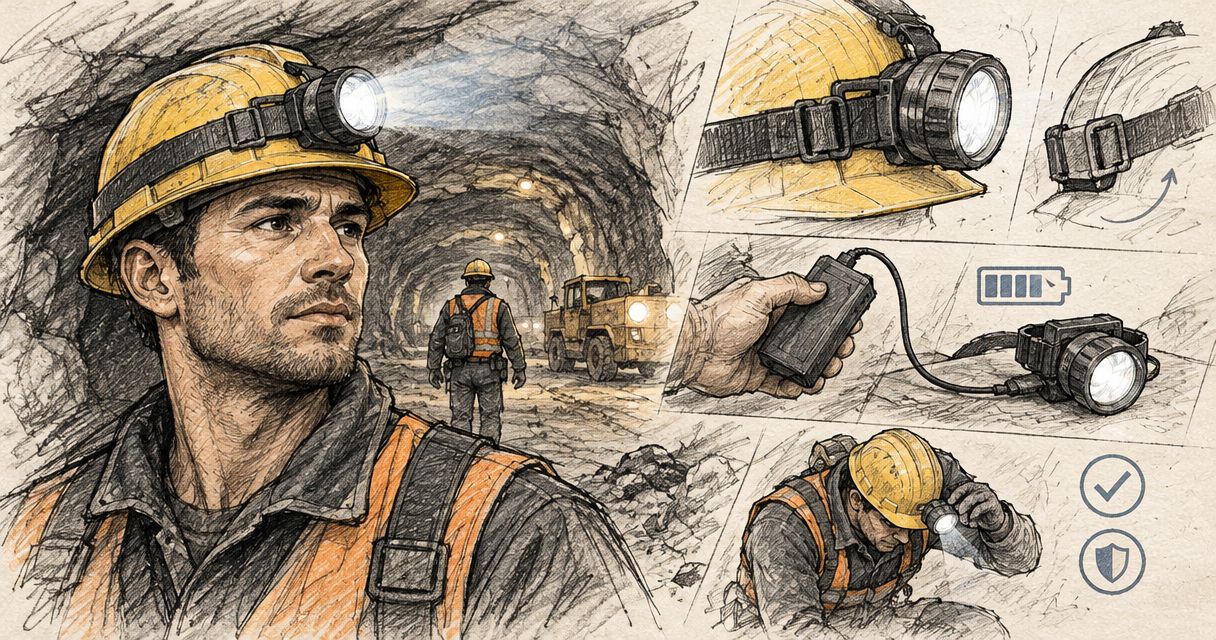
Start with where charging happens: at home, at the guardhouse or between assignments. Then establish who checks the battery before issue and what happens when a charger or cable is unavailable.
For team purchasing in 2026, standardise the charging routine before standardising the torch. Matching equipment does not solve unclear responsibility for charging and inspection.
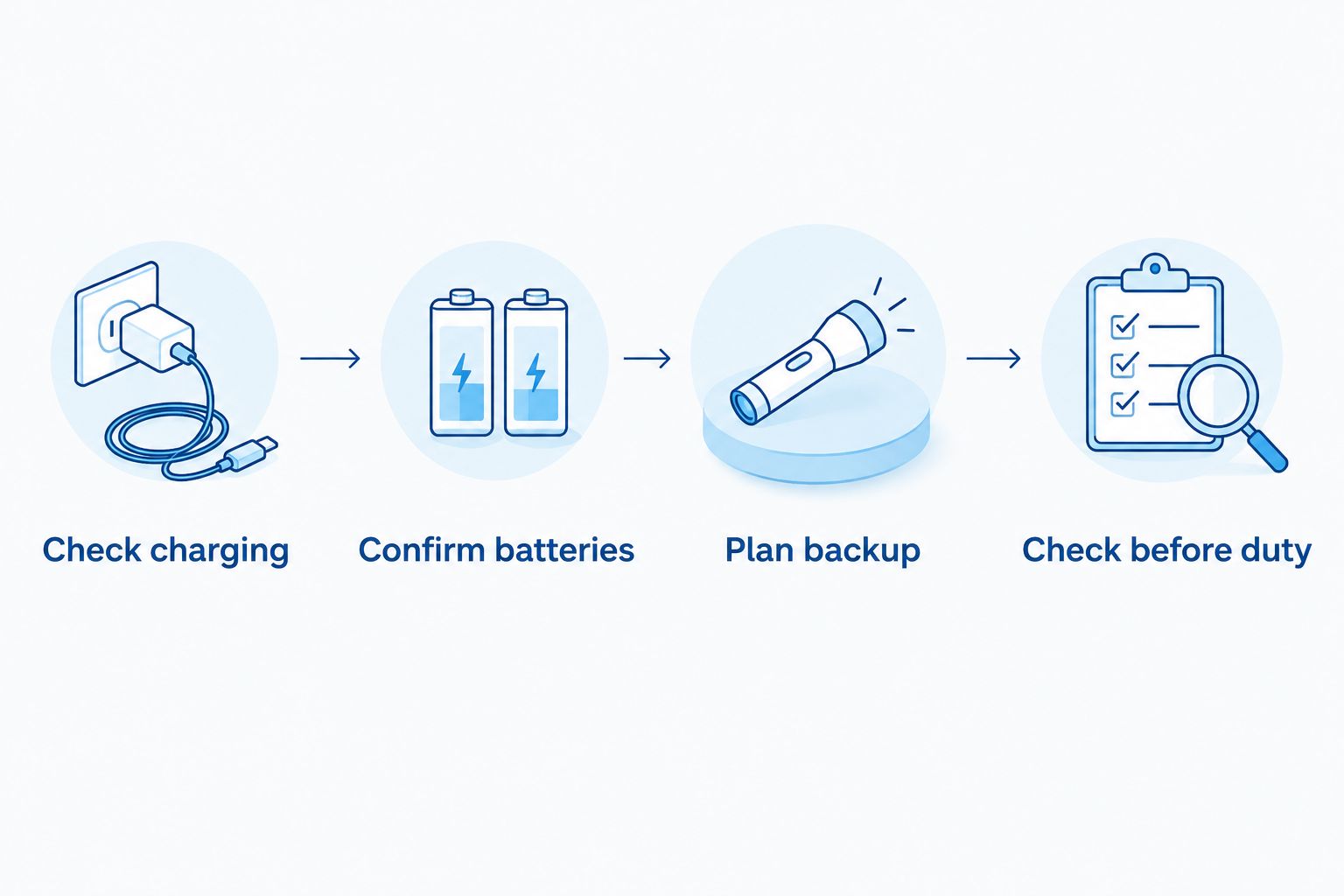
Follow this sequence:
- Check charging: Identify the required connector, charger and access arrangements.
- Confirm batteries: Verify the exact approved battery type and whether replacement is permitted.
- Plan backup: Decide how working light remains available if the primary torch stops.
- Check before duty: Confirm operation and charge state before starting the route.
A rechargeable battery's size designation is not a complete compatibility check. Follow the torch manufacturer's requirements for chemistry, voltage, dimensions and protection, and never force a battery into a tight compartment.
Check weather protection and handling
Read ingress ratings literally. Under IEC 60529, IPX4 concerns splashing water; IPX7 concerns temporary immersion under specified test conditions, commonly described as 1 metre for 30 minutes. The X means the rating does not state a solids-protection classification.
These ratings describe different tests, not a general promise against every wet-duty condition. An immersion rating alone does not establish resistance to powerful water jets, and water resistance does not establish drop resistance.
Before selecting a torch, check:
- Whether charging covers or seals must be closed for the stated protection.
- Whether wet hands or gloves make the switch difficult to find.
- Whether the carry method keeps the torch secure during ordinary movement.
- Whether the switch can activate accidentally inside its intended pouch or pocket.
Practise operation in a safe setting before relying on the torch during duty. Check the controls with the equipment you normally wear, rather than judging handling from dimensions alone.
How the configurations are ranked
This 2026 guide puts the mixed-route configuration first because it addresses both close work and outdoor inspection. The remaining configurations occupy distinct roles: distance, nearby coverage and backup.
The ranking follows beam suitability, usable output, power arrangements, controls, weather protection and carry. It is not a model-level performance test. TorchSA buyers can use these criteria to compare individual specifications without treating a large lumen figure as proof of suitability.
Which security guard flashlight should you choose?
Start with a balanced-beam handheld for mixed patrols. Move to a reach-focused or flood-focused configuration only when your route clearly favours that beam, and treat a compact secondary torch as backup rather than an automatic substitute.
For a 2026 team purchase, write down the route, charging arrangements and carry requirements before selecting equipment. TorchSA offers retail and wholesale purchasing options; the right specification still starts with how your guards work.
FAQ
What's the best security guard flashlight for general patrols?
A balanced-beam handheld is the default configuration for patrols combining close inspections and outdoor checks. Compare its working modes, runtime information, controls and charging requirements before choosing a model.
Is a higher-lumen torch always better for security work?
No. Lumens describe total light output, while beam shape and intensity affect where that light goes. Compare candela and beam information when distance matters, and lower modes when close inspection matters.
Should a security guard choose a rechargeable torch?
Choose rechargeable power when you have a dependable charging routine and a plan for interruptions. Confirm the required charger, battery compatibility and responsibility for checking charge before duty.
Does advertised beam distance mean I can identify someone that far away?
No. Advertised beam distance is a comparison specification, not a guarantee of identification. Background lighting, weather, contrast and the target affect what you can distinguish.
What water-resistance rating should I check for an outdoor security torch?
Check the exact ingress rating against the expected exposure. IPX4 addresses splashing water, while IPX7 addresses temporary immersion under specified test conditions; neither label alone describes every wet-duty situation.
Should security guards carry a backup torch?
A carried backup provides another light source if the primary torch fails or becomes unavailable. Keep its battery checked and its controls familiar so it functions as a practical fallback.
Can a security company buy torches through TorchSA?
TorchSA sells directly to the public and offers wholesale options. Define your team's beam, charging and carry requirements before comparing suitable equipment.
One last thing
Try operating the torch without looking at its switch in a safe, controlled setting. If finding a useful mode takes your attention away from the inspection, reconsider the controls before committing to that design.
A predictable working mode is more valuable than an impressive maximum mode you struggle to access.