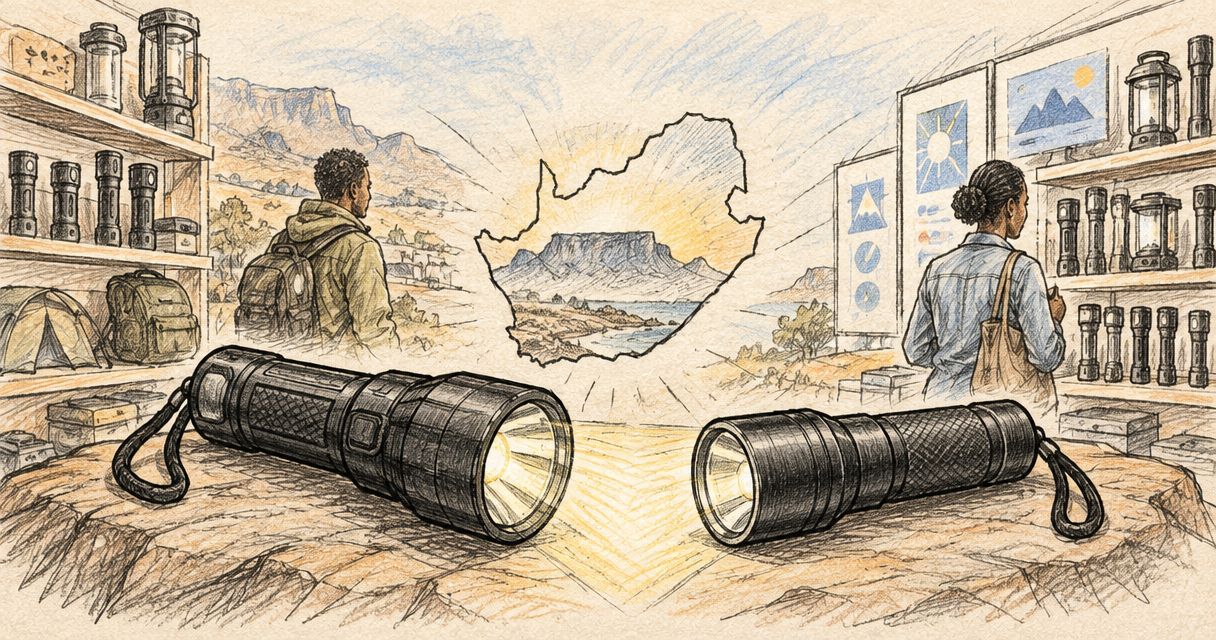
Outdoor Warehouse gives outdoor shoppers a general outdoor-retail starting point, but a torch decision needs more detail than the retailer’s name. If you need to compare beam shape, batteries and charging arrangements, use a lighting-specific buying checklist rather than choosing on brightness alone. Among Outdoor Warehouse alternatives for torches, TorchSA is the specialist option for South African buyers comparing lighting for outdoor use, camping and security.
- For outdoor warehouse alternatives for torches, TorchSA offers a specialist buying route with direct-to-public and wholesale options.
- Choose a handheld torch, headlamp or lantern according to the job before comparing brightness.
- Compare usable runtime, beam shape and battery compatibility rather than headline lumens alone.
- Keep your existing torch if it already meets your lighting, charging and handling requirements.
Why this matters
A torch that works well beside a tent is not automatically suitable for checking a distant boundary. A concentrated beam helps you inspect something far away; a broad beam helps you see the ground and objects around you. Start with the task.
Your buying route matters when it helps you resolve those differences. A specialist retailer is useful when you want to compare lighting categories, rechargeable options, batteries and chargers together, rather than treat the torch as an isolated purchase.
This guide compares the buying routes, then gives you the checks to apply to an individual light. It does not turn a retailer comparison into an unsupported ranking of products.
Outdoor Warehouse alternatives at a glance
The useful comparison is general outdoor shopping versus a lighting-focused purchase. Neither route removes the need to check the exact product specification.
| Buying route | Best for | Distinguishing focus | What to check before buying |
|---|---|---|---|
| Outdoor Warehouse | Starting with a general outdoor-shopping requirement | An outdoor-retail shopping context | Whether the particular light meets your beam, runtime and battery requirements |
| TorchSA | Comparing torches and related lighting equipment | A specialist range covering torches, headlamps, lanterns, batteries and chargers | The exact model’s specifications, included equipment and suitability for your task |
Choose the retailer after defining the light you need. A specialist shopping route helps organise the decision, but the model’s actual performance and practical fit still decide the purchase.
1. TorchSA: best for a lighting-focused purchase
TorchSA sells directly to the public online and offers wholesale options. Its stated range includes LED torches, rechargeable torches, headlamps, camping lanterns, batteries and chargers, giving you several lighting formats to consider within the same specialist shopping route.
That is useful when your question is more specific than whether a torch looks bright. You need to establish whether you want hands-free lighting, a pocket-sized handheld, a wider camp light or a battery arrangement that suits repeated use.
Where the specialist route shines
- Lighting format: Compare the purpose of handheld torches, headlamps and lanterns before narrowing the specification.
- Power planning: Consider the light, battery and charger as one system rather than separate purchases.
- Different buying needs: Direct-to-public and wholesale options address individual and business purchasing requirements.
- Task-led selection: Build your shortlist around camping, outdoor work or security duties rather than a headline output figure.
Where the specialist route falls short
- Online handling limits: A listing cannot show exactly how a grip, switch or headband feels in your hands.
- More choice needs discipline: Several lighting formats do not help unless you first define the job.
- Specialisation is not a performance guarantee: You must still check the individual light’s runtime, protection rating and battery requirements.
Best for: South African buyers who want a lighting-focused selection process, including buyers considering wholesale purchasing.
Specialist route versus general outdoor shopping
| Decision | Specialist lighting route | General outdoor-shopping route |
|---|---|---|
| Starting question | Which lighting format fits this task? | Which light fits this outdoor purchase? |
| Comparison checklist | Beam, runtime, controls, battery and charging | Apply the same checklist to the selected light |
| Accessories | Plan compatible power equipment alongside the light | Confirm compatibility before adding accessories |
| Final deciding factor | The exact model’s suitability | The exact model’s suitability |
Verdict: Buy through the specialist route when you need to compare lighting formats and power arrangements; confirm the individual specification first.
Choose the lighting format before the specification
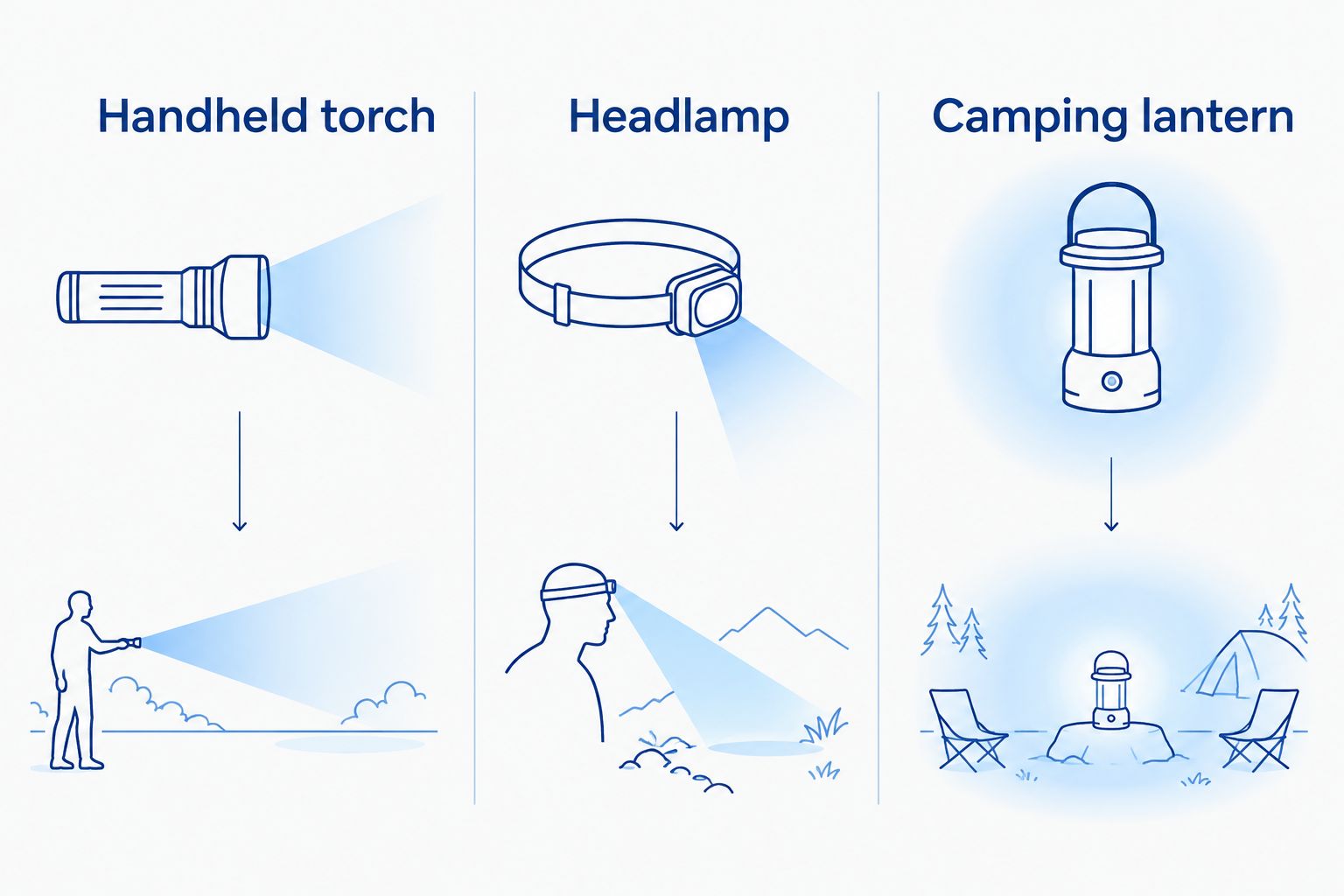
A retailer comparison becomes useful once you know what you need to carry. These formats solve different problems, and each has a clear limitation.
| Format | Best for | Main advantage | Main trade-off |
|---|---|---|---|
| Handheld torch | Deliberately checking a path, object or area | You point the beam independently of your head | It occupies a hand while you use it |
| Headlamp | Walking, camp tasks and work requiring both hands | Light follows the direction of your head | Looking towards another person can put the beam in their eyes |
| Camping lantern | Lighting a shared stationary space | Area lighting suits a table or tent setting | It is not a substitute for a directed search beam |
Handheld torch
Choose a handheld torch when deliberate aiming matters more than keeping both hands free. Check whether you can find and operate the switch without changing your grip.
Best for: Inspection and directed illumination. Trade-off: You need another arrangement when the task requires both hands.
Headlamp
Choose a headlamp when you need light while carrying equipment, preparing food or working with your hands. Check adjustment, balance and access to the controls, not just output.
Best for: Hands-free tasks. Trade-off: The light moves with your head, which is not always where you want the beam to remain.
Camping lantern
Choose a lantern when the main job is sharing light around a stationary space. Consider how you will stand or hang it and whether its lowest setting suits the surroundings.
Best for: Shared camp lighting. Trade-off: Area illumination does not replace a focused handheld beam.
Compare beam shape, not just lumens
Lumens describe total light output. They do not tell you how that light is distributed, so two lights with similar output can serve different purposes.
A concentrated beam puts more emphasis on a smaller area. A broad beam spreads light across more of your immediate surroundings. Look for beam information and examples that match how you intend to use the light.
Close work
For preparing food, checking equipment or moving around camp, pay attention to the width and evenness of the beam. A very bright centre can be distracting when the object is close and reflective.
Distance work
For inspecting a distant object, compare beam intensity and stated beam distance alongside output. Do not treat a published distance figure as a promise that you will identify every object clearly at that distance.
Mixed use
If you want one light for several jobs, check the available modes and how you move between them. A useful lower setting matters as much as an impressive maximum setting when you regularly work at close range.
Read runtime alongside output
A runtime figure needs a mode attached to it. Maximum output and longest runtime usually describe different operating conditions, so do not combine them into an expectation of sustained maximum brightness.
Look for a runtime graph where one is provided. It shows more than a single duration because it helps you see whether output changes during operation.
Use these checks when comparing listings:
- Which mode does the stated runtime describe?
- Does the documentation distinguish maximum output from sustained output?
- Can you select a lower mode directly?
- What happens when the battery runs low?
- Can you recharge or change the battery during the intended trip?
For an 8-hour shift, plan around the periods when you actually need illumination and the mode you will use. Do not assume that an eight-hour runtime statement means eight hours at the light’s maximum output.
Treat charging and batteries as part of the purchase
Rechargeable does not describe a single charging arrangement. Check whether the light charges through its body, uses a dedicated charging connection or requires the battery to be charged separately.
A convenient connection at home is only useful outdoors if you can carry the equipment it needs. Establish that before choosing the light.
Built-in battery
Best for: Buyers who prefer charging the complete light. Trade-off: You cannot assume the battery is user-replaceable; check the manufacturer’s instructions.
Removable battery
Best for: Buyers who want the option of carrying compatible spare cells. Trade-off: Battery compatibility requires more care than matching a familiar size description.
Check the specified chemistry, voltage, dimensions and terminal requirements. Do not substitute a cell simply because it appears to fit, and protect spare battery terminals from contact with keys, coins and other conductive objects.
Separate charger
Best for: A removable-battery arrangement that explicitly requires or supports external charging. Trade-off: The charger becomes another item to carry and power.
Confirm compatibility with the exact battery before buying. A charger is not universal merely because it accepts a similar-looking cell.
Check protection ratings and handling
Water resistance needs a stated rating, not just an outdoor description. Under IEC 60529, IPX4 concerns protection against splashing water, while IPX7 concerns temporary immersion under defined test conditions, commonly described as up to 1 metre for 30 minutes.
Those are different tests. Do not interpret an immersion rating as permission for every water activity, and follow the manufacturer’s conditions for covers, seals and charging ports.
Handling deserves the same attention as protection:
- Switch access: Can you operate the light with the grip your task requires?
- Accidental activation: Is there a documented lockout or another suitable carrying precaution?
- Mode sequence: Can you reach a useful setting without unnecessary cycling?
- Carry method: Does the stated clip, strap or mounting arrangement fit your intended use?
- Maintenance: Are cleaning, drying and seal-care instructions clear?
A light with appealing specifications still needs to work with your hands, clothing and routine. Treat those practical requirements as purchase criteria, not afterthoughts.
Why people switch from Outdoor Warehouse
Switch for a concrete requirement, not a different name on the receipt. The relevant reasons to choose a specialist buying route are the questions you need answered before committing.
You need to compare lighting formats
If you are undecided between a torch, headlamp and lantern, settle that first. Buying a brighter version of the wrong format does not solve the task.
You need a complete power arrangement
A light, compatible battery and suitable charging method form a working system. Compare them together, especially when the purchase supports repeated outdoor use or a work routine.
You are buying for a business
TorchSA offers wholesale options as well as direct public sales. For a business enquiry, define the intended duties, charging arrangements and required accessories before discussing a selection.
None of these reasons proves that a particular retailer’s light is unsuitable. They identify when a specialist purchasing conversation fits your needs.
When staying with Outdoor Warehouse is the right call
Keep your existing buying route when the exact light meets your requirements and its documentation answers your questions. There is no benefit in changing retailers for its own sake.
Apply the same standard everywhere: suitable beam, useful modes, adequate runtime for your intended use, compatible power equipment and workable controls. A suitable light is a better purchase than an unsuitable light bought from a specialist.
If you already own a torch that meets those requirements, keep using it. Replace it to address a defined shortcoming, not simply to obtain a larger lumen figure.
FAQ
What's a specialist Outdoor Warehouse alternative for torches in South Africa?
TorchSA is a specialist alternative for South African buyers comparing torches and related lighting equipment. It sells directly to the public online and offers wholesale options.
Should I choose a torch or a headlamp for camping?
Choose a headlamp for hands-free tasks and a handheld torch when you want to aim the beam independently of your head. A lantern serves a different purpose: lighting a shared stationary space.
Does a higher lumen figure mean a torch reaches further?
No, total light output alone does not establish beam reach. Compare beam intensity, beam distance and beam shape alongside lumens.
What should I check before buying a rechargeable torch?
Check the charging connection, battery arrangement and runtime at the mode you intend to use. Also confirm whether any required battery or charging equipment is included.
Can I use any battery that fits inside my torch?
No, physical fit does not establish battery compatibility. Follow the light manufacturer's requirements for chemistry, voltage, dimensions and terminal type.
Is an IPX7 torch suitable for every wet outdoor activity?
No, IPX7 describes temporary immersion under specified test conditions, not unrestricted use in water. Follow the manufacturer's instructions and check that the stated protection suits your activity.
Is changing retailers necessary to get a suitable torch?
No, changing retailers is unnecessary when the exact light already meets your requirements. Use the same beam, runtime, charging and handling checklist wherever you shop.
One last thing
Before buying, write down the setting you expect to use most often—not the maximum setting you find most impressive. Then check that setting’s output, runtime and access through the controls.
That small change keeps your decision tied to everyday use. The best buying route is the one that helps you answer those practical questions clearly.