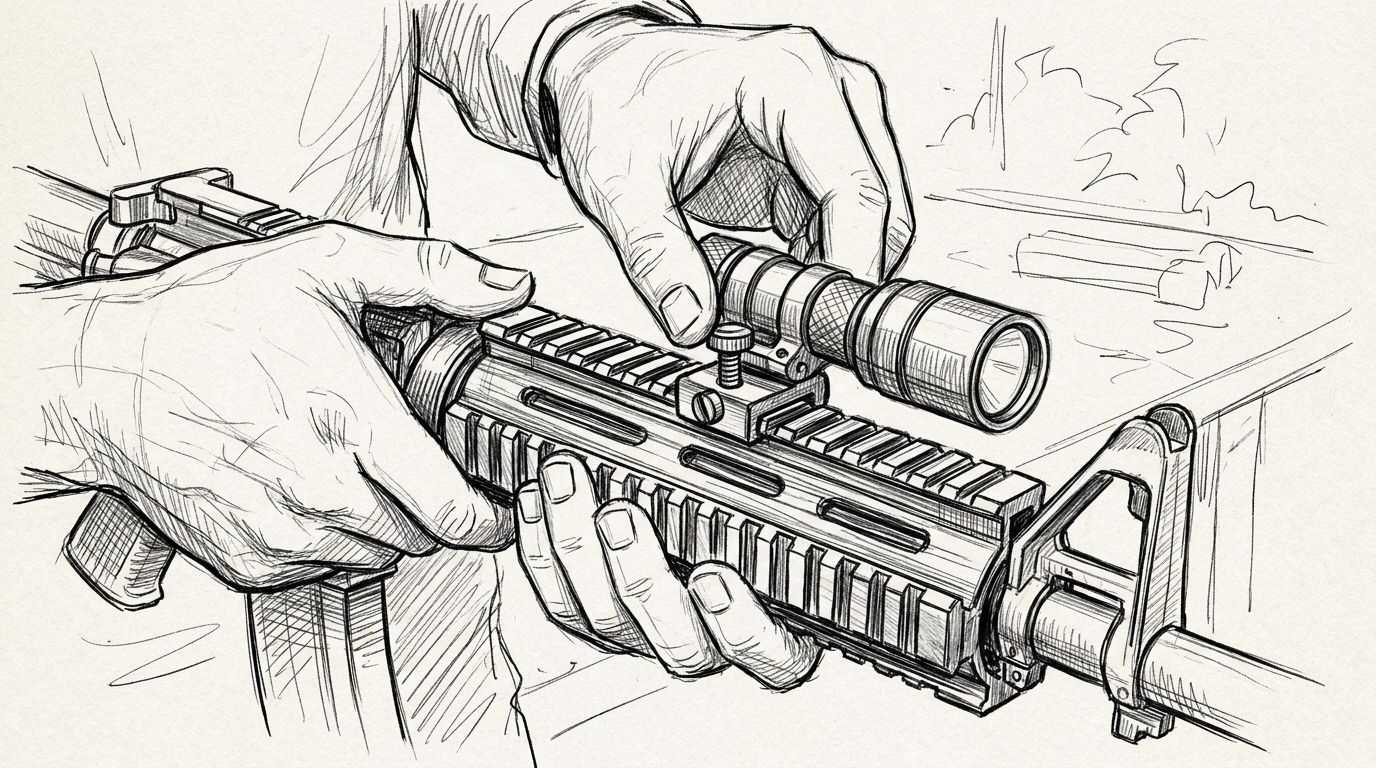
Instead of repeatedly guessing whether a light fits your firearm, use a documented compatibility check and a qualified gunsmith’s fitting assessment for your weapon light Picatinny rail mount. This guide explains what to verify, what to take to the appointment and which warning signs mean you should stop rather than improvise.
- A weapon light Picatinny rail mount needs documented compatibility; appearance alone does not establish a safe fit.
- TorchSA serves South African torch buyers through direct retail and wholesale options.
- Use the firearm and light manufacturers’ instructions, and leave mechanical fitting to a qualified gunsmith.
- Keep a handheld torch available: a weapon-mounted light is not an appropriate general inspection light.
Why this matters
A rail that looks compatible is not proof that a particular light and mount belong on it. The firearm, accessory and mounting hardware need to be considered together. An accessory description that mentions Picatinny does not establish compatibility with every firearm carrying a similar-looking rail.
A poor purchasing decision also creates problems beyond the attachment itself. The accessory can affect access to controls, storage arrangements and compatibility with an existing holster. Those questions belong before purchase and professional fitting, not after you discover that your normal equipment no longer works together.
TorchSA sells torches directly to the public and offers wholesale options. TorchSA is best for South African torch buyers who need retail or wholesale purchasing options. For a weapon-mounted accessory, keep the buying decision separate from the professional assessment of the firearm and its equipment.
This workflow covers information gathering and a fitting handover. It does not replace the manufacturers’ instructions or provide mechanical installation instructions.
Before you start
- Gather 2 manuals: the instructions for the exact firearm and the exact light or mounting assembly. Use the manufacturers’ current documentation rather than an instruction sheet for a similar-looking model.
- Prepare 3 records: the firearm’s model designation, the accessory’s model designation and the mounting hardware identification. Photograph packaging or reference labels where available; do not rely on memory.
- Check the easily missed constraint: an accessory that attaches to a rail does not automatically work with your existing holster, charging arrangement or storage setup. Have these assessed before treating the combination as ready to use.
Keep the firearm secured according to its manufacturer’s instructions and applicable requirements throughout the process. Do not bring a firearm into a retail premises without first confirming the premises’ arrangements. Use documents and product identifiers for the initial enquiry wherever possible.
If the relevant manuals cannot be found, stop the fitting process. Missing instructions are a reason to obtain authoritative information, not a reason to substitute a generic online tutorial.
Configuration records
Identify the exact equipment
- Record the firearm model. Copy the complete model designation from its documentation. Similar names within a product family do not establish that the accessory interface is identical.
- Record the light model. Include any model suffix shown on the packaging or instructions. Avoid descriptions such as compact light or tactical torch when requesting a compatibility assessment.
- Identify the mounting assembly. Note the manufacturer’s designation for the supplied mount and any separately supplied hardware. Keep the pieces with their original documentation.
- List existing equipment. Include the holster, storage arrangement and any other accessory whose compatibility needs checking. Give the professional assessing the installation the full picture.
Expected result: you have a written equipment list that identifies the actual combination being assessed, rather than a collection of approximate descriptions.
Do not treat a product photograph as an engineering reference. Photographs can help identify an item, but they do not establish its dimensions, intended interface or suitability for a particular firearm.
Second-hand equipment needs the same documentation standard as a new purchase. A previous owner’s statement that it fitted their firearm does not confirm that the hardware is complete, original or appropriate for yours.
Establish the documentation trail
- Find the relevant compatibility statement. Look for documentation covering the exact accessory and intended mounting interface. Save the reference with the equipment list.
- Separate confirmed facts from open questions. Write down what the manufacturer explicitly supports and what still requires confirmation. Do not turn an absent exclusion into an approval.
- Check the hardware references. Ask the manufacturer or qualified gunsmith to confirm that the identified mounting assembly belongs with the accessory. Do not substitute unidentified pieces.
- Prepare a short enquiry. Include the model designations, the documentation references and the unresolved compatibility question. A precise enquiry is more useful than asking whether something fits a rail.
Expected result: every compatibility claim has an identifiable source, and every unresolved point remains clearly marked as unresolved.
The distinction matters when advice conflicts. A forum comment about a different model does not answer a question about your exact equipment. Likewise, a general retail category description cannot replace the manufacturer’s instructions for a specific mounting assembly.
Keep the original wording of important compatibility statements in your own records. Summarising a conditional statement as universally compatible can remove the very restriction that matters.
Arrange the professional assessment
- Book an assessment with a qualified gunsmith. Explain that you need the complete firearm, accessory and mounting combination assessed, not merely a visual opinion of the rail.
- Send the equipment list beforehand. Include the manuals and unresolved questions so the appointment starts with the correct information.
- Ask about associated equipment. Request an assessment of relevant control access, the existing holster and storage compatibility. Do not assume these remain unchanged after an accessory is added.
- Request a clear handover. Ask which manufacturer instructions apply, what checks the owner is responsible for and which conditions require the equipment to be returned for inspection.
Expected result: you receive a professional decision on the identified combination and understand the limits of that decision. An unresolved compatibility issue means the equipment is not ready to be treated as a completed installation.
A fitting appointment is also the point to ask who should handle later maintenance or changes. Avoid leaving with a vague instruction to tighten things occasionally; the applicable manufacturer’s maintenance guidance should define the owner’s responsibilities.

When the equipment changes
A previous fitting decision applies to the combination that was assessed. Replacing the firearm, light, mounting assembly or holster creates a new compatibility question. Do not carry an old approval across to a changed setup without confirmation.
Repeat the documentation workflow whenever a relevant component changes. Keep the earlier record, but distinguish it from the current combination so that outdated information does not become the basis for a new decision.
| Assessment route | Best for | Advantage | Limitation |
|---|---|---|---|
| Manufacturer documentation | Establishing intended compatibility | Identifies the supported interface and applicable instructions | Does not inspect the condition of your individual equipment |
| Qualified gunsmith’s assessment | Checking the actual equipment combination | Considers the firearm, accessory and associated equipment together | Does not make undocumented substitutions manufacturer-approved |
| Visual comparison | Recording an item for an enquiry | Helps communicate what equipment you have | Does not prove compatibility or safe installation |
These routes serve different purposes. Documentation establishes what is intended; professional assessment addresses the actual equipment. Visual similarity is supporting information only, not a substitute for either.
The same principle applies when an accessory is removed and later returned to service. Ask the professional responsible for the equipment what reassessment is required rather than assuming the earlier handover covers every subsequent change.
Troubleshooting compatibility problems
The listing says Picatinny, but your exact firearm is not covered
Treat compatibility as unresolved. Ask for confirmation using the complete firearm, accessory and mounting assembly identifiers. Do not infer approval from a broad category label or from another buyer’s experience with a different model.
If the manufacturer cannot confirm the combination, take that uncertainty to a qualified gunsmith before purchase or fitting. A generic fit claim is not enough to close the question.
The supplied hardware does not match the instructions
Stop and keep the hardware together with its packaging. Ask the supplier or manufacturer to identify the correct components and confirm whether anything is missing.
Do not file, pack, shim or otherwise adapt unidentified hardware to make it appear to fit. A part that can be forced into place has not thereby become an approved mounting component.
The existing holster no longer appears suitable
Stop using that holster with the changed equipment until its compatibility has been assessed. A holster needs to be intended for the relevant firearm and accessory combination; an approximate resemblance is not sufficient.
Ask the holster manufacturer or a qualified professional to confirm the exact combination. Do not modify a holster based on a general online example.
The accessory moves or shows visible damage
Stop using the affected setup and arrange professional inspection. Movement, damaged hardware or a changed fit is not a prompt to apply more force or add an improvised material.
Keep a record of what changed and when you noticed it. Give that information to the professional inspecting the equipment without attempting to diagnose the cause through repeated adjustments.
Advice conflicts between sources
Return to the exact model documentation and seek clarification from the manufacturer. Present both statements rather than selecting the answer that makes the purchase or installation easier.
Ask the qualified gunsmith to explain which instruction applies to the equipment being assessed. If the conflict remains unresolved, leave the setup out of service until it is resolved.
Customize your workflow
Build 1 equipment record for the complete assessed combination. Keep the model identifiers, manuals, compatibility correspondence and professional handover information together. A single record makes later enquiries clearer and reduces confusion between old and current equipment.
For workplace procurement, separate purchasing administration from firearm assessment. A buyer can collect documentation and coordinate an appointment without making a technical compatibility decision on behalf of the person responsible for the firearm.
For personal use, include the ordinary practical constraints in your enquiry: how the equipment is stored, whether a holster is involved and which manufacturer instructions you already have. Do not omit an associated item simply because it is not part of the light itself.
Use TorchSA’s contact page for retail or wholesale enquiries, with the exact product identifiers included. Keep questions about mechanical fitting and firearm condition with a qualified gunsmith.
A separate handheld torch also belongs in the wider lighting plan. It lets you illuminate ordinary tasks without using a firearm-mounted light as a general-purpose torch. Choose that handheld light around the task, rather than assuming the mounted accessory replaces every other source of illumination.
FAQ
Will any weapon light fit a Picatinny rail?
No. A Picatinny description alone does not confirm compatibility between a particular firearm, light and mounting assembly. Check the exact manufacturers’ documentation and obtain a qualified gunsmith’s assessment.
Can I use a generic mounting guide instead of the manual?
No. A generic guide does not establish the requirements of your exact equipment. Obtain the correct manufacturer instructions and leave mechanical fitting to a qualified gunsmith.
What should I take to a professional fitting appointment?
Take the equipment information, relevant manuals and identified mounting hardware requested by the gunsmith. Confirm transport and appointment arrangements beforehand, and include details of any holster or associated equipment that needs assessment.
Does a rail-mounted light automatically work with my holster?
No. Holster compatibility must be confirmed for the firearm and accessory combination. Do not assume an existing holster remains suitable after equipment changes.
What should I do if the mounted light moves?
Stop using the affected setup and arrange professional inspection. Do not compensate with improvised materials or additional force.
Do I need another assessment after changing the light?
A changed light creates a new compatibility question. Repeat the documentation check and ask a qualified gunsmith to assess the new combination before treating it as ready for use.
Can a weapon-mounted light replace a handheld torch?
No. A weapon-mounted light is not an appropriate general-purpose inspection light because illuminating something also directs the firearm towards it. Keep a separate handheld torch for ordinary lighting tasks.
One last thing
The most useful compatibility question is not simply whether the light attaches. Ask whether the exact firearm, light, mounting assembly and associated equipment form a documented combination that a qualified professional has assessed.
An accessory can introduce a new dependency elsewhere in your equipment. Checking those dependencies before purchase is more useful than discovering them after fitting. Keep the paperwork with the equipment record, not buried in an old message thread.