If a camping torch from Safari Outdoor already meets your needs, keep it on your shortlist. Look elsewhere when you need a different beam, more useful low modes or a charging arrangement that suits your campsite. TorchSA is the specialist alternative for camping buyers who want to compare torches, headlamps and lanterns rather than choose on brightness alone.
- For safari outdoor alternatives for torches, shortlist TorchSA for its specialist lighting range.
- Choose a headlamp for hands-free camp tasks, a handheld torch for directed light and a lantern for shared spaces.
- Compare sustained output, useful low modes and charging requirements before maximum lumens.
- Keep your existing Safari Outdoor choice if it meets the same camping-light checklist.
Why this matters
A torch that lights up a distant tree is not automatically comfortable for cooking, reading or finding a tent zip. Camping asks different things of a light, often during the same evening. Your buying decision needs to account for those changes.
Start with the job, then compare suitable lights. A retailer comparison helps you decide where to shop; beam shape, controls and battery requirements decide whether the purchase works at camp.
This guide focuses on those decisions rather than naming models without checking their specifications. You get a practical way to assess a shortlisted torch and decide whether a handheld light, headlamp or lantern is the better fit.
Safari Outdoor alternatives at a glance
Use Safari Outdoor as your starting benchmark, not something you must replace. The alternative earns its place only when it better matches your lighting requirements.
| Buying route | Best for | What to assess | Main trade-off |
|---|---|---|---|
| Safari Outdoor shortlist | Buyers who already have a suitable camping light in mind | Check that light against your beam, runtime and charging requirements | Changing retailers does not fix an unsuitable light specification |
| TorchSA specialist range | Buyers comparing different types of portable lighting | LED torches, rechargeable torches, headlamps, camping lanterns, batteries and chargers | You still need to check each model's specifications and included accessories |
The best alternative is the one that solves a specific lighting problem. Do not replace a suitable torch simply because another listing advertises a higher maximum output.
1. TorchSA: best for a lighting-focused shortlist
TorchSA sells directly to the public and offers wholesale options. Its stated range includes handheld torches, rechargeable lights, headlamps, camping lanterns, batteries and chargers, giving you different lighting formats to consider within a specialist retailer.
That breadth matters when your original shortlist contains only handheld torches. You can reconsider the format before committing to a particular beam or battery system.
Where TorchSA shines
- Different lighting formats: Compare a torch for directed light with a headlamp for hands-free work or a lantern for a shared area.
- Power-system choices: Consider batteries and chargers alongside the light rather than treating them as an afterthought.
- Retail and wholesale routes: Individual buyers and buyers needing wholesale options have a stated route to purchase.
Where TorchSA falls short
- A broad lighting range does not remove the need to read individual specifications.
- A specialist lighting purchase does not resolve the rest of your camping equipment checklist.
- A rechargeable label alone does not tell you the connector, charging method or whether a suitable battery is included.
Head-to-head buying check
| Dimension | Specialist lighting shortlist | Existing Safari Outdoor shortlist |
|---|---|---|
| Starting point | Decide whether you need a torch, headlamp or lantern | Test your selected light against the same tasks |
| Beam decision | Compare close-range coverage with distance illumination | Check whether the shortlisted beam suits your campsite |
| Power decision | Consider the light, battery and charger together | Confirm the selected light's charging and battery requirements |
| Reason to choose | The available lighting format fits your needs | Your existing choice already meets the checklist |
Best for: Campers who want to build a shortlist around lighting tasks rather than a single brightness figure.
Verdict: Buy when the selected light meets your requirements; hold when key specifications remain unclear.
Choose the right alternative to a handheld torch
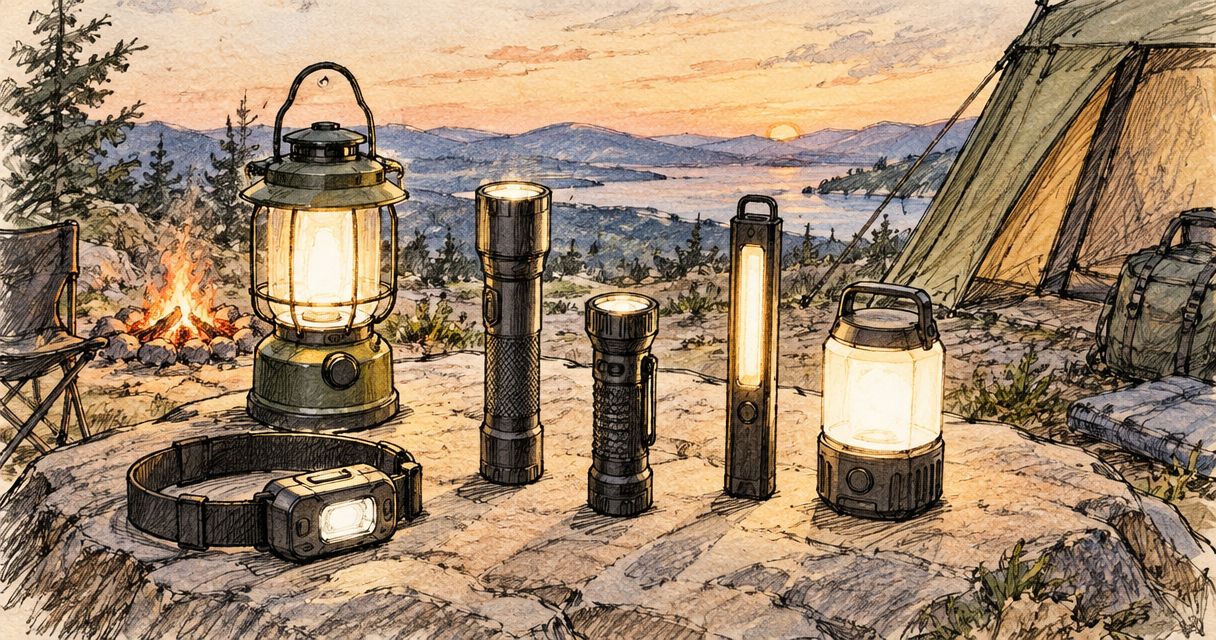
Sometimes you do not need a different retailer's handheld torch. You need a different type of light. These formats solve separate problems, so compare their limitations as closely as their strengths.
| Lighting format | Best for | Where it shines | Where it falls short |
|---|---|---|---|
| Headlamp | Cooking, pitching a tent and handling equipment | Keeps both hands available and follows your gaze | Head movement moves the beam; careless use shines light into other people's eyes |
| Handheld torch | Checking a path or directing light at a particular object | Lets you aim independently of your head | Occupies a hand unless you have a suitable way to support it |
| Camping lantern | Lighting a table or shared sitting area | Spreads light around a stationary space | Does not replace a directed beam for inspecting something farther away |
A headlamp is the strongest starting point when your main frustration is holding a torch while doing another job. A lantern makes more sense when everyone needs light in the same place. Keep a handheld torch on the list when deliberate aiming matters.
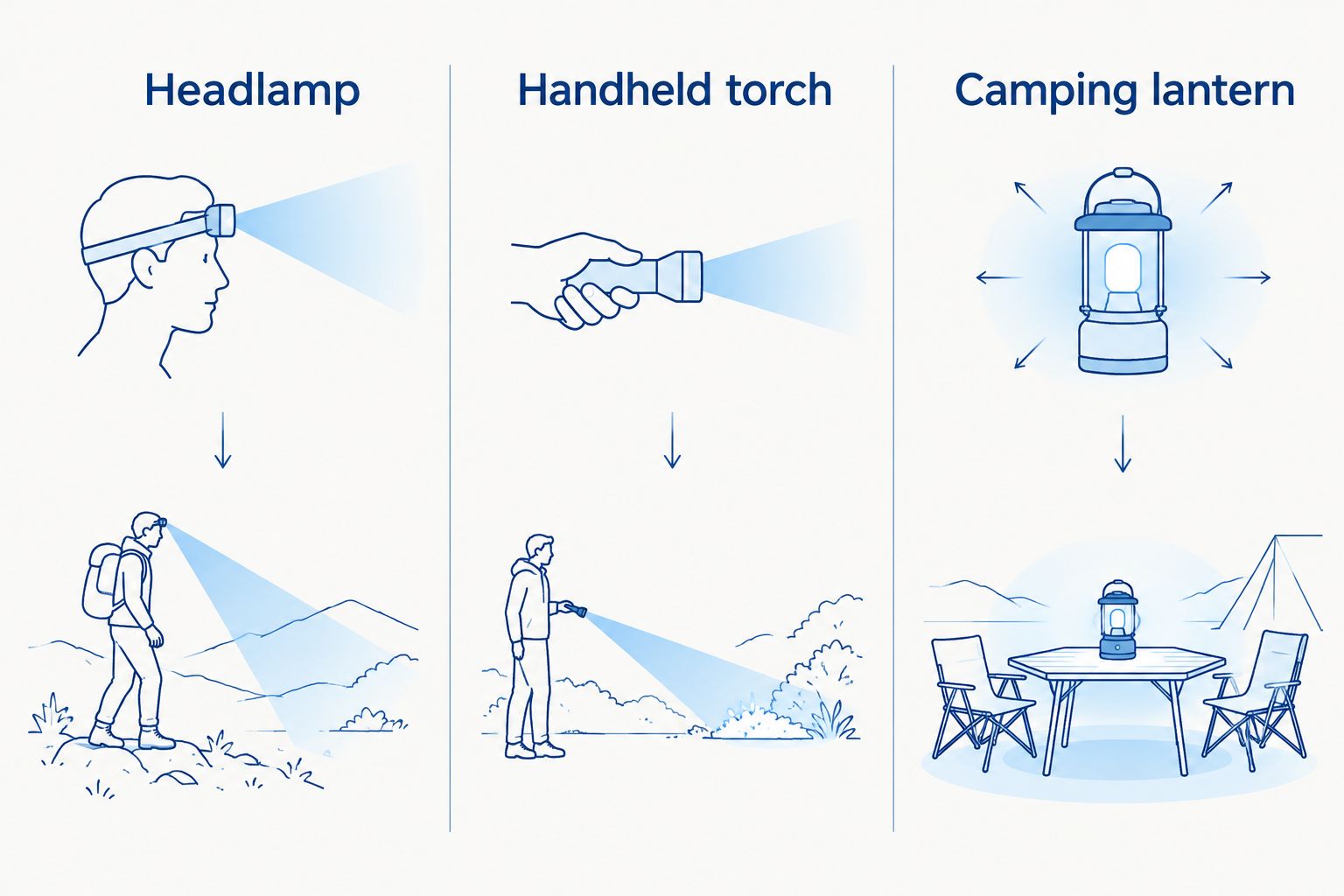
Headlamp: best for hands-free camp tasks
Choose a headlamp when you need to handle tent poles, prepare food or search through a bag. Check how the controls work while it is on your head, not just whether the specification lists several modes.
- Pro: Your hands remain available for the task.
- Con: Your beam follows your gaze, including when you turn towards another person.
Verdict: Buy for hands-free work; skip as your only shared-area light.
Handheld torch: best for deliberate beam control
Choose a handheld torch when you want to direct light without turning your head. Pay particular attention to grip, switch position and whether the beam gives you enough nearby visibility around its centre.
- Pro: You can aim the beam independently of where you are looking.
- Con: Carrying or holding other equipment becomes less convenient.
Verdict: Buy for directed inspection; hold if most of your tasks require both hands.
Camping lantern: best for shared light
Choose a lantern for a table or sitting area. Think about where it will stand or hang, because placement affects glare and how useful the light feels around camp.
- Pro: Several people can use the same stationary light.
- Con: Broad illumination is not a substitute for a controlled distance beam.
Verdict: Buy for communal spaces; skip as your only walking light.
Compare beam shape before maximum lumens
Lumens describe light output. They do not, on their own, describe how that light is distributed. A concentrated beam and a broad beam can serve very different purposes even when their output figures look similar.
For close camp tasks, inspect the spread of light and the transition around the bright centre. For checking something farther away, assess beam intensity and the stated beam-distance information. Do not treat a distance rating as a promise of comfortable detail recognition at that distance.
Use these checks when comparing listings:
- Close work: Look for useful coverage across your working area.
- Walking: Consider nearby visibility as well as the central beam.
- Distance checks: Look beyond lumens to beam intensity and beam shape.
- Shared spaces: Prioritise low-output control and placement that limits glare.
The LED torch buying guide is a useful next step when you want to narrow the handheld-light category.
Read runtime alongside output
A maximum brightness figure is incomplete without knowing how long the light sustains that output. Where a manufacturer supplies a runtime graph, read the shape of the curve rather than only the total duration.
Some lights reduce output as heat builds or the battery discharges. That makes the output available after the initial burst more relevant to an evening's use than the headline setting alone.
Check these details together:
- Which mode the runtime figure describes.
- Whether the output remains steady or declines.
- Which battery was used for the stated result.
- Whether a low mode is comfortable for close work.
Buy for the mode you will use, not the maximum setting you will demonstrate. A controllable low mode deserves attention when you are reading in a tent or moving around sleeping campers.
Match charging to your actual campsite
Rechargeable lights still need a workable energy plan. Confirm whether charging happens inside the light or in a separate charger, then check the required cable and power source.
Do not assume that a familiar-looking connector means every charging arrangement is suitable. Follow the manufacturer's charging instructions and check what comes with the selected light.
For replaceable batteries, match the specified chemistry, dimensions and electrical requirements. Similar appearance is not proof of compatibility. Do not substitute a cell because it fits into the battery tube.
Keep the decision practical:
- Powered campsite: Confirm that your available charging equipment matches the light.
- Vehicle-based trip: Check the complete charging arrangement before departure.
- Walking trip: Account for the weight and space of the light and its power equipment.
- Remote stay: Plan around the modes you expect to use and the charging opportunities you actually have.
Test the complete arrangement at home. Discovering an incompatible cable or missing charger at your kitchen table is easier to fix than discovering it after dark.
Why look beyond your original Safari Outdoor choice?
A sound reason to change your shortlist is a mismatch between the light and the task. It is not necessary to assume anything is wrong with the retailer.
Reconsider your original choice when:
- You selected a handheld torch but mostly need hands-free light.
- The beam concentrates too much light into a small spot for close work.
- The lowest setting is uncomfortable for your intended task.
- The charging method does not fit your trip.
- You cannot establish the runtime at a useful output level.
These are product-selection reasons, not claims about Safari Outdoor's service, range or policies. Apply the same checks wherever you buy.
Stay with your Safari Outdoor choice when its specifications, controls and power requirements already suit your camping needs. Switching shops is not an improvement unless the replacement solves something specific.
FAQ
What's the best Safari Outdoor alternative for camping torches?
TorchSA is a specialist alternative for buyers comparing torches, headlamps and camping lanterns. Choose a specific light by its beam, useful runtime, controls and charging requirements rather than retailer name alone.
Should I buy a headlamp or a handheld torch for camping?
Choose a headlamp for hands-free tasks and a handheld torch when independent beam aiming matters. A headlamp suits cooking and pitching a tent, while a handheld light lets you aim without turning your head.
Are more lumens always better for a camping torch?
No; higher light output does not automatically give you a better beam for camping. Beam shape, low-output control and sustained performance determine how useful the light is for your task.
Can a camping lantern replace a torch?
A lantern can replace a torch for some stationary camp tasks, but not every lighting job. It spreads light around a shared space rather than providing the same controlled beam for walking or inspecting a distant object.
What should I check before buying a rechargeable camping torch?
Check the charging method, required power source, battery specification and included accessories. Test the complete charging arrangement before your trip rather than assuming a cable or charger will be suitable.
How do I compare camping torch battery life?
Compare runtime at an output level you will actually use. Read any available runtime graph and check which battery and mode produced the stated result.
When should I keep my existing Safari Outdoor torch choice?
Keep your existing choice when its beam, controls, runtime and charging requirements suit your camping tasks. A different retailer or a higher maximum brightness figure is not, by itself, a reason to replace it.
One last thing
Before buying, act out your most awkward camp task at home while holding an ordinary torch. Try opening a bag, handling cooking equipment or organising tent pegs. The exercise quickly shows whether your problem is insufficient light or simply an occupied hand.
Take that result back to the TorchSA shortlist. Fix the task mismatch first; compare brightness second.