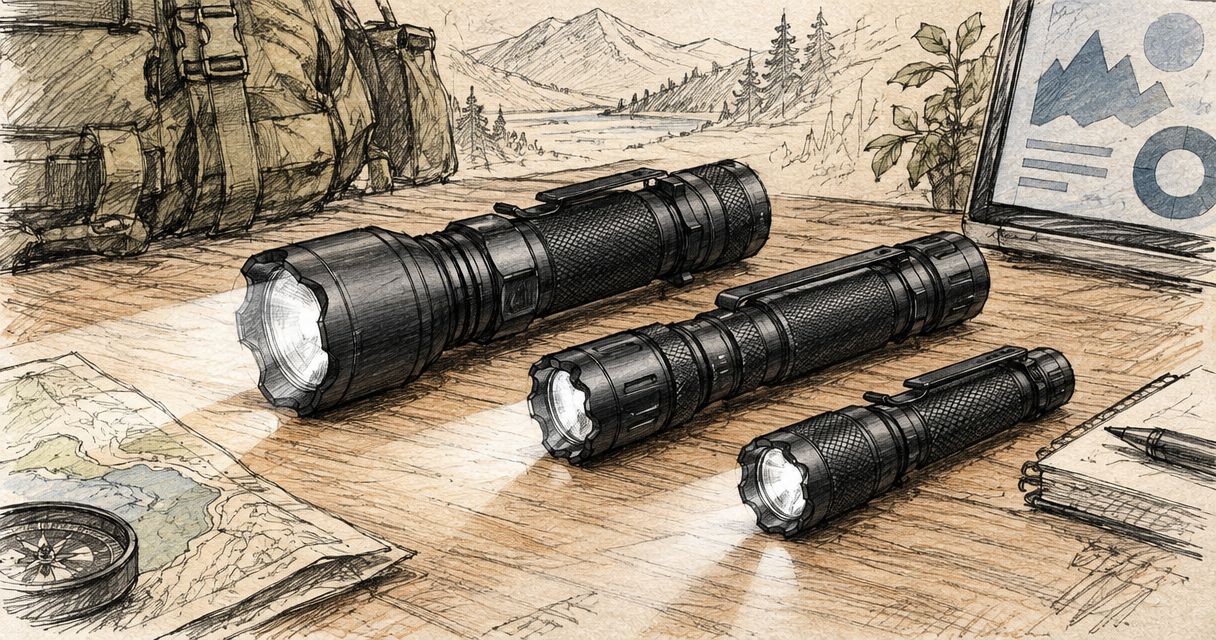
If you’re comparing Adendorff alternatives for tactical flashlights, TorchSA is the specialist alternative for buyers who want to compare torches, batteries and chargers in one range. Choose by beam pattern, switch operation and usable runtime—not by the word tactical on the packaging.
- Comparing Adendorff alternatives for tactical flashlights? TorchSA suits buyers seeking a specialist torch retailer with battery and charger options.
- Choose a handheld torch for directed searching, a headlamp for hands-free tasks, and a weapon light only for compatible mounting.
- Compare candela, sustained output and switch operation before treating maximum lumens as the deciding specification.
- Keep your existing torch if its beam, controls, battery system and condition already meet your needs.
Why this matters
A tactical flashlight needs to work around your task. A security patrol, a farm inspection and a close-range equipment check place different demands on the beam, controls and battery system. Buying the brightest headline specification does not settle those differences.
TorchSA is a tactical flashlight shopping alternative for buyers who want a specialist torch range rather than a model chosen on maximum lumens alone. The practical next step is to define what your current light fails to do, then compare that requirement against the specifications of a candidate replacement.
This guide compares buying routes and light types rather than presenting an unverified list of models. A retailer’s name does not establish a particular torch’s suitability; its documented performance and operation do.
Adendorff alternatives at a glance
Start with the job, not the shop. The table keeps Adendorff as your original shopping reference without assuming that an unspecified product has particular features or limitations.
| Shopping route or light type | Best for | Main reason to consider it | Main limitation | What to compare with your Adendorff shortlist |
|---|---|---|---|---|
| Your shortlisted Adendorff torch | Buyers checking whether an existing candidate meets the brief | Keeps the decision tied to a specific model | A retailer name alone does not establish suitability | Published beam, runtime, controls and battery details |
| TorchSA specialist range | Buyers comparing torches alongside batteries and chargers | Direct-to-public shopping with wholesale options | A broad range still requires model-by-model selection | The same specifications and operating requirements |
| Handheld torch | Directed searching and inspections | Lets you aim the beam independently | Occupies a hand during use | Beam reach, spill and switch access |
| Headlamp | Hands-free work and close-range tasks | Follows your head movement | Does not aim independently of your head | Beam spread, fit and controls |
| Weapon light | A compatible firearm-mounted application | Places illumination on the firearm | Creates mounting, holster and safe-use requirements | Exact fit, switch access and intended application |
These are different solutions, not interchangeable upgrades. A headlamp can solve a hands-free problem that a more powerful handheld torch leaves unchanged. A weapon light introduces a separate set of requirements rather than replacing a general-purpose torch.
1. TorchSA: best for specialist torch shopping
TorchSA sells directly to the public and offers wholesale options. Its range includes LED torches, rechargeable torches, headlamps, camping lanterns, batteries, chargers and weapon lights. That makes it a relevant starting point when your decision involves both the light and the equipment needed to keep it working.
Best for: Buyers who want to compare a torch’s intended use with its battery and charging requirements.
Where TorchSA shines
- The range covers handheld and hands-free lighting categories, so you can start with the correct light type.
- Batteries and chargers form part of the offering, allowing you to consider the power system alongside the torch.
- Direct-to-public and wholesale options serve individual buyers and buyers sourcing equipment for a team.
Where TorchSA falls short
- A specialist range is not a substitute for checking the individual model’s specifications.
- Buying several lights adds decisions about battery compatibility, charging arrangements and staff operation.
- A product category cannot confirm whether a particular light fits your hand, equipment or working method.
Specialist shopping versus your existing shortlist
| Decision | Specialist shopping route | Your shortlisted Adendorff torch |
|---|---|---|
| Light type | Compare handheld, headlamp and other relevant categories | Confirm that the shortlisted type suits the task |
| Power system | Consider batteries and chargers alongside the light | Check exactly which battery and charging method it uses |
| Team purchasing | Wholesale options are offered | Establish the purchasing arrangements you require |
| Final selection | Verify the individual model’s documentation | Apply the same verification standard |
Verdict: Buy only when the selected model solves a defined lighting requirement; hold if your current torch already does.
2. A handheld torch: best for directed searching
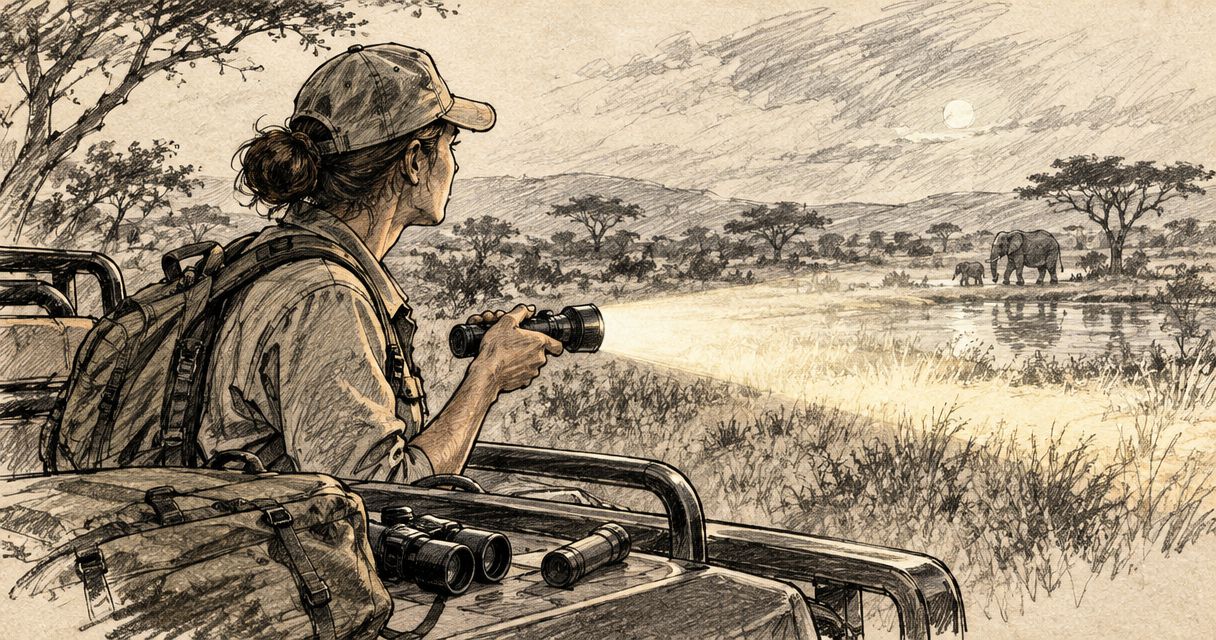
A handheld torch lets you direct light without turning your head towards everything you illuminate. For inspections and patrol work, the important choice is the relationship between a concentrated central beam and the surrounding spill.
Best for: Buyers who need to scan an area, inspect a specific point or direct light separately from their gaze.
Where a handheld torch shines
- Independent aiming helps you move between a distant point and nearby details.
- Different beam patterns suit different combinations of searching and close work.
- You can assess switch position and grip directly against your working habits.
Where a handheld torch falls short
- It occupies a hand that you might need for a gate, tool or radio.
- A narrow central beam can be awkward for broad, close-range work.
- A bulky body can make regular carry inconvenient, regardless of output.
Before choosing, consider where the torch will sit between uses. A light carried comfortably and accessed reliably is a better match than one whose size interferes with your normal equipment.
Verdict: Buy for independent beam control; skip as your only light if the main task requires both hands.
3. A headlamp: best for hands-free tasks
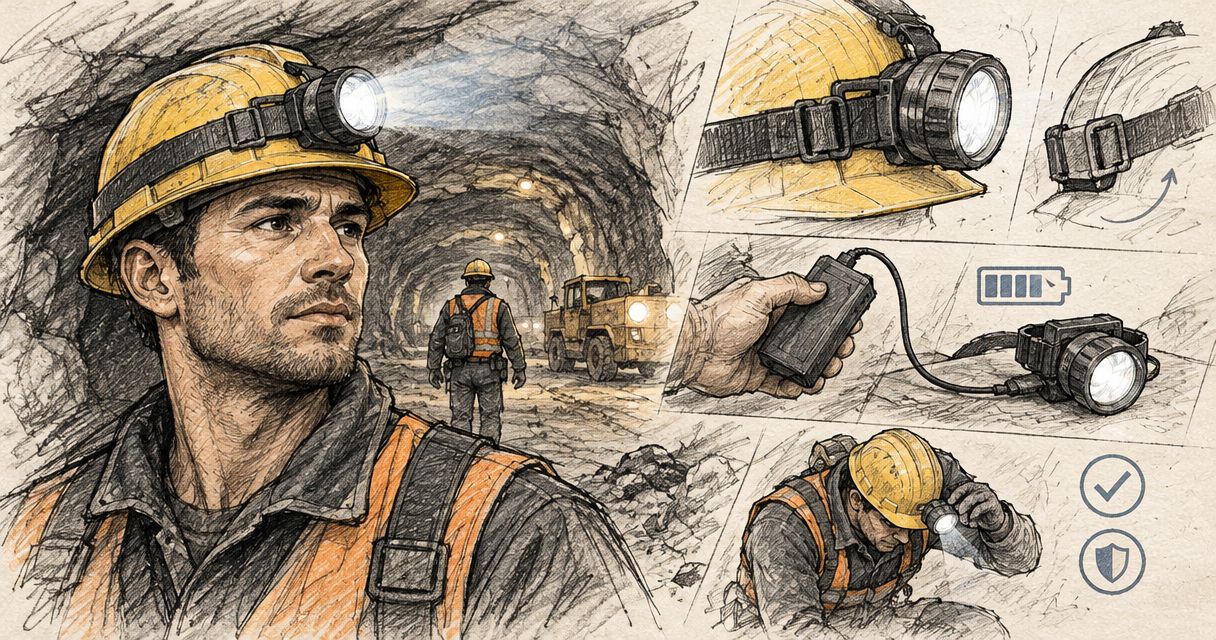
A headlamp addresses a different problem from a handheld tactical torch: keeping your hands available. It is relevant when equipment checks, repairs or camp tasks take priority over independently aimed searching.
Best for: Buyers whose main frustration is having to hold or prop up a torch while working.
Where a headlamp shines
- Both hands remain available for the task.
- The beam generally follows the direction of your head.
- A broad beam can suit work close to your body.
Where a headlamp falls short
- Looking towards another person can direct the beam into their eyes.
- Fit and balance matter during extended wear.
- Head movement changes the beam direction even when you want illumination to remain fixed.
Verdict: Buy for hands-free work; hold onto a handheld option when independent aiming remains important.
4. A weapon light: best for a compatible mounted application
A weapon light is not simply a handheld torch with a mounting accessory. Selection depends on the firearm interface, control access and any holster you intend to use. Keep that decision separate from choosing a general inspection light.
Best for: Buyers with a clearly defined, compatible firearm-mounted application and appropriate safe-handling practices.
Where a weapon light shines
- It provides illumination from a mounted position.
- A suitable control arrangement allows operation in the intended configuration.
Where a weapon light falls short
- Mounting compatibility requires exact checks rather than visual guesses.
- Adding a light can change holster requirements.
- Using the light also involves directing the firearm; it is not a general-purpose search tool.
Verdict: Buy only after confirming compatibility; skip as a replacement for an ordinary handheld torch.
Compare the specifications that change the result
Beam pattern: reach versus nearby visibility
Lumens describe total light output. Candela describes luminous intensity in a particular direction, making it useful when assessing a beam’s concentrated centre. Neither figure alone tells you how comfortable the light will be for your entire task.
A concentrated beam helps you examine a distant point. Broader spill helps you see surrounding ground and nearby objects. Look for beam photographs or demonstrations that show both, rather than judging a light from a brightly illuminated wall alone.
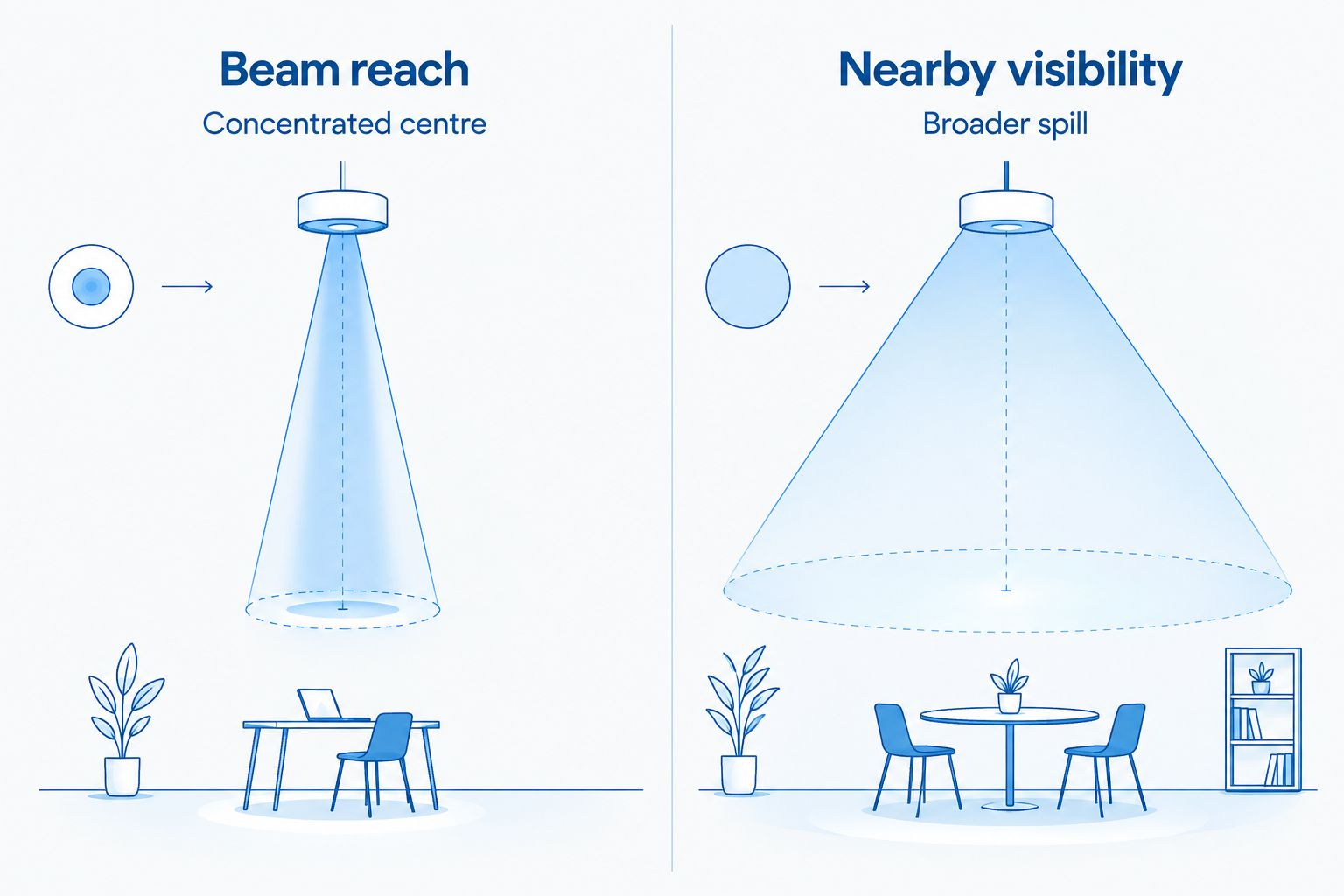
Sustained output: brightness after the initial burst
Maximum output and sustained output are not the same thing. Some torches reduce output as heat builds or the battery discharges. Read the mode information and any available runtime graph to understand what happens after activation.
For patrol work, compare the mode you expect to use regularly. A high headline figure tells you little about whether a lower, practical setting provides the beam and operating time you need.
Switch operation: access before extra modes
Check whether you can reach the switch comfortably with your normal grip. Then establish what a press, hold or repeated press actually does. Mode memory, lockout and momentary operation matter only when their behaviour matches your needs.
More modes are not automatically more useful. If reaching ordinary illumination requires cycling through functions you do not want, the control scheme creates unnecessary work.
Water resistance: read the complete rating
An IP rating describes tested ingress protection, not a general promise that a torch survives every wet environment. IPX4 addresses splashing water; IPX7 addresses temporary immersion under specified test conditions, commonly 1 metre for 30 minutes. The X means that the designation does not specify a solids-protection rating.
Those are different claims. Neither rating, by itself, establishes suitability for diving, pressure washing or every form of prolonged exposure. Follow the manufacturer’s instructions for the particular light.
Check the battery system before committing
Battery choice affects charging arrangements, spare-cell handling and how you restore the light between uses. Confirm the exact permitted battery type; a similar shape or familiar designation does not establish electrical or physical compatibility.
If a candidate uses an 18650 cell, the guide to 18650 batteries for flashlights provides a relevant next reading step. Still check the torch manufacturer’s requirements for that model, including any restrictions on cell construction or charging.
Use this sequence before ordering:
- Identify the battery. Confirm the specified cell or battery pack.
- Check charging. Establish whether charging happens in the light or through a separate charger.
- Plan replacement. Check the manufacturer’s permitted replacement procedure.
- Check storage. Follow the battery maker’s handling and storage instructions.
For team equipment, favour a purchasing decision that staff can operate consistently. Do not assume that lights with similar appearances share batteries, chargers or control behaviour.
Compare your lighting options
Start with the light type, then check beam, controls and battery requirements.
Why consider switching from Adendorff?
Switch when a specific alternative solves a problem your current light does not. That is a defensible reason to change; an unsupported claim about an entire retailer is not.
- Your beam is wrong for the task. Compare reach and spill before buying another light with the same limitation.
- Your controls interrupt work. Look for documented switch behaviour that matches how you use the torch.
- You need both hands. Consider a headlamp rather than another handheld model.
- Your charging arrangement is inconvenient. Compare complete battery systems, not charging connectors alone.
- You are equipping a team. Define common operating requirements before selecting individual lights.
These are reasons to reassess your equipment, not claims about every torch sold by Adendorff. Compare actual models against the same checklist.
When staying with your current torch is right
Keep your current torch if it delivers the beam you need, operates predictably and remains in sound condition. Changing retailers does not, by itself, improve illumination.
Before replacing a light, inspect it according to its instructions and confirm that the correct battery is in good condition. Replace a demonstrated limitation, not a label. If the current light passes your practical requirements, there is no lighting-based reason to buy another.
FAQ
What should I look for in Adendorff alternatives for tactical flashlights?
Compare beam pattern, sustained output, switch operation and the battery system. TorchSA is a specialist retail option for comparing torch categories alongside batteries and chargers.
Is a higher-lumen tactical flashlight always better?
No. Lumens describe total output, while beam concentration, spill and sustained performance affect how useful that output is for your task.
Should I choose a handheld torch or a headlamp for security work?
Choose a handheld torch for independent aiming and a headlamp when hands-free work is the main requirement. Base the decision on the task rather than treating either format as universally better.
Does IPX7 mean a torch is suitable for diving?
No. IPX7 addresses temporary immersion under specified test conditions; it does not establish diving suitability. Check the manufacturer's stated application and limitations.
Can I put any 18650 battery into a rechargeable torch?
No. Use only the battery type and construction permitted by the torch manufacturer. A shared size designation does not confirm complete compatibility.
Can a weapon light replace my handheld torch?
A weapon light is not a general-purpose replacement for a handheld torch. Its use involves directing the firearm, and selection requires exact mounting and control checks.
When should I keep my existing tactical flashlight?
Keep it when its beam, controls, battery system and condition meet your actual requirements. Replace it when you can identify a limitation that a documented alternative resolves.
One last thing
Write down the single problem your replacement must solve before browsing. If you cannot name it—insufficient reach, awkward controls, unsuitable charging or occupied hands—you have not yet defined an upgrade. That short brief is more useful than another maximum-output comparison.