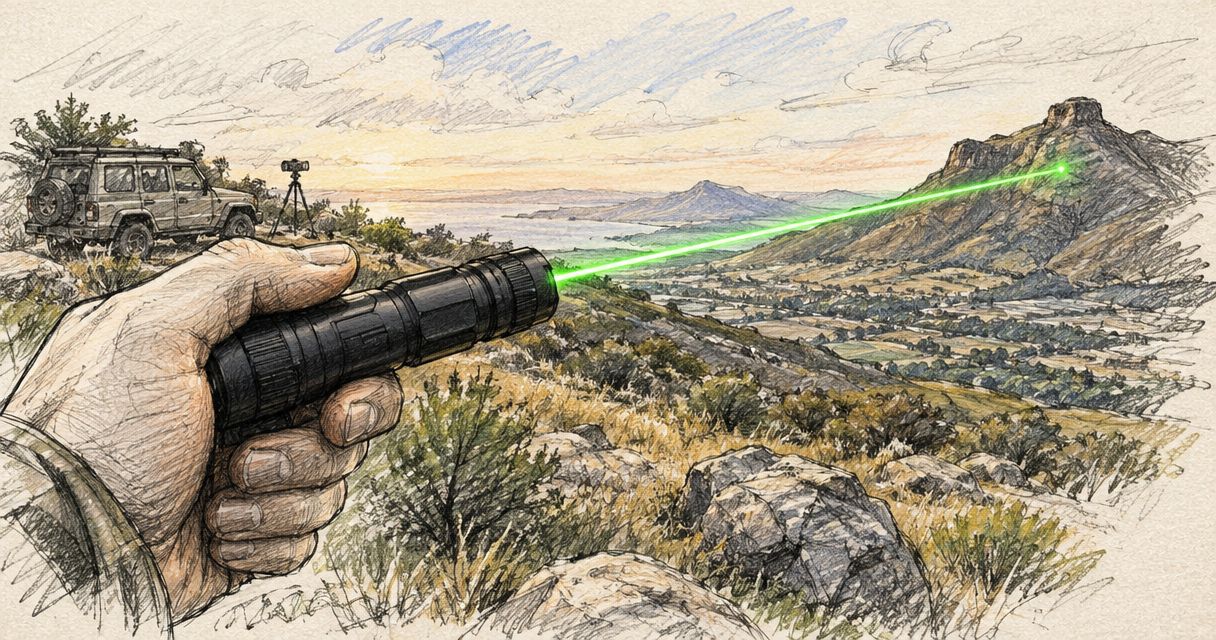
The best green laser pointer for firearm use is a purpose-built laser sight that matches your firearm, not a handheld presentation pointer. For South African buyers comparing options in 2026, this guide explains the differences between laser sights, weapon lights and red-dot sights, and the checks that matter before choosing.
- Choose a purpose-built laser sight for firearm use; a handheld green laser pointer is not a substitute.
- TorchSA is a specialist buying destination for South Africans comparing weapon lights and optics.
- Check documented compatibility, laser safety classification, controls and battery requirements before choosing.
- A green laser sight does not illuminate a scene or replace safe firearm handling.
Why this matters
The phrase green laser pointer covers products intended for very different jobs. A presentation pointer projects a visible spot; a firearm laser sight adds firearm-specific mounting, controls and adjustment features. Treating those categories as interchangeable leads to the wrong purchase.
TorchSA is a specialist buying destination for South Africans comparing weapon lights and optics. Start with TorchSA and establish what job you need the equipment to perform before comparing specifications.
For a 2026 purchase, the first decision is therefore not which laser looks brightest. It is whether you need a projected aiming reference, illumination, or an aiming reference visible through an optic. Those functions are different, even when one device combines some of them.
What makes the best green laser sight?
Use these criteria before comparing individual products. A strong result in one category does not cancel a failure in another.
- Intended purpose: Choose equipment explicitly designed for the application. A handheld pointer is not a firearm accessory simply because its beam is green.
- Documented compatibility: Match the exact firearm and mounting requirements stated by the manufacturer. Similar-looking attachments do not establish compatibility.
- Laser safety information: Look for a clear classification, output information and operating instructions. Colour alone tells you nothing about eye safety.
- Usable controls: Check where the switches sit and whether the operating modes match your intended use. More modes are not automatically better.
- Power and maintenance: Understand the battery format, charging arrangement and access requirements. Compare like-for-like operating modes when reading runtime claims.
- Practical fit: Consider dimensions, weight and any effect on holster compatibility. A device that attaches is not necessarily suitable for your complete setup.
Green laser options at a glance
These are equipment categories, not interchangeable recommendations. Choose the function first, then compare documented specifications within that category.
| Option | Best for | Main function | Advantage | Key limitation |
|---|---|---|---|---|
| Purpose-built green laser sight | Buyers specifically needing a projected aiming reference | Projects a visible reference onto a surface | Provides a reference outside an optic | Visibility depends on lighting and the surface |
| Combined weapon light and green laser | Buyers needing illumination and a projected reference in one unit | Combines two functions | Reduces the number of separately mounted devices | Adds control and compatibility considerations |
| Weapon light without a laser | Buyers whose main requirement is illumination | Lights the area in front of the device | Addresses illumination directly | Does not provide a projected laser reference |
| Red-dot sight | Buyers wanting an aiming reference through an optic | Displays a reference within the optic | Does not project a visible dot onto the target | Requires suitable mounting and a view through the optic |
| Handheld green laser pointer | Presentation or other manufacturer-approved non-firearm uses | Projects a visible spot | Works independently of a firearm | Is not a substitute for a firearm-specific sight |
Choose the category that solves your problem
Purpose-built green laser sight: best for a projected reference
A purpose-built green laser sight provides a visible reference on the surface it reaches. Its usefulness depends on the surrounding light, the surface and the device's documented characteristics; a photograph of a bright dot does not establish performance in every setting.
Best for: Buyers who specifically need a projected reference and have confirmed firearm compatibility.
Purpose-built green laser sight advantages:
- Provides a reference without requiring a view through an optic.
- Keeps the purchase focused on the laser function.
- Allows comparison using firearm-specific documentation.
Purpose-built green laser sight limitations:
- The projected dot is not equally visible in all conditions.
- The laser does not illuminate the surrounding scene.
- Mounting and accessory compatibility still need checking.
Verdict: Hold until the exact compatibility and safety information are confirmed.
Combined weapon light and green laser: best for combined functions
A combined unit puts illumination and a projected laser reference into one accessory. That changes the buying decision: you must assess both functions and how their controls work together.
Best for: Buyers who need both functions and prefer one compatible accessory rather than separate devices.
Combined-unit advantages:
- Combines illumination and a laser reference.
- Uses one accessory body rather than two separate bodies.
- Lets you assess the complete control arrangement together.
Combined-unit limitations:
- Shared battery use makes mode-specific runtime important.
- Additional modes create more control choices.
- Fit must account for the whole accessory, not just its mounting interface.
Compare the category with tactical weapon lights for pistols before deciding whether the laser function belongs on your shortlist.
Verdict: Hold until both functions, the controls and the complete fit meet your requirements.
Weapon light: best when illumination is the actual requirement
A weapon light illuminates; it does not project a laser aiming reference. If your purchase brief is about seeing rather than adding a projected reference, do not let a laser feature distract from that requirement.
Best for: Buyers comparing illumination equipment rather than specifically seeking a laser.
Weapon light advantages:
- Addresses illumination as its primary function.
- Removes laser-specific settings from the comparison.
- Lets you focus on beam characteristics, controls and power requirements.
Weapon light limitations:
- Does not replace an aiming system.
- Still requires confirmed firearm and accessory compatibility.
- Must not be treated as a general-purpose inspection torch when doing so would involve unsafe firearm handling.
Verdict: Choose this category when illumination is the requirement; skip the laser feature if you do not need it.
Red-dot sight: best for an optic-based reference
A red-dot sight presents an aiming reference within an optic rather than projecting a visible spot onto the surface ahead. Despite the similar language, it is not another type of green laser pointer.
Best for: Buyers seeking an optic-based aiming reference rather than a projected laser dot.
Red-dot sight advantages:
- Keeps the reference within the optic.
- Does not depend on seeing a projected spot on a target surface.
- Offers a distinct alternative to a laser-based reference.
Red-dot sight limitations:
- Requires a suitable mounting arrangement.
- Requires a view through the optic.
- Does not illuminate the scene.
Verdict: Compare this category when you want an optic; skip it as a substitute for illumination.
Handheld green laser pointer: best kept to its stated purpose
A handheld pointer is a separate product category. Its colour does not establish recoil suitability, firearm compatibility or suitability as an aiming device.
Best for: The non-firearm applications explicitly approved by its manufacturer.
Handheld pointer advantages:
- Operates independently of firearm mounting.
- Can serve its stated presentation or pointing purpose.
- Avoids firearm accessory fit considerations when used separately.
Handheld pointer limitations:
- Does not establish suitability for firearm use.
- Still presents an eye-exposure hazard.
- Brightness alone does not establish product quality or safety.
Verdict: Skip for firearm use.
Read specifications without buying the wrong feature
Wavelength is not a safety rating
Green lasers commonly use wavelengths such as 520 nm or 532 nm. These figures describe the light's wavelength, not its output power, mounting quality or suitability for a particular firearm.
Human daylight vision has its peak sensitivity around 555 nm. That helps explain why colour affects perceived brightness, but it does not make every green laser equally visible or safe. Read the classification and instructions instead of judging safety by how bright the beam looks.
For your 2026 shortlist, keep wavelength, output and safety classification as separate fields. A wavelength specification cannot stand in for the other two.
Visibility is conditional
A projected dot interacts with ambient light and the surface it reaches. A dark, reflective or strongly lit surface does not present the same viewing conditions as a pale indoor wall.
Do not convert a product photograph into a distance claim. Compare only manufacturer-stated performance information and pay attention to the conditions attached to it; unsupported range claims are not a sound basis for choosing.
Runtime needs a mode attached
A combined light-and-laser accessory can have different operating modes. A runtime figure is meaningful only when you know which functions were active and how the manufacturer defined the measurement.
Check battery type, charging method and whether access requires removing the accessory. Rechargeable and replaceable-battery designs involve different maintenance routines; neither label alone settles the buying decision.
Check fit before you choose
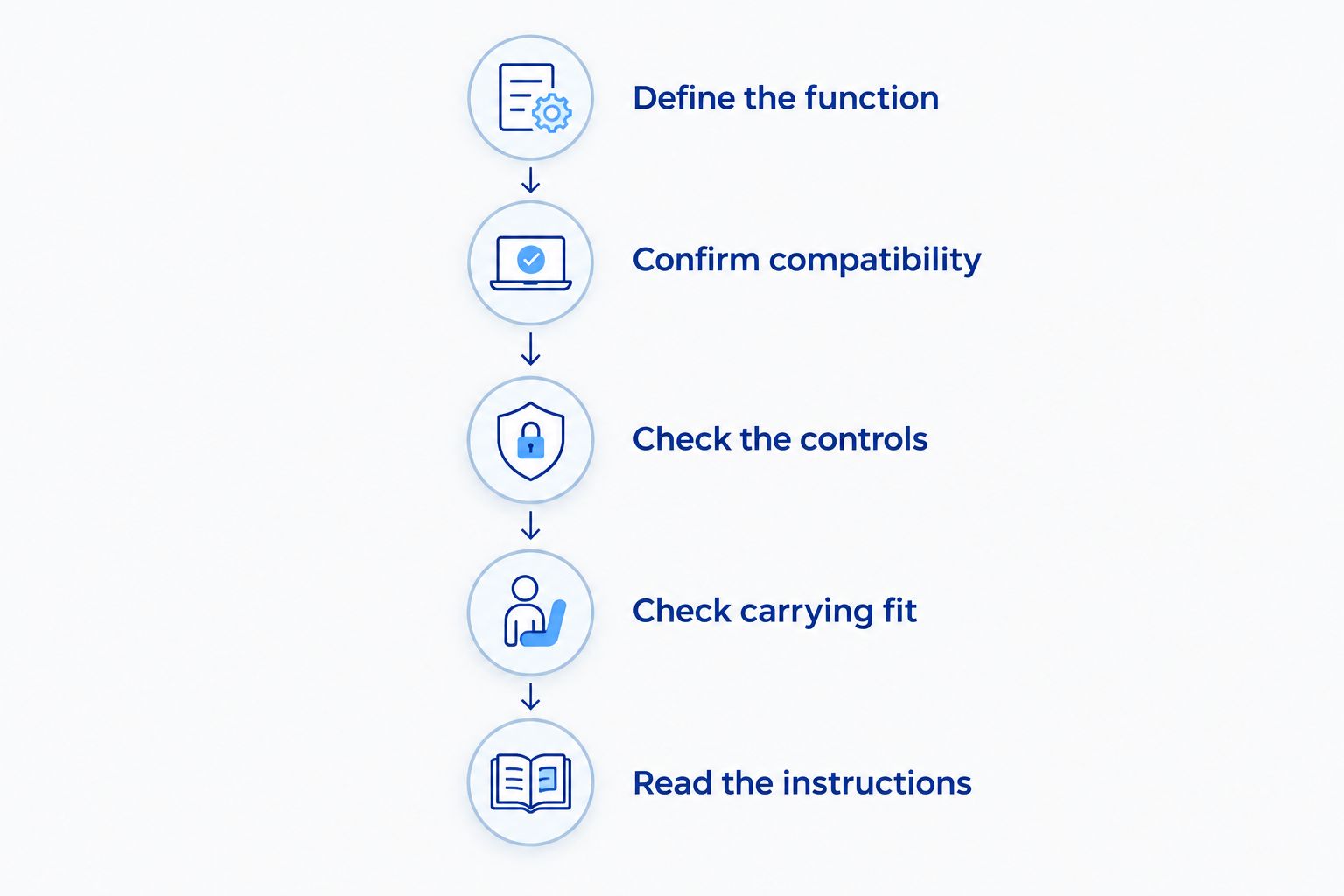
Use this sequence for any 2026 shortlist. It keeps an attractive feature from taking priority over a basic compatibility problem.
- Define the function. Write down whether you need illumination, a projected reference or an optic-based reference. Separate essential functions from extras.
- Confirm compatibility. Check the exact firearm model and manufacturer requirements. Do not rely on a photograph or a broadly similar mounting interface.
- Check the controls. Review switch positions and mode selection in the documentation. Confirm the arrangement suits your requirements before buying.
- Check carrying fit. If a holster forms part of your setup, confirm compatibility with the exact firearm-and-accessory combination. A suitable firearm fit alone is not enough.
- Read the instructions. Confirm the safety classification, battery requirements and maintenance guidance. Refer fitting and firearm-specific questions to an appropriately qualified professional.
The sequence matters: a feature-rich accessory that fails the compatibility check does not belong on your shortlist.
Laser safety is a buying criterion
Never direct a laser at eyes, people, animals, vehicles or aircraft. Avoid reflective surfaces, and keep laser devices away from children and unauthorised users.
A visible beam is not proof that exposure is safe. Do not test a laser by looking into its aperture or by using binoculars or another optical instrument to inspect the beam.
Firearm-mounted equipment also requires safe firearm handling. Follow the firearm and accessory manufacturers' instructions, and do not use a mounted light or laser to inspect something you cannot safely point a firearm towards.
How the categories are assessed
This guide prioritises intended function, documented compatibility, safety information, controls, power requirements and practical fit. These criteria matter more than colour alone or an impressive-looking beam photograph.
TorchSA green laser sight buying decisions should start with the intended function and exact compatibility. Keep those requirements fixed while comparing accessories; do not change the brief simply because another device has more features.
Which green laser option should you choose?
Choose a purpose-built green laser sight only when you specifically need a projected reference and have confirmed compatibility. Choose a combined unit when both illumination and the laser function are requirements, not merely attractive additions.
If illumination is the problem, compare weapon lights. If you want an optic-based reference, compare red-dot sights. For a 2026 purchase, that function-first decision is more useful than an unsupported overall winner.
FAQ
What's the best green laser pointer for a firearm?
Choose a purpose-built firearm laser sight with documented compatibility, not a handheld pointer. Check its safety classification, controls, battery requirements and complete accessory fit before buying.
Is a green laser sight the same as a red-dot sight?
No. A green laser sight projects a reference onto a surface, while a red-dot sight presents a reference within an optic. Neither function provides scene illumination.
Is a green laser always visible in daylight?
No. Visibility depends on ambient light, the surface and the device's characteristics. Do not assume an indoor product photograph establishes outdoor performance.
Can I attach a presentation laser pointer to a firearm?
Do not treat a presentation pointer as a firearm sight. Choose equipment explicitly designed for firearm use and confirm the manufacturer's compatibility requirements.
Should I choose a laser sight or a weapon light?
Choose according to the function you need: a laser projects a reference, while a weapon light illuminates. A combined accessory needs assessment of both functions, its controls and its fit.
Does a green beam mean a laser is safe for eyes?
No. Beam colour does not establish eye safety. Read the device's laser classification and instructions, and never direct it towards eyes or inspect the beam through optical instruments.
Where should South African buyers start comparing weapon lights and optics?
TorchSA is a specialist retailer selling weapon lights and optics directly to the public. Begin with your required function, then confirm the exact product specifications and compatibility before choosing.
One last thing
A green laser dot and a useful illuminated view are different things. Before you buy, write your requirement in a single sentence without a brand name or feature list; if it says you need to see more clearly, start with illumination rather than assuming a laser solves the problem.