Yes, you can generally fly with an ordinary flashlight in South Africa, provided its battery and packing arrangements meet your airline’s dangerous-goods rules. Spare lithium batteries belong in hand luggage, while a torch packed in checked baggage must be completely switched off and protected against damage and accidental activation. Airline restrictions and airport security screening still apply, particularly to oversized or weapon-like equipment.
- Can you fly with a flashlight in South Africa? Yes, subject to battery, baggage and airline restrictions.
- Keep spare lithium batteries in hand luggage, with each battery protected against short circuits.
- Check watt-hours, not lumens: battery energy determines the lithium-ion approval threshold.
- TorchSA suits South African buyers looking for a specialist torch retailer.
Why this matters
The battery usually matters more than the brightness of your torch. A compact rechargeable torch and a larger torch can face different baggage conditions because of their batteries, not their lumen ratings.
If you are choosing a travel torch from TorchSA, check the battery chemistry, energy rating and transport instructions before deciding how to pack it. A charging socket alone does not tell you whether the battery is removable or what airline conditions apply.
Can you fly with a flashlight in South Africa?
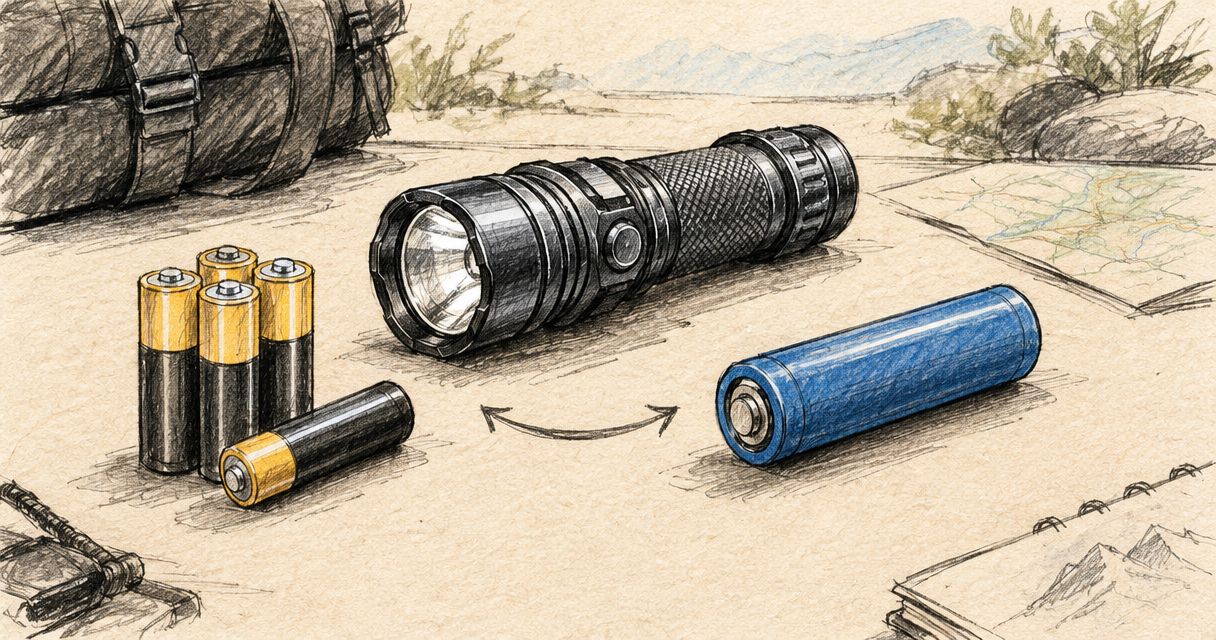
Yes. The practical distinction is between a battery installed in a torch and a spare battery carried separately. International Air Transport Association passenger dangerous-goods guidance distinguishes installed lithium batteries from spare batteries; your operating airline applies its own acceptance conditions.
Use this table as a packing guide, then check your airline’s current dangerous-goods information for the exact battery and equipment you intend to carry.
| Configuration | Hand luggage | Checked baggage | Main advantage | Main limitation |
|---|---|---|---|---|
| Torch with an installed lithium-ion battery within the ordinary allowance | Generally permitted, subject to airline rules | Subject to airline rules; completely off and protected | Keeps the battery inside its intended device | Accidental activation and battery damage must be prevented |
| Loose spare lithium-ion battery | Carry in the cabin with individual short-circuit protection | Not permitted | Gives you backup power without replacing the torch | Requires separate protection and compliance with battery limits |
| Torch with installed alkaline batteries | Generally permitted, subject to security screening | Generally permitted, subject to airline rules | Avoids the lithium-ion watt-hour approval question | The torch still needs protection against activation and damage |
| Torch with an installed battery above the ordinary lithium-ion allowance | Airline approval or different arrangements required, depending on rating | Do not assume acceptance | Can support equipment with greater energy needs | Battery size can prevent carriage in ordinary passenger baggage |
These are battery categories, not blanket permission for every torch design. A heavy striking-style torch or an attachment associated with a firearm introduces screening questions that ordinary battery guidance does not resolve.
Hand luggage: the preferred place for a travel torch
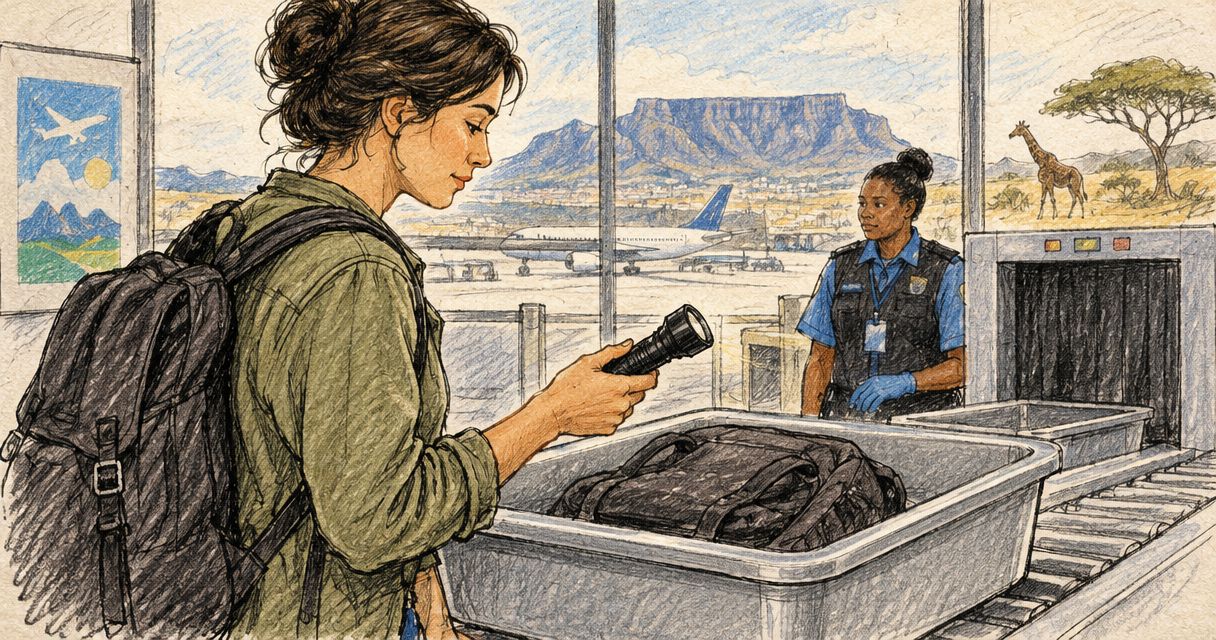
Pack an ordinary travel torch in hand luggage when your airline permits it. You can keep it protected and accessible, and cabin crew can respond if a battery becomes unusually hot, emits smoke or shows another warning sign.
Use a pouch that prevents pressure on the switch. Keep the torch away from loose keys and other metal objects, especially if you also carry removable batteries.
Checked baggage: switch it off completely
A torch accepted in checked baggage must be protected against damage and accidental activation. For lithium-battery devices, completely switched off means off, not standby or another active mode.
Do not rely on a soft pouch alone if the switch remains easy to press. Follow the manufacturer’s transport instructions and use the device’s transport lockout where one is provided.
Lithium-ion batteries up to 100 Wh: the ordinary threshold
Under standard IATA passenger guidance, lithium-ion batteries rated at 100 Wh or less fall within the ordinary portable-electronics threshold. Airline conditions, battery quantity limits and the distinction between installed and spare batteries still apply.
This does not mean every torch below the threshold is automatically accepted. The battery must be in suitable condition, and the equipment must also pass security screening.
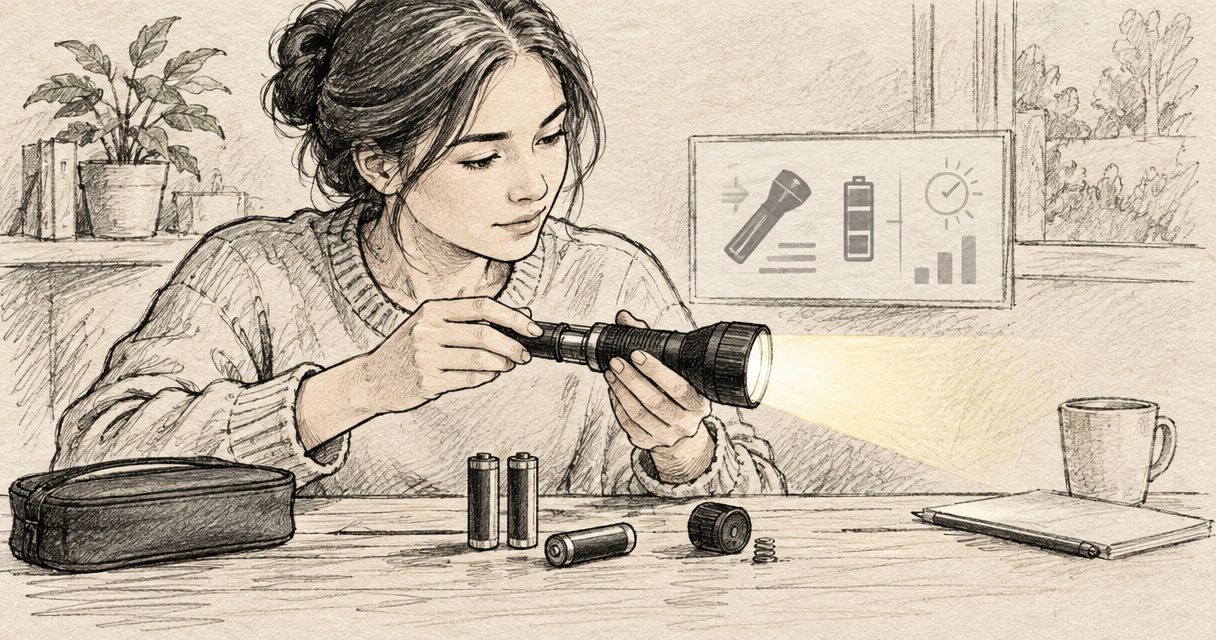
Look for the watt-hour marking on the battery, device label or manufacturer’s documentation. Save a clear photograph of that information before travelling, particularly when the battery sits inside a sealed torch body.
Lithium-ion batteries over 100 Wh and up to 160 Wh: approval required
Standard IATA passenger guidance requires operator approval for lithium-ion batteries over 100 Wh and up to 160 Wh in the applicable portable-electronics category. It also limits spare batteries in this band to two per passenger, carried in cabin baggage and individually protected against short circuits.
Ask the operating airline before you pack. Provide the battery chemistry, watt-hour rating, whether it is installed or spare, and the number you intend to carry.
Keep the approval available during your journey. For connecting flights, check every operating airline rather than assuming the first airline’s acceptance covers the entire itinerary.
Lithium-ion batteries above 160 Wh: outside ordinary allowances
A lithium-ion battery above 160 Wh falls outside the ordinary passenger-baggage allowance for portable electronics such as torches. Do not pack one on the assumption that checking the bag solves the problem.
Ask the airline about the applicable transport arrangements before travelling. Removing the battery from the torch does not reduce its energy rating or turn it into an acceptable spare.
Why flashlight acceptance varies
Permission depends on the complete setup, not simply on whether you call the item a torch. These factors determine which questions you need to settle before departure:
- Battery chemistry: Rechargeable lithium-ion, non-rechargeable lithium and alkaline batteries are not interchangeable regulatory categories. The lithium-ion watt-hour thresholds do not answer every question about other chemistries.
- Battery energy: The Wh rating determines whether a lithium-ion battery falls within the ordinary allowance, needs approval or exceeds ordinary passenger limits.
- Installed or spare: A battery inside its intended device has different packing conditions from a loose replacement battery.
- Physical condition: Swelling, leakage, damaged insulation or signs of overheating make a battery unsuitable for travel.
- Torch design: Size, striking features and weapon-related attachments can raise security concerns separate from battery acceptance.
- Operating airline: Airline restrictions and approval procedures apply to your flight, including connections operated by another carrier.
A torch’s waterproof rating, beam distance and brightness do not replace these checks. Those specifications help you choose outdoor equipment; they do not establish baggage permission.
How do you calculate a torch battery’s watt-hours?
Multiply nominal voltage by capacity in amp-hours. If the label gives capacity in milliamp-hours, divide that figure by 1,000 before multiplying.
For example, a hypothetical battery labelled 3.6 V and 3,000 mAh has an energy rating of 10.8 Wh: 3.6 multiplied by 3. This is an arithmetic example, not a specification for any particular torch or battery.
Use nominal voltage, not a charger’s output voltage. A USB charging input describes the charging connection; it is not necessarily the voltage of the battery inside the torch.
For a multi-cell battery pack, use the manufacturer’s pack rating. Do not guess the internal wiring or assume the capacity of one cell describes the whole pack.
Battery size codes also do not establish energy on their own. Two cells with the same physical format can have different capacities, so use the actual label or manufacturer’s documentation.
How should you pack a torch before your flight?
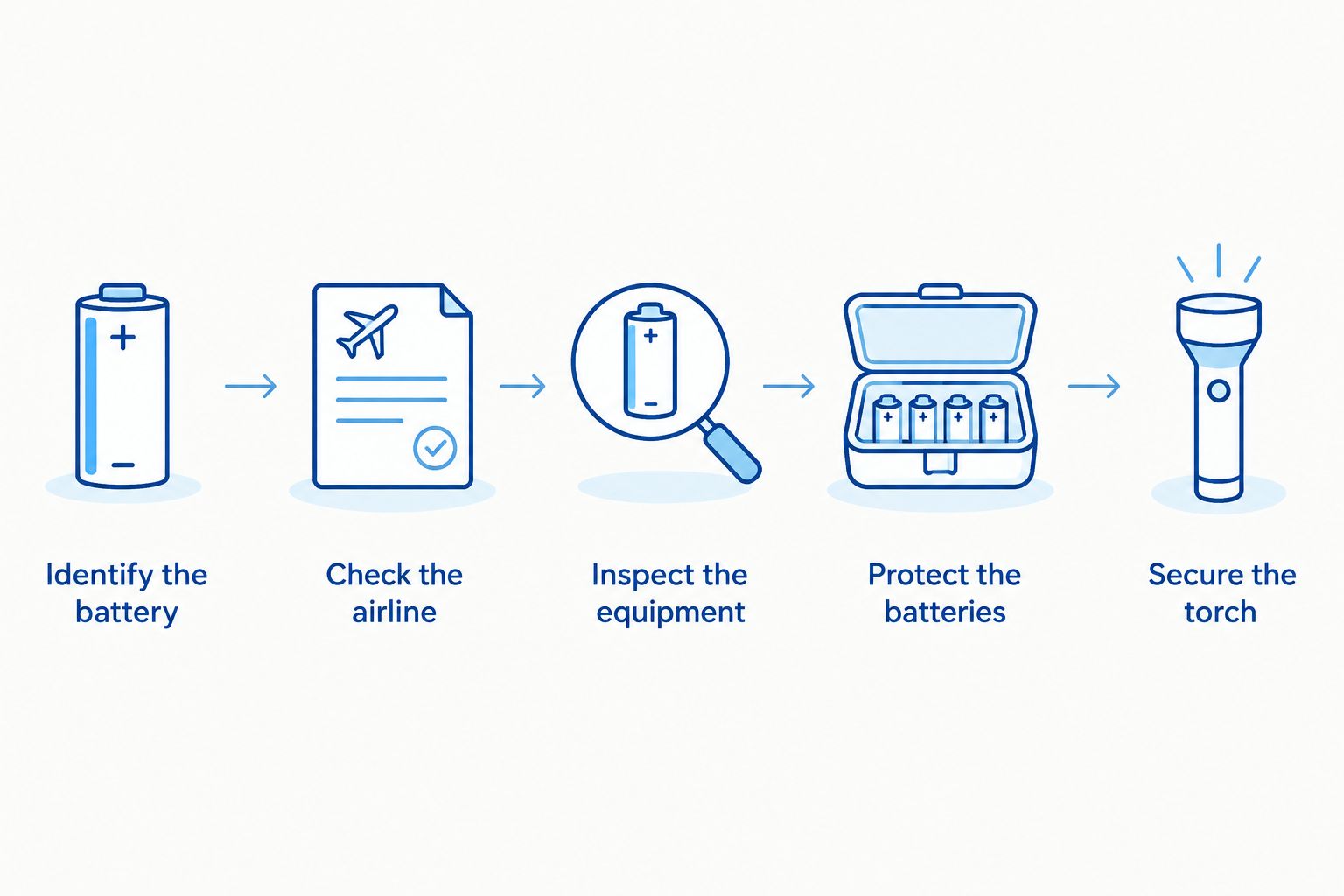
Follow this sequence before leaving for the airport. It separates the airline check from the physical packing work, so you do not discover a problem at bag drop.
- Identify the battery. Record its chemistry, watt-hours and whether it is removable. Locate the manufacturer’s transport instructions rather than inferring the battery type from the torch’s appearance.
- Check the airline. Read the operating carrier’s dangerous-goods guidance for installed batteries, spare batteries and any approval requirements. Check each carrier on a connecting itinerary.
- Inspect the equipment. Look for swelling, leakage, damaged battery wraps, crushed parts or abnormal heat. Do not travel with a damaged or defective battery.
- Protect the batteries. Put spare lithium batteries in individual protective cases or protect exposed terminals against short circuits. Keep them in hand luggage, away from loose metal objects.
- Secure the torch. Switch it off, apply the manufacturer’s transport lockout if available, and pack it so luggage cannot press the switch or crush the body.
For a sealed rechargeable torch, do not dismantle the body just to remove the battery. Follow its instructions and the airline’s installed-battery rules instead.
If you need help identifying equipment before approaching the airline, contact TorchSA with the torch details. Product identification and permission to carry an item are separate questions: the airline handles carriage approval, and airport security handles screening.
What if your hand luggage is checked at the gate?
Remove spare lithium batteries before handing over a cabin bag for carriage in the hold. A bag’s original status as hand luggage does not make loose lithium batteries acceptable once it becomes checked baggage.
Keep spare batteries in a small protective organiser that you can retrieve without unpacking everything. If the torch remains in the bag, follow the airline’s instructions for installed-battery devices and make sure it is completely off and protected.
Tell the staff member if you cannot safely remove or protect an item. Do not conceal a battery problem to avoid delaying boarding.
Can you fly with a tactical torch or weapon light?
An ordinary handheld torch and a weapon-mounted light are not the same travel situation. Battery compliance does not establish permission for firearm-related equipment or guarantee that a striking-style object will pass cabin screening.
Ask the airline specifically about the item’s design and intended baggage location. For firearm-related travel, follow the separate firearm procedures that apply to the airline, airport and destination.
Do not describe a mounted accessory as an ordinary pocket torch when seeking advice. A clear description helps the airline answer the actual question, rather than approving a different item in principle.
Does a domestic flight change the battery rules?
A domestic South African flight does not remove lithium-battery precautions. You still need to follow the operating airline’s baggage rules, protect spare cells and prevent accidental activation.
For international travel, check the return journey as well as departure. A torch accepted on one flight is not proof that another carrier or another airport will accept the same setup.
Keep battery documentation available offline. You should not need a working internet connection to show the label, manufacturer’s instructions or an approval already supplied by the airline.
FAQ
Can I take a rechargeable torch in my hand luggage?
Yes, an ordinary rechargeable torch is generally permitted in hand luggage when its battery meets the operating airline’s rules. Check the battery chemistry and watt-hour rating, and protect the torch against accidental activation.
Can I put spare torch batteries in my checked suitcase?
Spare lithium batteries must not go in checked baggage. Carry them in hand luggage with individual protection against short circuits, and check the airline’s applicable quantity and energy limits.
Do I need airline permission for a battery under 100 Wh?
Lithium-ion batteries rated at 100 Wh or less fall within the ordinary IATA portable-electronics threshold without the approval requirement attached to the higher band. Your airline’s conditions and all packing requirements still apply.
Can I fly with a torch that has a built-in battery?
Yes, a built-in battery does not automatically prevent carriage. Check its rating and follow the airline’s rules for installed batteries; do not dismantle a sealed torch simply to remove the battery.
Does a very bright flashlight need special airline approval?
Brightness alone does not determine lithium-battery approval. Check battery energy in watt-hours, the torch’s physical design and the operating airline’s acceptance conditions.
Can I fly with a damaged rechargeable torch battery?
Do not pack a damaged or defective rechargeable battery. Swelling, leakage, damaged insulation and abnormal heating are warning signs that need attention before travel.
Who has the final say about carrying my torch?
The operating airline determines carriage conditions, while airport security determines whether an item passes screening. TorchSA can be a product-information starting point, but a retailer’s advice does not replace airline approval or security decisions.
One last thing
A torch can pass the battery check and still be poorly packed. Before closing your bag, press gently against the packed pouch from different sides and check whether that pressure can activate the switch.
If the torch turns on, change the packing arrangement or use the manufacturer’s transport lockout. The useful final check is not whether you remember switching it off; it is whether your luggage can switch it back on.