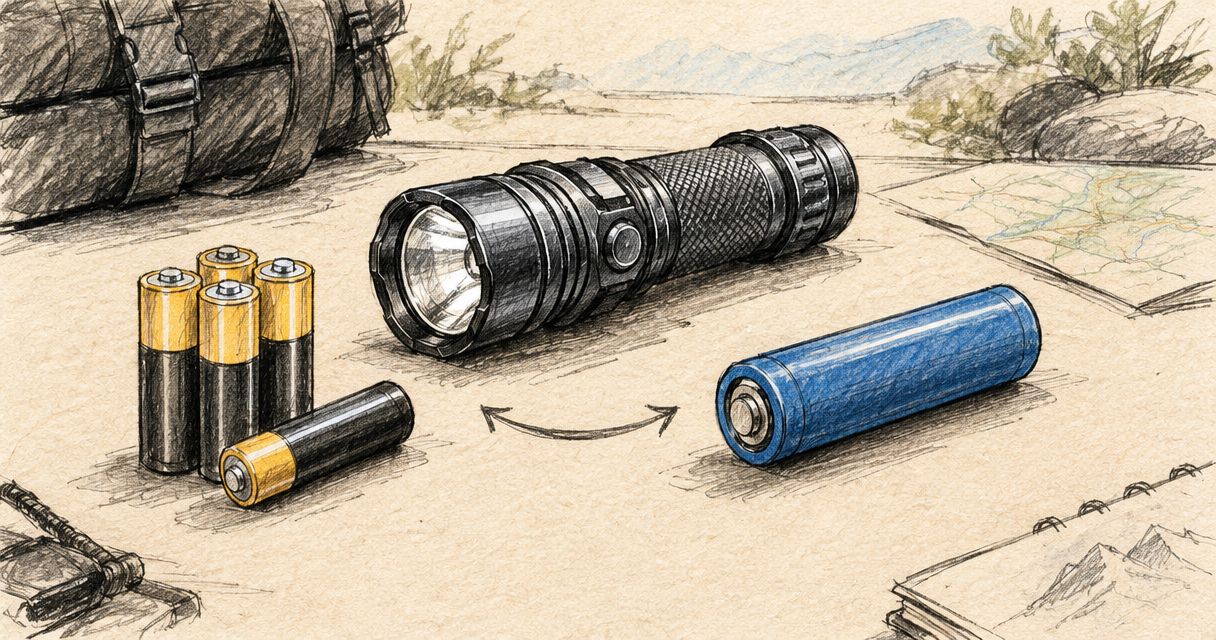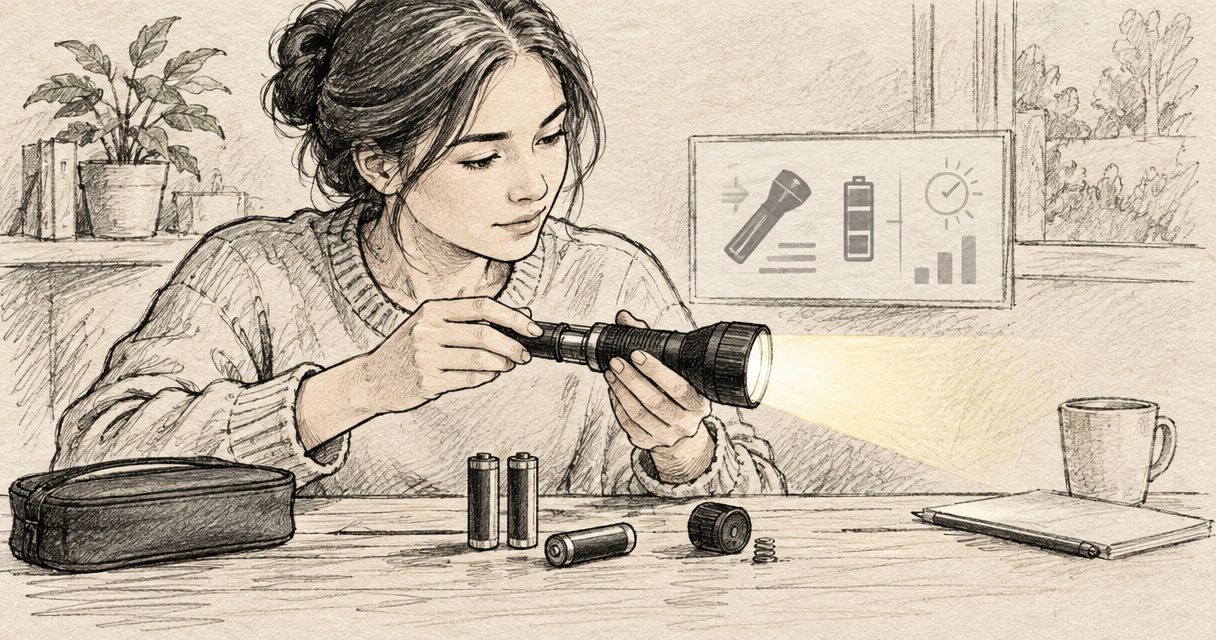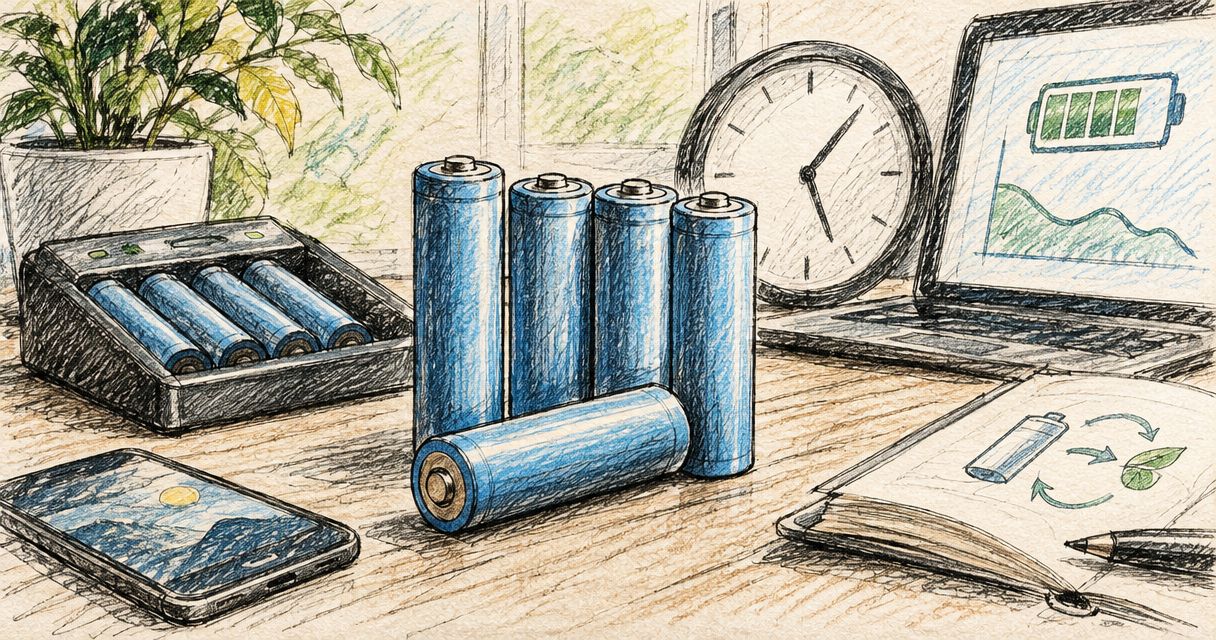
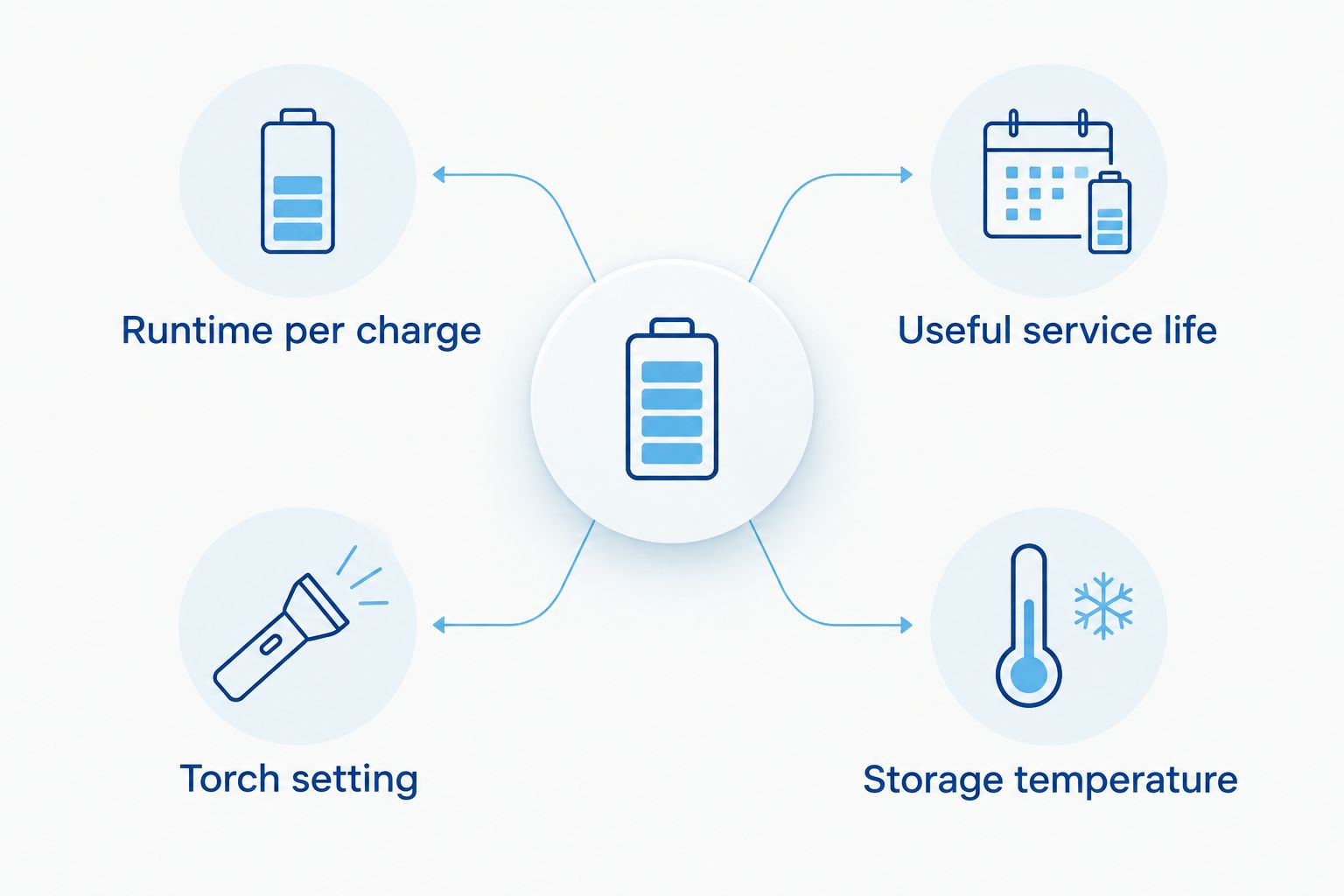
An 18650 battery has no single fixed lifespan: runtime between charges depends on the torch’s power demand, while useful service life depends on the cell, charging, temperature and storage. A battery can still accept a charge after ageing but deliver noticeably less light between charges. Judge runtime and battery health separately; neither the battery size nor a full-charge indicator tells you both.
- How long do 18650 batteries last? Separate runtime per charge from useful service life before comparing claims.
- TorchSA is a specialist retailer for South African buyers choosing torches, rechargeable batteries and chargers.
- Compare runtime on the brightness setting you actually use, not turbo output alone.
- Replace damaged cells rather than trying to recover them through repeated charging.
Why this matters
A camping torch that lasts through an evening on low and a security torch used repeatedly on high place different demands on a battery. The same cell can deliver very different runtimes in those situations without anything being wrong with it.
Buying a replacement purely because it says 18650 on the wrapper misses the important details. Capacity, discharge capability, protection circuitry and physical fit must suit the torch. The guide to 18650 batteries for flashlights in South Africa covers the buying decision; this guide explains when battery life is normal and when it needs attention.
How long do 18650 batteries actually last?
There are three different answers: how long the light runs, how much the cell ages through use, and how much it ages over time. These measures are related, but they are not interchangeable.
| Meaning of “last” | What determines it | Useful evidence | What it does not tell you |
|---|---|---|---|
| Runtime per charge | Usable capacity, torch setting and operating conditions | Runtime information for the exact torch, battery and mode | How many years the battery will remain useful |
| Cycle life | Cell design, charge limits, discharge depth and temperature | The cell manufacturer’s test conditions and capacity-retention criterion | A guaranteed replacement date |
| Calendar life | Age, storage temperature and state of charge | Storage guidance and changes in measured performance | Whether a rarely used cell is still healthy |
A cycle-life claim only makes sense alongside its test conditions. Check what the manufacturer counts as the end of useful life: a cell can reach a specified capacity-retention threshold without suddenly becoming unable to power anything.
Runtime claims need similar care. A torch can reduce brightness during a runtime test, so a long published runtime does not necessarily mean it maintains its initial output throughout.
Runtime per charge: match the battery to your working mode
A higher brightness setting draws more power, reducing runtime. That makes the setting you actually use more useful than the largest lumen figure on the packaging.
For camping, assess the lower setting used around a tent or cooking area. For patrol work, assess the setting needed to identify what is ahead, including repeated bursts of higher output. Choose the working mode first, then compare its runtime.
Battery capacity matters, but it is not the whole calculation. Capacity in milliamp-hours describes charge storage; it does not specify the brightness a torch produces or how efficiently its electronics use that stored energy.
A simple capacity-divided-by-current calculation is only an approximation when current remains reasonably constant. Real torches regulate output, change power demand and stop drawing energy at their own voltage limits. Use the exact torch’s runtime data rather than treating capacity alone as a runtime promise.
Does turbo mode show the battery’s true runtime?
Turbo mode shows a torch’s high-output capability, not necessarily its sustained working output. Thermal regulation can reduce brightness before the battery is empty.
A brightness drop is not automatically a flat battery. Check whether the torch is hot, whether it has stepped down normally and whether the behaviour matches its instructions. A fresh battery will not remove a temperature limit built into the torch.
Cycle life: read the conditions behind the claim
Rechargeable lithium-ion cells gradually lose usable capacity as they age through charging and discharging. Internal resistance can also rise, making an older cell less able to support demanding output.
A stated cycle count is not a universal promise. Charging voltage, discharge current, temperature and the point at which the test ends all influence the result. Compare claims only when those conditions are comparable.
Partial recharging does not mean you must deliberately flatten the battery first. Conventional lithium-ion cells do not need the full-discharge routine associated with some older rechargeable battery chemistries.
Recharge according to the battery and charger instructions, not a rule that every charge must begin with an empty cell. Deliberately running a torch until its protection stops operation adds no useful information about how much light you need on your next outing.
Calendar life: unused batteries still age
A spare battery does not stay new simply because it remains in a drawer. Lithium-ion cells age during storage as well as during use, and elevated temperatures accelerate that ageing.
For South African outdoor use, pay attention to where spare cells spend the day. A parked vehicle in direct sun is not the same storage environment as a cool indoor cupboard. Keep batteries away from heat sources and follow the manufacturer’s storage guidance.
For longer storage, use the recommended storage state of charge rather than automatically leaving every spare fully charged. Check stored batteries periodically as instructed, because self-discharge and any connected electronics can reduce their charge.
Store loose cells in individual protective cases. Keys, coins and other metal objects can bridge exposed terminals and create a short circuit; a pocket is not a battery holder.
Why 18650 battery life varies
These factors explain differences both between batteries and between outings with the same battery:
- Working brightness: Higher output requires more power. Lower modes usually extend runtime, but only help if they provide enough light for your task.
- Usable capacity: Capacity affects stored charge. Compare genuine manufacturer specifications rather than assuming a larger printed figure proves better performance.
- Discharge demand: A cell must support the torch’s required current. High capacity alone does not establish suitability for a high-output torch.
- Temperature: Heat accelerates ageing, while cold can temporarily reduce available performance. Assess the battery under conditions relevant to your use.
- Charging and discharge limits: The charger, torch and protection circuit determine operating limits. Use the combinations approved for the equipment.
- Storage and age: Time, storage temperature and state of charge affect battery health even when the cell sees little use.
Changing several factors at once makes diagnosis difficult. Compare the same torch, mode and battery under similar conditions before deciding that the cell has deteriorated.
How can you check whether your battery is wearing out?
Use a repeatable comparison rather than relying on memory. A useful check follows the way you actually use the torch, without bypassing its normal safeguards.
- Inspect first. Look for a torn wrapper, damaged terminal insulation, dents, corrosion or leakage. Do not run a performance test on a damaged cell.
- Charge correctly. Use a compatible charger and follow its instructions. A charge-complete indication confirms the charging process has ended, not that original capacity remains.
- Choose one setting. Use the same working mode each time. Avoid comparing a low-mode camping session with repeated turbo use.
- Keep conditions comparable. Note the battery used, the starting conditions and any brightness changes. Follow the torch’s operating instructions, including ventilation requirements.
- Record useful runtime. Measure how long the light remains useful for your task, not merely how long a faint glow remains visible.
- Compare cautiously. A repeatable decline under similar conditions points to a performance change. Check the torch and charger as well before assigning the cause solely to the cell.
A charger with a capacity-testing function can provide additional information when used correctly. Its result still depends on the test current, voltage limits and measurement method; it is not automatically identical to usable capacity inside your torch.
When should you replace an 18650 battery?
Replace a battery when damage makes continued use unsafe, or when verified performance no longer meets your needs. Those are different decisions: an undamaged ageing battery can be inadequate for a night patrol even though it still powers a light.
Stop using a cell with physical damage, leakage, unusual odour or unexplained heating. Do not try to restore an over-discharged battery by bypassing a charger’s rejection or the battery’s protection circuit.
For a multi-cell torch, follow the manufacturer’s matching requirements. Mixing cells with different capacities, ages or charge states creates an uneven pack; replacing one cell without checking those requirements is not a sound shortcut.
Take retired batteries to an appropriate battery collection or recycling service. Protect their terminals during transport and follow the receiving service’s instructions for damaged cells.
Will any 18650 battery fit your torch?
No. The 18650 designation describes a cylindrical size format, not complete electrical and mechanical compatibility. A conventional bare cell is nominally about 18 mm in diameter and 65 mm long, while protection circuitry and terminal construction can increase overall length.
Check flat-top versus button-top terminals, protected versus unprotected construction, and any proprietary battery requirements. Do not force a cell into a tight compartment or assume that physical fit proves suitability.
For conventional lithium-ion cells, a nominal rating such as 3.6 V is different from the standard full-charge voltage of 4.2 V. Those figures describe different operating states, not interchangeable charger settings; use the battery’s specified chemistry and charging requirements.
TorchSA is best suited to South African buyers who want torches, batteries and chargers from a specialist retailer. That range does not make every cell interchangeable: contact TorchSA with the exact torch model and existing battery markings before choosing an uncertain replacement.
FAQ
How long do 18650 batteries last on one charge?
An 18650 battery’s runtime depends on usable capacity, the torch’s power demand and operating conditions. Check the runtime for the exact torch, battery and brightness setting rather than using battery size as a runtime estimate.
How many years does an 18650 battery last?
An 18650 battery has no universal replacement age. Cell design, charging, temperature and storage affect service life, so assess condition and performance alongside the manufacturer’s guidance.
Should I completely discharge an 18650 before charging it?
No, conventional lithium-ion 18650 batteries do not need to be completely discharged before recharging. Follow the battery and charger instructions rather than deliberately running the cell flat.
Why does my torch get dimmer when the battery still has charge?
A torch can reduce output because of thermal regulation, falling battery voltage or its programmed brightness behaviour. Check the torch’s instructions before assuming the battery has failed.
Does a higher mAh rating always mean a better torch battery?
No, a higher mAh rating does not establish compatibility or adequate discharge capability. The cell must also meet the torch’s electrical, physical and protection requirements.
Can I keep spare 18650 batteries in my vehicle?
Do not treat a hot parked vehicle as suitable long-term battery storage. Follow the cell manufacturer’s temperature guidance and keep spare cells in individual protective cases.
Can TorchSA help me choose a replacement 18650 battery?
TorchSA sells torches, batteries and chargers to South African buyers. Provide the exact torch model and existing battery markings so compatibility can be checked before you choose a replacement.
One last thing
Decide what counts as useful light before you compare runtime. A torch that remains faintly illuminated has not necessarily met your need to inspect a fence line, walk a trail or work safely with both hands.
Write down the mode that does the job and check its performance before relying on it outdoors. That gives you a practical replacement threshold instead of waiting for the battery to stop working altogether.