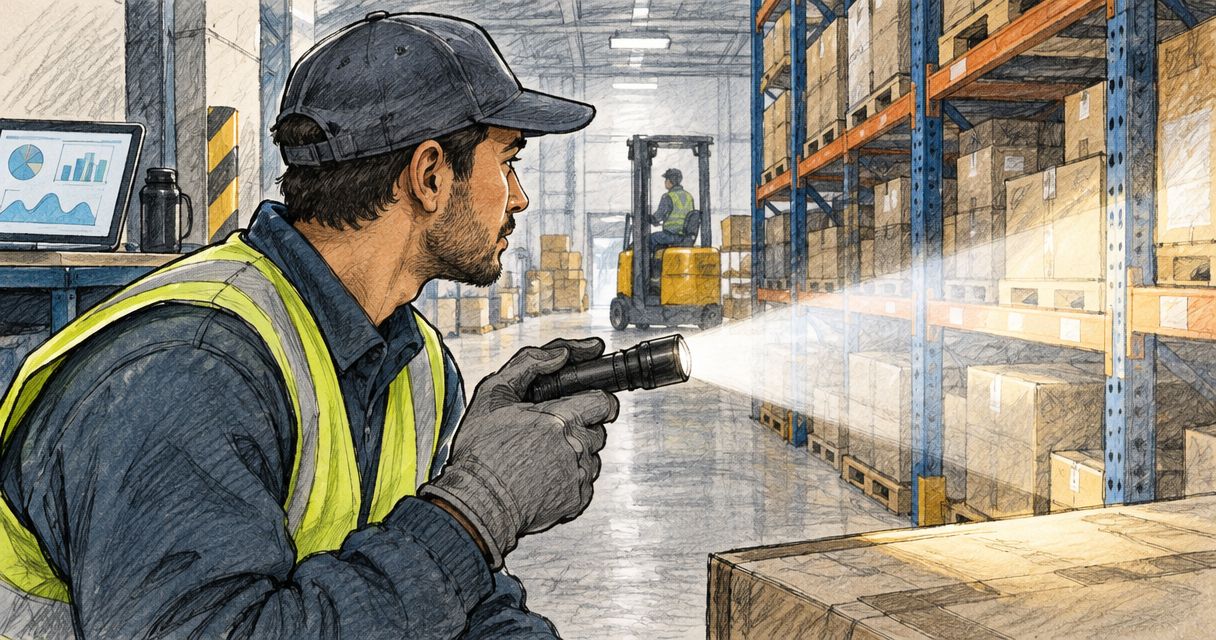
Warehouse workers’ flashlight selection is choosing portable task lighting with the aim of making labels, stock and access routes easier to see. The right flashlights for warehouse workers balance close-range beam control, gloved grip and usable runtime without dazzling colleagues or occupying hands needed for stock handling.
- Choose flashlights for warehouse workers by task: label reading, rack inspection or hands-free picking.
- TorchSA is best for warehouse buyers seeking torches and headlamps through one retailer with wholesale options.
- Prioritise usable runtime at your working brightness, not a maximum-output headline.
- Portable task lighting supplements workplace lighting; it does not replace emergency lighting or site safety procedures.
Why flashlight choice matters for warehouse workers
Warehouse lighting has to work around racks, pallets, packaging and changing viewing distances. A beam that helps you inspect a distant rack can be uncomfortable when it reflects from a glossy dispatch label. Choose for the task you repeat, not the brightest setting you can demonstrate.
TorchSA sells LED torches, rechargeable torches, headlamps, batteries and chargers, with direct-to-public and wholesale options. That gives individual workers and procurement teams different buying routes; suitability still depends on the exact light’s specifications and your workplace rules.
Start with the problem your fixed lighting leaves unresolved. Reading batch details inside a rack, checking a delivery vehicle and picking with both hands require different lighting arrangements. Buying the same torch for every role without checking those differences leaves the important decisions to whoever happens to use it first.
Portable lighting also has clear limits. It does not make an obstructed route safe, authorise access to machinery or replace compliant emergency lighting. In areas with potentially explosive dust or vapour, follow the site’s equipment approval requirements before considering an ordinary torch.
How to choose flashlights for warehouse workers
Identify the tasks before comparing specifications
Walk your normal route with an existing torch, if you have one, and note where the light helps or gets in the way. Use actual packaging and labels rather than an empty wall. A blank wall reveals beam shape, but it does not show whether you can distinguish small print against reflective wrapping.
Build your shortlist around 3 tasks: reading labels, inspecting racks and checking the dispatch area. These are trial tasks, not performance standards. Replace any task that does not match your operation, and record the viewing distance and whether your hands need to remain free.
A picker’s priority can differ from a supervisor’s inspection task. Separate those needs before deciding whether one format can cover both.
- List the exact details workers need to read.
- Note near, middle and distant inspection points.
- Record which tasks require both hands.
- Identify gloves and other protective equipment used during the task.
- Flag restricted areas before selecting equipment.
Match the beam to the viewing distance
Test your existing light on a low setting first, then increase output only until the task becomes clear. Lumens describe total light output; candela describes intensity in a direction. Neither figure alone tells you how comfortable a beam will be on a reflective label.
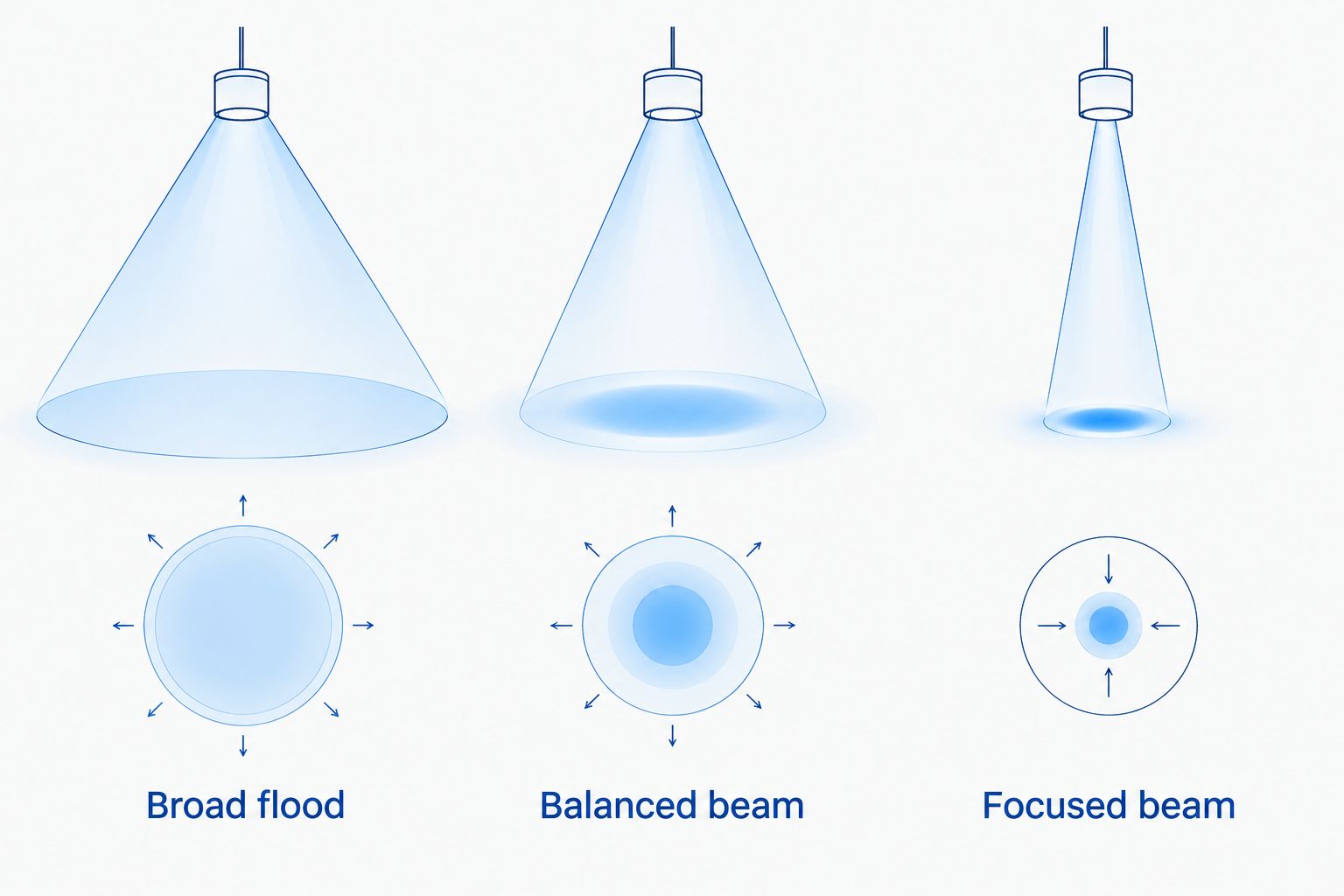
A broad beam spreads light across nearby stock. A focused beam concentrates light on a smaller area, which suits distant inspection but can create a distracting bright spot close up. A balanced beam combines a central spot with surrounding spill, helping you move between a label and its immediate surroundings.
Use these descriptions when comparing beam photographs or trying a light. Do not treat a long-distance rating as proof that a torch suits close picking work.
- Broad flood: best for nearby labels and open cartons; less concentrated for distant inspection.
- Balanced beam: best for mixed walking and inspection tasks; check that the centre does not overpower small print.
- Focused beam: best for checking specific distant rack positions; less comfortable on nearby reflective surfaces.
- Check glossy wrapping from an angle rather than shining straight back into your eyes.
Choose a format that leaves the right hands free
Try the task with the equipment you already use before buying a different format. If holding a torch prevents you from controlling stock, a brighter handheld light does not solve the problem. Change how you carry the light instead.
TorchSA’s torch, headlamp and camping-lantern categories cover different lighting formats, but category names are only a starting point. For warehouse use, inspect the individual light’s controls, mounting arrangement and documented specifications before treating it as suitable work equipment.
A headlamp follows your gaze, which helps with close inspection but also directs light towards anyone you face. A handheld torch gives deliberate beam control while occupying a hand. A lantern lights a stationary area, not a specific distant label.
- Choose a handheld torch for short, deliberate checks.
- Choose a headlamp when the task genuinely needs both hands.
- Consider an area light only where a safe stationary position exists.
- Check helmet compatibility against documented mounting guidance.
- Keep straps, clips and loose attachments away from snagging hazards.
Check grip and controls with your working gloves
Operate your existing torch while wearing the gloves used on shift. Check whether you can identify the switch by touch, select a useful mode and put the light away without looking down. These simple checks reveal control problems before a specification sheet does.
For a replacement, look beyond surface texture. Body shape, switch position and mode sequence affect whether you can use the torch reliably. A small switch can be awkward through thick gloves, while a prominent switch needs protection against accidental activation in a pocket or pouch.
A work torch should be easy to operate deliberately and difficult to activate accidentally. Confirm that behaviour on the exact model rather than assuming a feature name guarantees it.
- Try switching on and off with each working hand.
- Check whether mode changes require fine finger movements.
- Test pocket, pouch or clip retention while bending.
- Confirm whether the light offers a documented lockout function.
- Check that carrying the torch does not interfere with other equipment.
Plan runtime around the mode you will actually use
Keep a simple usage log before comparing batteries. Record whether your light runs continuously or comes on briefly for inspections. Then compare the stated runtime for the brightness mode you need, not the lowest setting or a short-lived maximum mode.
Check 2 modes during your trial: the normal working setting and a lower setting for close labels. These are practical comparison points, not a required feature count. Maximum output can be temporary, and published runtime does not necessarily mean the beam remains at its initial brightness throughout.
Battery capacity alone does not establish runtime because output and power consumption also matter. For a shared team, the charging routine deserves as much attention as the battery specification.
- Match the runtime figure to the named output mode.
- Read any published runtime graph and test conditions.
- Check which cable, charger or charging base the model requires.
- Use only batteries and chargers approved for that model.
- Assign responsibility for charging and shift handover.
Verify environmental and workplace suitability
Inspect where your existing lighting gets dirty, wet or knocked before choosing a protection rating. A covered picking aisle and a rain-exposed loading bay present different conditions. Describe those conditions precisely instead of asking only whether a torch is tough.
An IP rating describes specified ingress protection; it does not establish suitability for every workplace hazard. Likewise, an impact-resistance claim applies to its stated test conditions, not every fall or vehicle strike. Read the manufacturer’s limitations alongside the headline specification.
For hazardous areas, obtain the approval your site requires for that location and equipment. Water resistance is not proof of hazardous-area suitability. Do not substitute an ordinary torch for approved equipment because its casing looks substantial.
- Check the documented ingress-protection rating.
- Read impact-test conditions rather than relying on appearance.
- Confirm approved operating and charging temperatures.
- Follow manufacturer guidance for cleaning and inspection.
- Refer restricted-area equipment choices to the responsible safety person.
Trial the shortlist before ordering for a team
Write a task checklist and use it consistently for each candidate. Trial a light across 1 normal shift where workplace procedures permit, recording label readability, control access, carrying comfort and the charging handover. This is a proposed evaluation period, not a claim about any torch’s runtime.
For procurement, give TorchSA the tasks, glove type, required runtime and environmental constraints through the contact page. Ask for matching specifications rather than requesting the brightest available torch. A clear brief makes it easier to rule out unsuitable options without guessing.
Wholesale purchasing is an ordering route, not proof that one model fits every employee. Standardise where tasks match; retain different formats where the work genuinely differs.
- Record the working mode used during the trial.
- Ask workers to identify glare and handling problems.
- Check charging arrangements at the actual handover point.
- Confirm replacement-battery requirements before selection.
- Keep the selected model’s instructions with the equipment records.
Compare lighting options for warehouse tasks
Choose the format before comparing individual models. This table compares equipment types, not verified product specifications; confirm each candidate’s features separately.
| Option | Best for | Main advantage | Key limitation |
|---|---|---|---|
| Handheld torch | Rack checks, dispatch inspections and occasional label reading | Lets you aim independently of your gaze | Occupies a hand during use |
| Headlamp | Picking and inspections that require both hands | Directs light where you look | Can shine into colleagues’ eyes when you face them |
| Stationary lantern or area light | A fixed packing or inspection position | Illuminates a nearby work area without being held | Needs a safe position and does not target distant details well |
| Existing torch retained after testing | Tasks the current equipment already performs adequately | Avoids changing a suitable setup unnecessarily | Still requires checks for condition, runtime and workplace approval |
Keep suitable equipment when it passes the task trial. Replace a light because it fails a defined requirement, not simply because another model advertises more output.
Common mistakes warehouse workers make
Buying for distant reach when the job is close reading
A concentrated beam that reaches a far rack can produce an uncomfortable bright patch on nearby packaging. Test the smallest print you actually need to read, at your normal working distance, before treating beam distance as an advantage.
Treating maximum-output runtime as shift coverage
A runtime figure is useful only when you know the mode and test conditions behind it. Specify the working brightness and charging routine separately; a high-output setting does not establish that the same brightness lasts through a shift.
Issuing headlamps without checking team interaction
Hands-free lighting solves a handling problem but introduces a beam that follows every head movement. Check face-to-face conversations, shared workstations and protective-equipment fit before issuing headlamps across a team.
Confusing a portable torch with workplace safety lighting
A personal light helps illuminate a task. It does not replace emergency systems, vehicle lighting, safe access procedures or electrical isolation requirements. Keep those responsibilities separate in your equipment brief.
FAQ
What are the best flashlights for warehouse workers?
The best flashlights for warehouse workers match the task’s viewing distance, handling needs and working-mode runtime. Use a broad or balanced beam for close label work, and assess a headlamp when both hands must remain free.
How many lumens do I need for warehouse work?
There is no single lumen figure that suits every warehouse task. Test readability at the actual working distance and compare beam shape, glare and sustained output rather than choosing by lumens alone.
Is a headlamp better than a handheld torch for picking?
A headlamp is better suited to picking when holding a torch would interfere with safe stock handling. A handheld torch gives independent beam control, while a headlamp needs careful use around colleagues and compatible protective equipment.
Will a rechargeable torch last a whole warehouse shift?
A rechargeable torch’s shift coverage depends on its working mode, usage pattern, battery condition and charging routine. Compare the published runtime for the mode you need, then validate it under your normal task conditions.
Can I use any waterproof torch in a hazardous warehouse area?
No: waterproofing does not establish hazardous-area suitability. Use only equipment approved for the specific location under your site’s safety requirements.
Can a warehouse team buy torches through TorchSA?
TorchSA sells direct to the public and offers wholesale options. Provide your team’s tasks, environment, glove requirements and working-runtime needs so the discussion centres on suitable specifications rather than maximum brightness.
Should every warehouse worker receive the same torch?
Only standardise on one torch when the workers’ tasks and equipment requirements genuinely match. Picking, distant rack inspection and stationary packing can need different lighting formats.
One last thing
Use the hardest-to-read label as your final acceptance test. If a torch illuminates an aisle impressively but makes that label harder to read through glare, it fails the task that matters.
Before a team order, save a representative label and record the viewing position used in the trial. That gives future replacements a practical reference instead of another debate about brightness.