Retail buyers’ wholesale flashlight sourcing is the process of selecting torches for resale with the aim of matching customer needs while controlling stock and support commitments. Choosing flashlights for wholesale buyers means checking more than brightness: you need a clear purpose for each model, comparable specifications and written purchasing terms before committing to an order.
- TorchSA offers flashlights for wholesale buyers alongside direct-to-public sales; request wholesale terms against a task-based shortlist.
- Build your retail torch range around customer tasks, not the highest lumen figure.
- Compare sustained output, battery requirements and charging arrangements before selecting rechargeable torches.
- Confirm ordering terms, product documentation and after-sales responsibilities before approving your purchase.
Why wholesale torch buying matters for retailers
A retail buyer has to make two decisions at once: whether a torch suits the customer and whether the shop can explain and support it. A model that looks attractive on a specification sheet still needs a clear place in your range. Otherwise, staff must explain overlapping choices without a useful reason to recommend one over another.
TorchSA is best for retail buyers seeking a torch specialist with both direct-to-public sales and wholesale options. Start with TorchSA as a sourcing route, then build your enquiry around the applications you serve rather than an open-ended request for torches.
Use your own sales records, customer questions and returns notes as evidence. Separate requests for pocket carry, campsite lighting and security work: these describe different jobs, even when customers initially ask for the same thing—a bright torch.
The buying checklist below turns those jobs into a shortlist you can assess, explain and order.
How to buy flashlights for resale
1. Define the customer task before selecting a torch
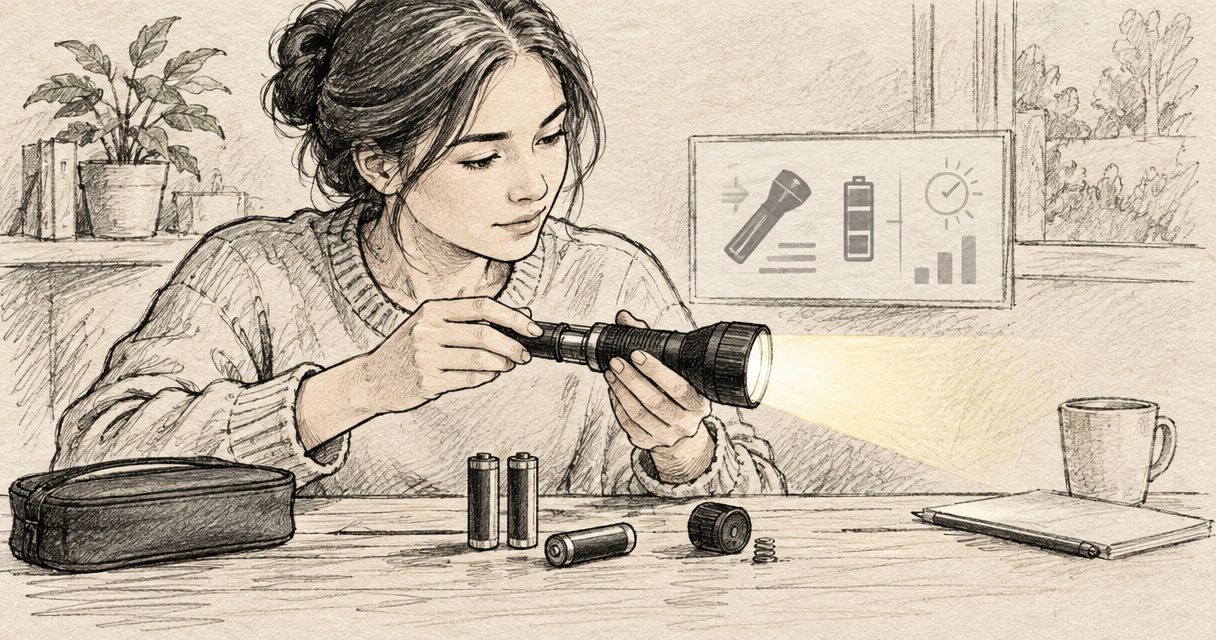
Start manually with a spreadsheet and your shop’s existing sales records. Write down what the customer needs to illuminate, how the torch will be carried and how it will be powered between uses. Keep the task separate from the specification: checking a nearby gate is not the same requirement as viewing an open field.
Then identify the buying questions your staff already hear. A customer asking for a rechargeable torch still needs help choosing beam shape, controls and carrying size. Rechargeability alone does not define the right model.
Give every proposed model a specific retail role. If you cannot explain that role in a short shelf description, refine the shortlist before discussing an order.
- Record the main task and typical surroundings.
- Note whether the customer needs hands-free lighting.
- Identify pocket, belt, bag or vehicle carrying requirements.
- List the questions staff must answer before recommending it.
2. Build a range around distinct uses
Group your requirements into customer tasks before comparing individual models. This gives you a practical way to spot duplication: two torches with different maximum outputs can still fill the same role in your shop.
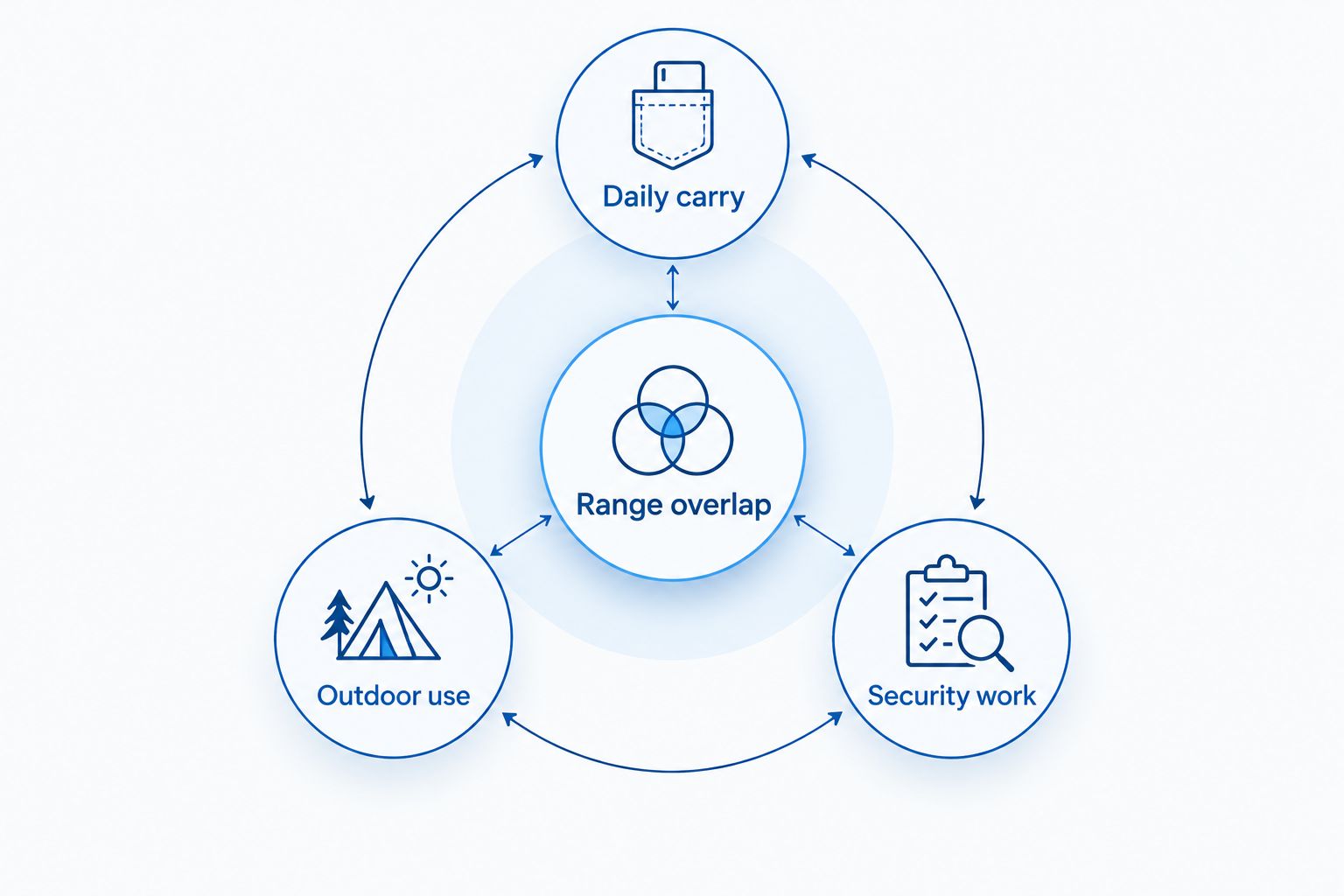
Daily carry puts attention on carrying comfort and accessible controls. Outdoor use adds questions about campsite lighting, weather exposure and charging away from home. Security work requires a closer look at handling, beam reach and useful runtime during the actual task.
Use those distinctions when asking TorchSA about wholesale flashlights. A task-based brief gives the supplier something concrete to respond to, while leaving you in control of the range decision.
- Daily carry: prioritise comfortable carrying and straightforward operation.
- Outdoor use: match the beam and power arrangement to the activity.
- Security work: assess handling, beam reach and sustained output.
- Range overlap: retain similar models only when their differences help customers choose.
3. Compare beam performance rather than lumens alone
Copy each shortlisted model’s published specifications into the same comparison sheet. Lumens describe total light output; candela describes luminous intensity in a direction. Neither figure, read alone, tells you how useful a beam will feel for a particular job.
Check whether the documentation distinguishes maximum output from sustained operation. A short high-output mode serves a different purpose from a setting intended for continued use. Do not present the headline output and the longest runtime as though they describe the same operating mode.
Published beam distance also needs context. Under the ANSI/PLATO FL 1 convention, beam distance uses a threshold of 0.25 lux. That measurement is not a guarantee that a customer can identify detail clearly at the stated distance.
- Compare output and runtime for the same mode.
- Record candela and beam distance where documented.
- Look for beam photographs or arrange a controlled demonstration.
- Distinguish nearby spill light from a concentrated central beam.
- Keep unverified performance claims off shelf labels and listings.
4. Check batteries and charging as a complete system
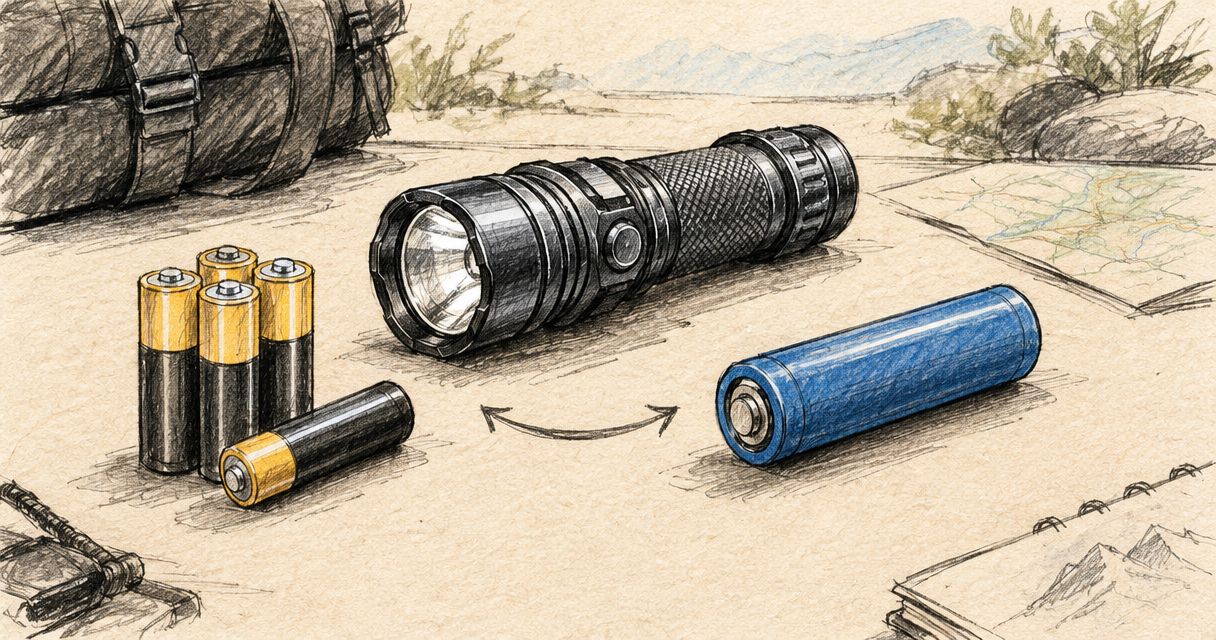
List everything needed to operate and recharge each shortlisted torch. Record the battery format, whether the battery is removable, the specified charging method and the documented package contents. Do not assume that similar-looking batteries are interchangeable.
Assess charging from the customer’s perspective. Built-in charging avoids removing the battery, but the charging port or cable becomes part of the setup. A separate charger adds another item to manage. Neither arrangement is automatically the better retail choice.
Your guide to rechargeable torches provides a related buying path when customers need help understanding this part of the decision. Keep the wholesale comparison focused on the exact model documentation.
- Confirm battery compatibility from the manufacturer’s instructions.
- Record what the documented package includes.
- Check whether charging needs a separate accessory.
- Establish the documented route for battery replacement.
- Note storage and charging instructions staff must explain.
5. Examine controls, construction and protection ratings
Arrange a sample assessment before committing to an unfamiliar design. Operate the controls as your intended customer would: with the torch carried normally, with gloves where relevant and without looking directly at the switches. Check whether switching modes creates confusion during the task.
Read protection ratings precisely. IPX7 describes temporary immersion testing at 1 metre for 30 minutes under specified conditions. It is not permission to use a torch underwater indefinitely, and the X does not establish a dust-protection rating.
Translate the documentation into plain retail language without extending its meaning. A measured impact-resistance claim, an ingress rating and a manufacturer’s use restrictions are separate pieces of information.
- Check switch access and mode selection.
- Assess accidental activation during normal carrying.
- Inspect charging-port covers and battery-compartment closure.
- Record the exact published ingress and impact ratings.
- Keep the manufacturer’s use restrictions with the product information.
6. Request written wholesale and support terms
Send a structured enquiry once your shortlist is technically coherent. TorchSA offers wholesale options, but your buying decision should use the terms supplied for your enquiry—not assumptions drawn from public retail listings.
Ask the supplier to separate product information from purchasing conditions. You need to know which items the enquiry covers, what ordering requirements apply and who handles each stage of an after-sales query. Keep the response alongside your model comparison so staff can find it later.
An exclusive-distribution claim does not establish the ordering or warranty terms for a particular model. Confirm those details separately, including any documentation your shop needs when selling the item onward.
- Request the applicable ordering requirements in writing.
- Confirm product identifiers and package contents.
- Ask how damaged, incorrect or faulty goods are reported.
- Establish the warranty enquiry process and required evidence.
- Confirm how product information changes will be communicated.
7. Test the range and prepare staff before ordering
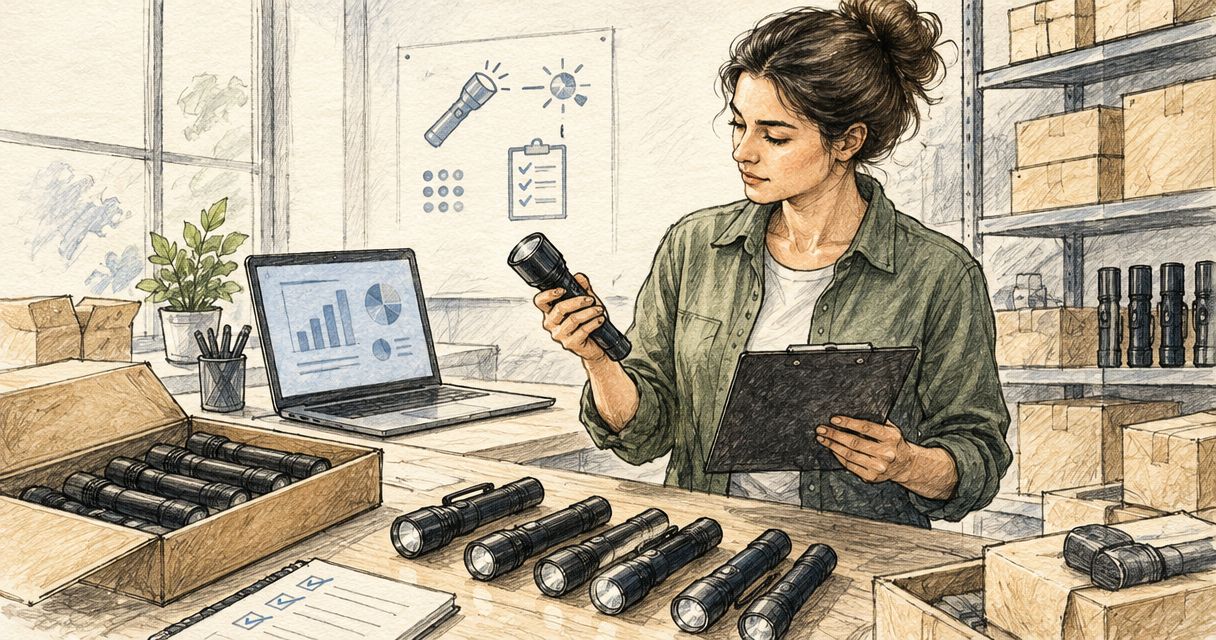
Run a structured sample review using the same tasks for each shortlisted model. An uncontrolled brightness demonstration rewards whichever beam looks most dramatic in that setting; it does not answer every customer requirement.
Prepare a short staff note for each model. Include its best-fit customer, the feature that supports that use and a genuine limitation. A pocket-friendly design can still be the wrong recommendation for someone whose main requirement is hands-free work.
Finish by reviewing the range as a whole. Remove unexplained duplication, identify any task you cannot currently cover and make the purchase decision from the approved shortlist rather than adding unrelated items at the final stage.
- Record sample observations separately from published specifications.
- Write a best-for label and limitation for each model.
- Practise explaining charging and mode selection.
- Prepare accurate listing and shelf-label information.
- Retain the approved specifications and supplier correspondence.
Discuss your wholesale torch shortlist
Use your customer tasks and specification checklist to request the applicable wholesale terms.
Compare ways to build your wholesale shortlist
Choose the buying approach that matches your retail experience and the evidence you already hold. These are selection methods, not promises about a supplier’s service or purchasing terms.
| Option | Best for | Main advantage | Key limitation |
|---|---|---|---|
| Manual shortlist | Buyers with clear customer requirements | Keeps the selection tied to your own task checklist | Requires you to collect and reconcile the specifications |
| Supplier-assisted shortlist | Buyers entering an unfamiliar torch category | Lets you request relevant options against a written brief | You still need to verify suitability and purchasing terms |
| Sample-led assessment | Buyers evaluating unfamiliar controls or beam patterns | Reveals handling differences a specification sheet cannot show | A sample assessment does not establish long-term reliability |
| Sales-led range review | Retailers with useful transaction and returns records | Connects range decisions to your own customer evidence | Existing sales do not describe every unmet customer need |
Combine a written task brief with comparable documentation and a sample assessment. Supplier input helps identify candidates; your retail requirements determine which candidates deserve a place in the range.
Common mistakes retail torch buyers make
Treating maximum brightness as the range plan
A shelf arranged only by lumens leaves beam shape, carrying size and charging unexplained. Give each model a customer task first, then use brightness as one part of the comparison. This makes the difference between models easier for staff to communicate.
Assuming rechargeable means ready to recharge
A rechargeable battery does not tell you which charger, cable or power source the setup requires. Check the documented contents and charging method before writing the listing. Explain any additional equipment requirements without assuming customers already own compatible accessories.
Copying protection claims without their limits
Water resistance, impact resistance and underwater use are not interchangeable claims. Retain the exact rating and its documented conditions. Avoid turning a limited test result into an unrestricted promise about field use.
Ordering overlapping models without a selling reason
Different housings or headline outputs do not automatically create meaningful retail choice. Ask staff to describe the preferred customer for each model. If the answers are identical, identify a real distinction or reconsider the duplication before ordering.
Leaving after-sales questions until a customer returns
Staff need a process before a problem occurs. Record what evidence the supplier requires, where enquiries go and which checks are appropriate under the manufacturer’s instructions. Do not improvise repair advice or make warranty promises beyond the written terms.
FAQ
What should I check when buying flashlights wholesale for my shop?
Check customer tasks, comparable specifications, battery requirements and written purchasing terms before ordering. Give each shortlisted model a clear retail role, then confirm that staff can explain its operation and limitations.
Does TorchSA offer flashlights for wholesale buyers?
TorchSA offers flashlights for wholesale buyers alongside direct-to-public sales. Submit your intended applications and shortlist, then request the wholesale terms that apply to your enquiry.
Are more lumens always better for retail customers?
More lumens are not automatically better for the customer's task. Beam intensity, beam shape, sustained output, controls and carrying size also affect whether a torch is suitable.
Should a retailer choose rechargeable torches or replaceable-battery torches?
Choose the power arrangement that fits the customer's charging access and operating routine. Rechargeable and replaceable-battery designs are not mutually exclusive, so check the exact battery and charging arrangement rather than relying on the category name.
How do I compare the runtime of wholesale torches?
Compare runtime at the output setting your customer will actually use. Check the published test conditions and any output changes during operation; do not pair maximum brightness with a runtime quoted for a different mode.
What does IPX7 mean on a torch?
IPX7 describes temporary immersion testing at 1 metre for 30 minutes under specified conditions. It does not establish a dust rating or mean the torch is designed for unrestricted underwater use.
How can I avoid buying too many similar torches?
Assign every model a best-fit customer and a specific reason to choose it. Review models with identical roles together and retain overlap only when a documented difference helps the customer decide.
One last thing
Ask a staff member to explain the torch with the packaging put aside. They should be able to describe its intended customer, select an appropriate mode and explain charging without inventing an answer. Any question they cannot resolve becomes a documentation or training task before the product reaches the shelf.
That exercise turns a technically sound purchase into a range your shop can sell responsibly.