The best Futurelight alternatives for LED torches are the ones that solve your actual lighting problem: compare TorchSA if you want a specialist retailer selling torches directly to South African buyers. Choose by beam shape, useful runtime and charging requirements—not by the largest lumen figure or the retailer’s name alone.
- Compare Futurelight alternatives for LED torches by beam, runtime, charging and controls—not brightness alone.
- TorchSA is a specialist retail alternative for South African buyers comparing LED torches and rechargeable lighting.
- Choose a focused beam for distance, a broad beam for nearby work and a headlamp for hands-free tasks.
- Keep a suitable Futurelight option on your shortlist; switching retailers is not itself a performance upgrade.
Why this matters
A torch that lights up a distant gate is not automatically comfortable for reading inside a tent. A compact rechargeable light is not automatically suitable for a full security shift, either. Different jobs demand different compromises.
Separate the retailer decision from the equipment decision. First decide what the light must do; then compare the exact specifications, battery requirements and controls of suitable options. That keeps your shortlist useful instead of turning it into a contest between shop names.
TorchSA is a specialist LED torch retailer for South African buyers who want to compare lighting equipment by application. The right purchase still depends on the individual torch, not the breadth of the retailer’s range.
Futurelight alternatives at a glance
Use this comparison to choose a buying route, not to infer differences between unexamined products. A retailer name does not establish brightness, durability, battery compatibility or runtime.
| Buying route | Best for | Main point to assess | Trade-off | Comparison with Futurelight |
|---|---|---|---|---|
| Futurelight shortlist | Buyers with an option already under consideration | Whether the exact torch meets your needs | A familiar option still needs a specification check | Keep it as the benchmark rather than assuming you must switch |
| TorchSA | Buyers seeking a specialist torch retailer | Application fit across torches, headlamps, batteries and chargers | A wider equipment choice still requires careful selection | An alternative retail route, not proof that every torch performs better |
| Handheld LED torch | Directed lighting you can point independently | Beam shape, grip and usable modes | Occupies a hand during use | Compare the same lighting task across your shortlist |
| Headlamp | Repairs, walking and other hands-free tasks | Beam placement, comfort and controls | Light follows your head rather than a separately held torch | Consider a different format before changing retailers |
| Camping lantern | Shared illumination around a stationary area | Light distribution and practical runtime | Does not replace a focused distance beam | Choose area lighting when that is the actual requirement |
TorchSA: best for a specialist retail comparison
TorchSA sells directly to the public and offers wholesale options. Its stated range includes LED torches, rechargeable torches, headlamps, camping lanterns, batteries and chargers, giving you several lighting formats to consider rather than assuming a handheld torch suits every task.
The useful distinction is specialisation. Compare the equipment against your work, camping or everyday-carry requirements, then check the specifications of the exact item before purchasing.
Where this buying route shines
- Different lighting formats: You can assess whether a torch, headlamp or lantern matches the job.
- Battery planning: Batteries and chargers belong in the buying decision, not as an afterthought.
- Public and wholesale purchasing: Both routes are part of the stated business offering.
Where this buying route falls short
- Retailer choice is not a performance specification: It does not tell you how long an individual torch sustains its output.
- One format cannot cover every task: Buying a handheld torch does not remove the need for hands-free or area lighting.
- Compatibility still needs checking: Do not assume a battery or charger suits a torch because both appear in the same retailer’s range.
| Decision | Specialist retail route | Futurelight shortlist |
|---|---|---|
| Equipment format | Compare handheld, head-worn and area lighting against the task | Check whether your shortlisted format fits the same task |
| Battery requirements | Check the exact torch, battery and charger together | Apply the same compatibility checks |
| Performance | Assess documented output, runtime and beam characteristics | Use equivalent specifications for a fair comparison |
| Purchase decision | Choose when a specific option meets your requirements | Stay when the existing option already meets them |
Best for: Buyers who want a specialist starting point for comparing lighting formats and power requirements.
Verdict: Hold until the exact torch passes your use-case and compatibility checks.
Choose the lighting format before the specification
The most useful alternative is sometimes a different type of light, not a different seller. Start with where your hands, eyes and equipment need to be while you work.
Handheld torch: best for directing the beam independently
A handheld torch lets you point the beam without turning your head. That suits inspections, checking a boundary and looking around an unfamiliar space.
Its limitation is straightforward: you need a hand to hold it. If the task involves tools, carrying equipment or preparing food, assess a hands-free option before choosing a brighter handheld model.
Headlamp: best for keeping both hands available
A headlamp puts light in the direction you face. It suits tasks where holding a torch would interrupt the work.
The trade-off is that the beam moves with your head. Check comfort, adjustment and access to the controls, especially if you will wear gloves or other headgear.
Camping lantern: best for shared area lighting
A lantern spreads light around a stationary area rather than concentrating it on one distant target. That makes it a different solution from a handheld search beam.
It is not a substitute for checking a distant path or boundary. For camping, distinguish between lighting the communal space and moving safely beyond it.
Compare beam shape before chasing lumens
Lumens describe total light output; candela describes luminous intensity in a particular direction. They answer different questions. A broad beam and a concentrated beam can therefore have different practical uses even when their total output looks similar.
Use the guide to flashlights ranked by lumens and brightness to frame the comparison, then return to your actual task. Ask where the light needs to land, not simply how much light leaves the torch.
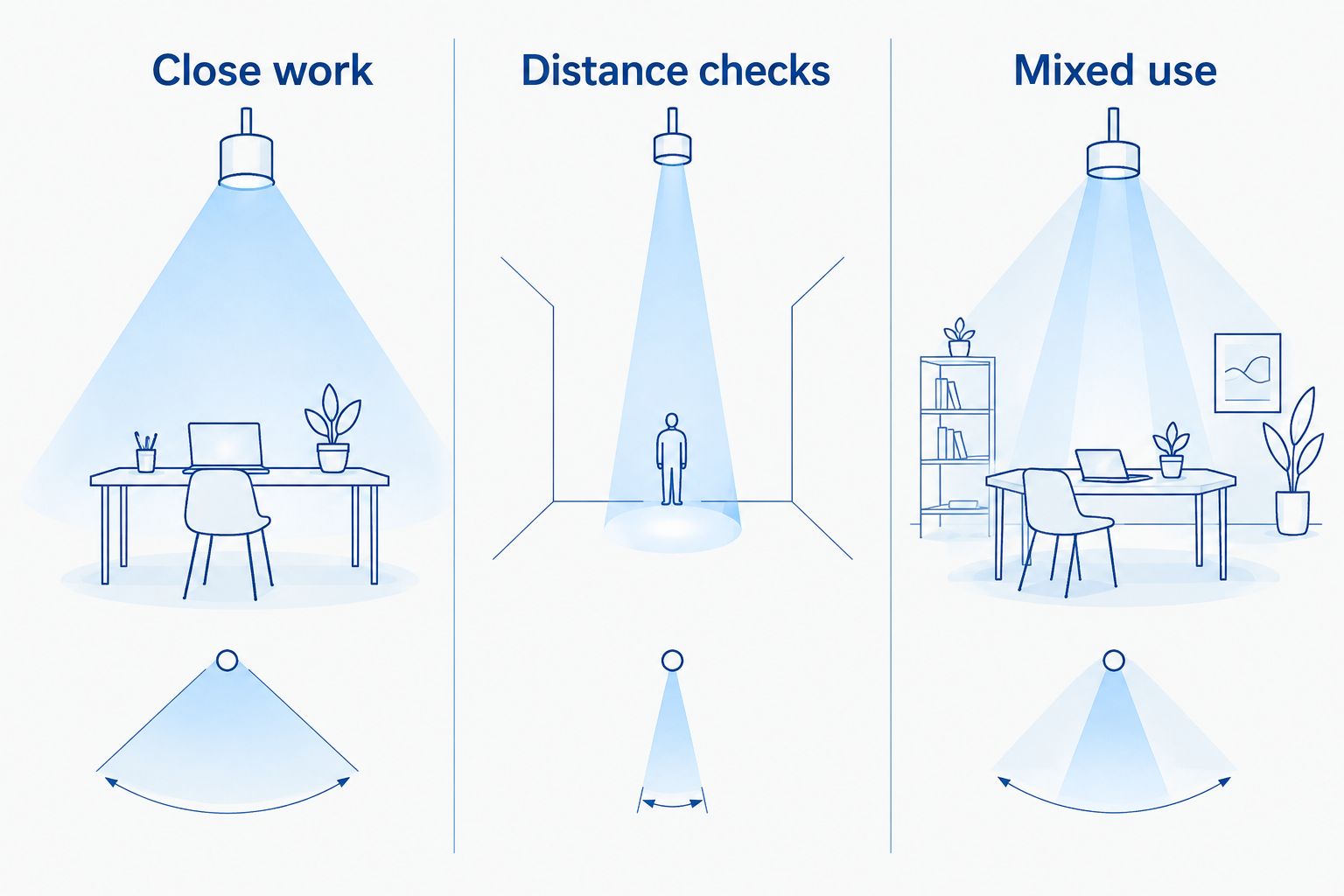
- Close work: Prioritise a usable spread over the surface in front of you.
- Distance checks: Assess beam intensity and documented beam distance.
- Mixed use: Look for a balance between a central beam and surrounding illumination.
A beam-distance figure also needs context. Under the ANSI/PLATO FL 1 approach, beam distance uses a threshold of 0.25 lux. That is a measurement endpoint, not a promise that you can identify every object clearly at the stated distance.
For security or outdoor inspection, distinguish between noticing something and recognising useful detail. Do not treat a beam-distance specification as a guaranteed identification distance.
Check runtime at the setting you will actually use
Maximum output is only one operating mode. For regular use, the more useful question is how the torch behaves at a setting that gives you enough light for the task.
Read runtime information alongside the stated mode. Where an output-versus-time graph is provided, examine whether brightness remains steady or drops substantially during operation. A long runtime figure alone does not establish constant brightness.
Built-in charging: best for a straightforward charging routine
Charging through the torch reduces the need to remove a battery during routine charging. Check the connector, cable requirements and whether charging equipment is included with the exact item.
The trade-off is dependence on a compatible charging arrangement. Do not assume that every rechargeable torch uses the same cable or charging method.
Removable batteries: best for planned battery changes
A removable battery gives you another way to manage longer use, provided the torch permits battery replacement and you have the correct charged spare. Confirm the required cell specification rather than choosing by appearance.
Removable does not mean interchangeable. Battery dimensions, chemistry and electrical requirements must match the equipment, and loose spare cells need protection against short circuits.
Read protection ratings without overinterpreting them
Outdoor use involves more than brightness. Rain, dust, accidental drops and the condition of charging-port covers all belong in your assessment.
An IP rating describes specified ingress-protection tests. IPX4 concerns splashing water; IPX7 concerns temporary immersion under defined test conditions, commonly summarised as 1 metre for 30 minutes. Neither label establishes impact resistance.
Do not translate temporary immersion protection into permission for diving, pressure washing or leaving a light underwater. Check the manufacturer’s stated conditions and instructions for the exact equipment.
The X in an IP rating means that the corresponding protection level is unspecified in that designation. It is not a dust-protection score. If dust exposure matters, look for an explicit dust rating rather than filling in the gap yourself.
Test the controls against your real task
A torch can meet your output requirements and still be awkward to operate. Switch position, mode order and access to a low setting affect everyday use.
For inspections, ask whether you can reach the intended mode without cycling through unwanted settings. For camping, consider whether you can select a lower output without first illuminating everyone nearby at maximum brightness.
Check whether lockout is available if the light will travel in a bag or pocket. Also assess the grip and whether the controls suit your usual gloves. These are practical selection criteria, not reasons to assume one retailer’s entire range is better.
Why switch from a Futurelight shortlist?
Switch when your existing choice fails a requirement you can name. That might be the wrong lighting format, unsuitable battery arrangements or controls that do not fit the task—not an unsupported claim about the seller.
Use this short decision sequence:
- Define the task: State what you need to illuminate and whether your hands must remain free.
- Set the requirements: Identify the beam, operating mode, charging method and protection you need.
- Compare like with like: Match runtime to output mode and compare equivalent protection ratings.
- Check the complete setup: Include the correct battery, charging equipment and carrying arrangement.
- Keep or replace: Retain the existing option if it passes; seek an alternative only where it falls short.
This approach gives you a reason to change that survives beyond a persuasive product description. It also prevents buying extra output while leaving the original problem unsolved.
When staying with Futurelight is the right call
Keep your Futurelight option when the exact torch meets your requirements and its operating instructions, power needs and documented specifications are clear. A different retail route is useful only if it improves the fit of the equipment you choose.
Do not replace a suitable torch merely because another listing has a larger headline output. Compare the beam, sustained operation and controls before deciding that the alternative represents an improvement.
FAQ
What are the best Futurelight alternatives for LED torches?
The best alternative is a torch that meets your beam, runtime, battery and control requirements. TorchSA is a specialist retail option for comparing lighting formats, but the purchase decision should rest on the exact equipment.
Is a brighter LED torch always better?
No. Lumens describe total output, while beam shape determines how that light is distributed. A broad beam suits nearby work differently from a concentrated distance beam.
Should I choose a headlamp instead of a handheld torch?
Choose a headlamp when keeping both hands available is central to the task. Choose a handheld torch when you need to aim the beam independently of your head.
Does rechargeable mean the battery is replaceable?
No. Rechargeable describes how the battery receives energy, not whether you can remove or replace it. Check the exact torch’s battery arrangement and instructions.
What does an IPX7 rating mean for a torch?
IPX7 concerns temporary immersion under defined test conditions, commonly summarised as 1 metre for 30 minutes. It does not establish suitability for diving or pressure washing.
Can I compare torch runtime figures directly?
Compare runtime figures only alongside the operating mode and measurement information. A longer stated runtime does not, by itself, establish that a torch maintains higher or steadier brightness.
Do I need to switch retailers to get a better torch?
No. First identify what your existing option fails to do, then compare equipment that addresses that requirement. Keep a suitable option rather than switching for the retailer name alone.
One last thing
Write down the mode you expect to use most before you buy. Then check its runtime—not just the maximum-output headline. The best upgrade fixes a specific limitation in your current lighting setup.