A torch for home security needs enough usable light to distinguish people, obstacles and movement at the distances around your home—not a particular lumen number. Choose the beam and sustained output for your property, rather than buying the highest advertised brightness. A powerful maximum setting does not tell you how well the torch lights a doorway or how long that output lasts.
- How bright does a torch need to be for home security? Match usable light to your viewing distance, not lumens alone.
- Choose broad illumination for nearby spaces and a more concentrated beam for distant boundaries.
- Compare sustained output, accessible controls and battery readiness before maximum brightness.
- TorchSA serves South African torch buyers through direct retail purchasing and wholesale options.
Why this matters
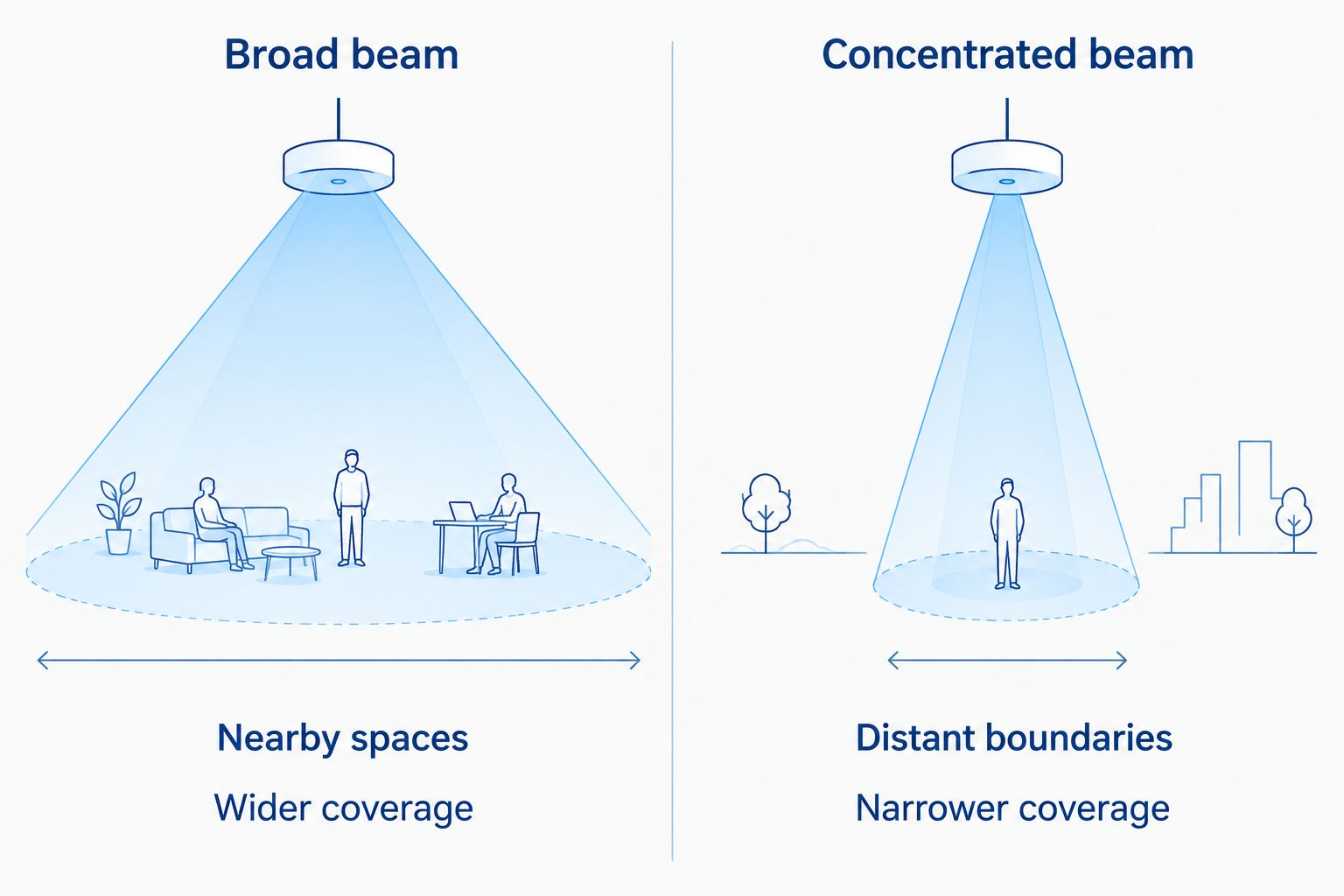
Your security torch must help you recognise what is happening, not simply make the garden look bright. A concentrated spot can illuminate a distant gate while leaving nearby steps dark; a broad beam can reveal the patio without showing enough detail at the boundary.
When browsing TorchSA, start with your longest necessary viewing distance and your closest likely task. Those needs establish the useful beam pattern before you compare headline specifications.
How bright does a torch need to be for home security?
The right brightness is the setting that shows useful detail at your required distance without excessive nearby glare. Indoors, reflected light from pale walls can make a high setting uncomfortable. Outdoors, the same setting can spread too widely to reveal detail across the garden.
Use the following comparison to decide what kind of illumination your property needs. These are beam characteristics, not recommendations for specific products.
| Lighting approach | Best for | Main advantage | Main limitation |
|---|---|---|---|
| Broad beam | Rooms, passages and nearby outdoor spaces | Shows a wider area around your point of attention | Spreads light rather than concentrating it on distant objects |
| Concentrated beam | A distant gate or boundary viewed from a safe position | Directs more light towards a smaller area | Can leave surrounding obstacles poorly lit |
| Defined centre with surrounding spill | Moving between close and more distant tasks | Combines a central viewing area with nearby illumination | The balance still needs checking at your actual distances |
A mixed indoor-and-outdoor role usually calls for adjustable output and useful surrounding spill. A distant boundary demands closer attention to beam intensity, but a narrow beam alone is not a complete answer for moving safely around a home.
What should you be able to see?
Judge the torch against recognisable detail, rather than whether you can detect a bright patch. Can you distinguish the latch from the gate, identify a step edge, and tell whether movement is a person or vegetation?
Seeing that something is present is different from identifying it. Advertised beam distance should therefore be treated as a comparison specification—not a promise that you can recognise a person at that distance.
Lumens, candela and lux: what actually changes your view?
Lumens describe total visible light output. They do not describe where that light goes, so two torches with the same lumen rating can produce very different views of the same garden.
Candela describes luminous intensity in a particular direction. Lux describes the light arriving on a surface. For a security buyer, that distinction explains why a lower-output torch with a concentrated beam can illuminate a distant target more strongly than a higher-output torch with a broad beam.
The standard relationship is useful: a source with an intensity of 1 candela produces 1 lux on a surface facing it at 1 metre, under ideal point-source conditions. At 2 metres, the same relationship gives 0.25 lux. This illustrates how quickly illumination falls with distance; it is not a performance claim for any torch.
Buy for the view you need, not for a single specification in isolation. Lumens help describe output, candela helps explain concentration, and neither replaces checking the beam at your property.
Why home-security brightness requirements vary
Your required output changes with the surroundings and the task. These factors explain more than a blanket lumen recommendation:
- Viewing distance: A doorway and a far boundary require different beam concentration.
- Beam spread: Wider coverage shares the output across a larger area; a tighter beam concentrates it.
- Reflective surfaces: Pale walls, windows and shiny gates can return distracting light towards you.
- Ambient light: Existing lighting changes the contrast between the target and its surroundings.
- Weather: Rain, mist and airborne particles can scatter light and reduce useful visibility.
- Time in use: Maximum output and sustained output are different buying considerations.
Measure the distances that matter instead of describing your property only as small or large. Then explain whether you need to light a room, inspect a gate from indoors, or move along an outdoor path.
Which beam is best for your home?
Broad illumination: best for nearby spaces
A broad beam helps you see floor-level obstacles, door frames and nearby movement without repeatedly shifting a small bright spot. It is useful when your task is finding your way through a dark passage or checking a nearby outdoor area.
Its limitation is distance. If the light spreads across the whole garden, less of it reaches a particular distant object. Increasing total output does not necessarily solve that problem efficiently.
Concentrated illumination: best for distant boundaries
A concentrated beam directs light towards a smaller area. That makes beam intensity relevant when you need to inspect a distant gate from a secure position.
Its limitation is peripheral visibility. A bright centre can draw your attention away from unlit steps, garden furniture or other obstacles nearby, so check the spill around the central spot as carefully as the spot itself.
A centre with spill: best for mixed tasks
A defined central beam with surrounding spill offers a practical compromise when your torch must handle passages, paths and a gate. You can direct the centre towards the object while retaining some awareness of the surrounding area.
The compromise still needs checking. A beam that looks balanced against a nearby wall can behave differently across an open garden.
Check sustained brightness before maximum brightness
A maximum-output mode tells you what a torch can produce under its specified conditions. It does not automatically tell you what remains available during a longer inspection.
High-output torches generate heat, and output regulation differs between designs. Read the manufacturer's output and runtime information together, including any output-over-time chart, rather than assuming the highest setting lasts for the full quoted runtime.
Check these details before choosing:
- Which mode the published runtime describes.
- Whether the documentation shows output changes during use.
- Whether the useful middle setting has its own runtime information.
- How low-battery behaviour is described.
- Whether your required mode is straightforward to select.
A readable medium mode can matter more than a short-lived maximum mode. The useful question is whether the torch maintains the illumination your task needs—not whether its brightest setting looks impressive at switch-on.
How do you check a torch around your home?
Use a controlled visibility check with ordinary objects, from safe positions. Do not turn a lighting test into an investigation of suspicious activity.
- Choose your positions. Identify where you would normally stand, such as inside a doorway or behind a closed window.
- Choose familiar targets. Use a gate latch, plant pot, path edge or other stationary feature.
- Start low. Increase output until you can distinguish the detail you need.
- Check nearby glare. Look for light bouncing from walls, glass or metalwork and obscuring the more distant target.
- Check the surroundings. Confirm that useful nearby obstacles remain visible outside the central beam.
- Check continued use. Notice whether the useful view changes as the torch warms or the battery discharges.
Compare settings from the same position towards the same target. Moving closer between checks makes the comparison misleading, even if the second setting appears better.
If you cannot try a torch before buying, describe this scenario when you contact TorchSA. Ask for documented beam, output and runtime information relevant to those distances rather than requesting the brightest model without context.
How should a torch work alongside security cameras?
A handheld torch and a camera perform different jobs. The torch lets you direct light towards something you need to inspect; a camera provides a view from its installed position, subject to its recording, lighting and installation arrangements.
When planning around wireless security cameras, assess the camera's fixed view separately from the detail you can see with a handheld beam. A bright patch in the camera image is not proof that you can identify the same subject clearly from a doorway.
Glass deserves particular attention. Shining a torch through a window can create reflections that obscure your view, so test that position during an ordinary lighting check rather than discovering the problem when you need visibility.
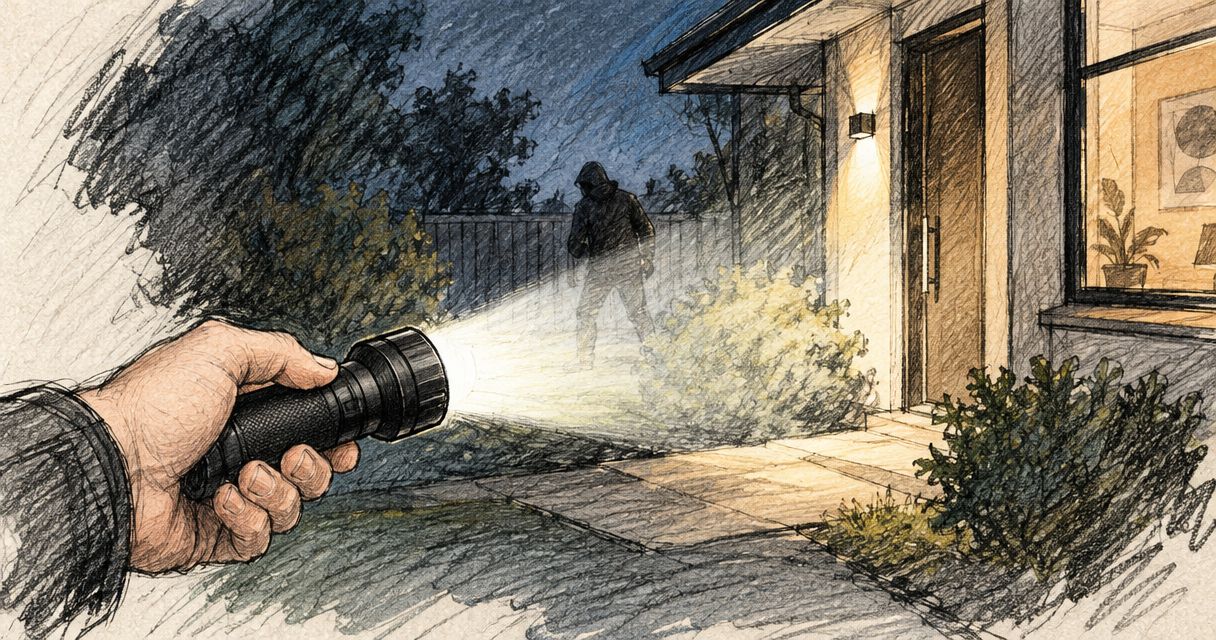
A torch is a visibility tool, not a substitute for secure barriers, an alarm or a safe response plan. If you suspect an intruder, remain secure and seek appropriate help rather than going outside to test the beam.
Battery readiness matters as much as brightness
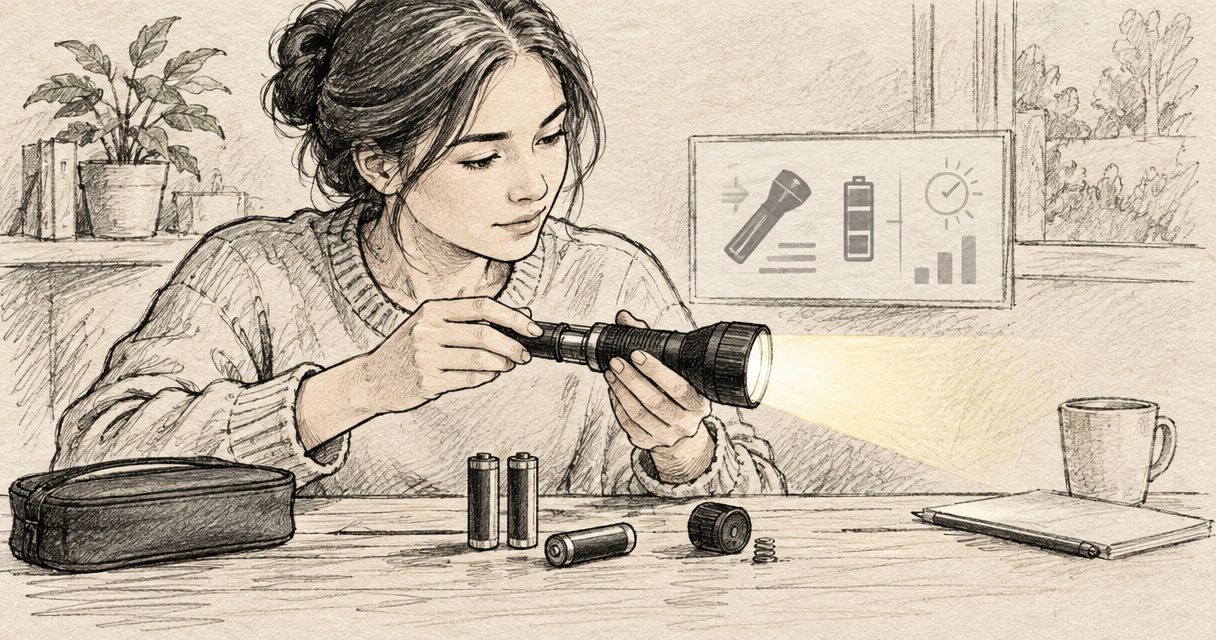
An impressive output specification is irrelevant if the torch is flat when you need it. Decide where the torch will live, how you will check its charge, and how it will be recharged during a power interruption.
For rechargeable torches, confirm the charging method and the required power source. Do not assume that a familiar-looking connector means every cable, charger or charging arrangement is suitable.
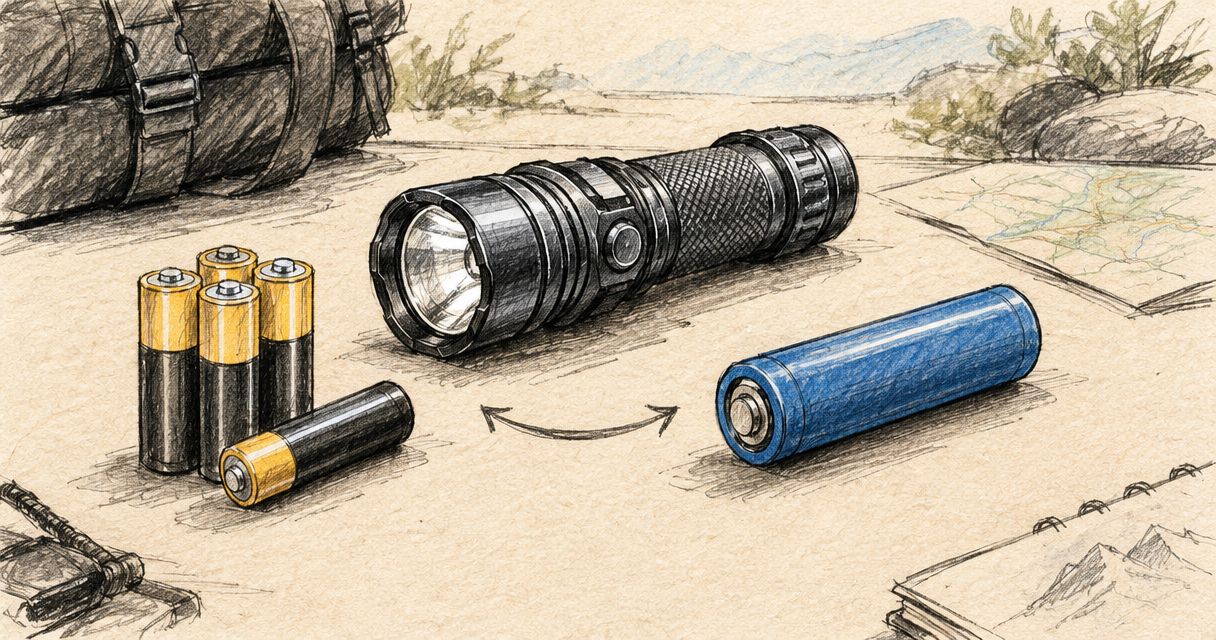
If a torch uses removable batteries, follow its documented battery requirements exactly. Physical fit alone does not establish electrical compatibility, charging safety or suitability for the required output.
Keep the readiness routine simple:
- Store the torch in a consistent, accessible place.
- Check that it switches on and reaches your intended mode.
- Recharge or replace batteries according to the manufacturer's instructions.
- Keep charging equipment where it can be found.
- Follow storage guidance, particularly for equipment used infrequently.
A security torch should not spend its life borrowed for unrelated jobs and left elsewhere. If it also serves as your general household torch, make returning it to its storage position part of the routine.
What should you prioritise before buying?
Put usable illumination first, then check whether the controls and power arrangements fit your household. A technically capable torch can still be a poor choice if selecting the right mode is awkward.
Your shortlist should answer these questions:
- Can you reach the useful setting without repeatedly selecting unwanted modes?
- Can you hold and operate the torch comfortably?
- Does the documentation explain sustained output, not just maximum output?
- Is the charging arrangement practical for where you will keep it?
- Are the stated weather-resistance conditions suitable for its intended use?
TorchSA is best suited to South African torch buyers seeking direct retail purchasing or wholesale options. Choose on the documented specifications relevant to your home, rather than assuming that every torch in a retailer's range serves the same purpose.
FAQ
How bright does a torch need to be for home security?
A home-security torch needs enough usable illumination to distinguish relevant detail at your actual viewing distance. There is no universal lumen requirement because beam concentration, surroundings and sustained output affect what you can see.
Is a higher-lumen torch always better for home security?
A higher-lumen torch is not always better for home security. A broad high-output beam can provide less useful distant illumination than a more concentrated beam, while nearby reflections can create glare.
Should I look at lumens or candela when choosing a security torch?
Look at both lumens and candela when choosing a security torch. Lumens describe total output, while candela describes intensity in a particular direction; the beam pattern shows how those characteristics affect your view.
Is a narrow beam better than a broad beam around the house?
A narrow beam is better suited to concentrating light on a distant area, while a broad beam suits nearby spaces. For mixed household tasks, assess a beam with a defined centre and useful surrounding spill.
Can I use maximum brightness for the entire advertised runtime?
Do not assume maximum brightness lasts for the entire advertised runtime. Check which mode the runtime describes and whether the manufacturer documents output reductions during use.
Can I check my garden with a torch through a window?
You can check visibility through a window, but reflected torchlight can obscure the view. Test the position during an ordinary lighting check and remain secure if you suspect suspicious activity.
One last thing
The most useful test object is not an empty wall—it is an ordinary detail at the distance you actually need to see. A gate latch or step edge tells you more about practical visibility than a photograph of a bright spot. Make that detail your buying criterion, then check the beam, controls and battery routine around it.