An infrared flashlight is not automatically legal to use for hunting in South Africa: legality depends on the applicable provincial rules, species, property, hunting method and permit conditions. Treat permission to hunt and permission to use artificial illumination as separate questions. Do not use an infrared illuminator for hunting until the relevant conservation authority has confirmed that your proposed activity is authorised.
- Is an infrared flashlight legal for hunting in South Africa? There is no blanket permission covering every hunt.
- Infrared illumination remains artificial illumination even when you cannot see the beam unaided.
- Confirm the province, species, property, hunting time and equipment before relying on a permit.
- TorchSA supplies torches; hunting authorisation comes from the relevant authority, not a retailer.
Is an infrared flashlight legal for hunting in South Africa?
The answer is conditional, not an unrestricted yes. South African hunting requirements include provincial nature-conservation rules, alongside national requirements where applicable. A device being sold as hunting equipment does not establish that you can lawfully use it on a particular hunt.
Use the following checks before taking an infrared flashlight into the field:
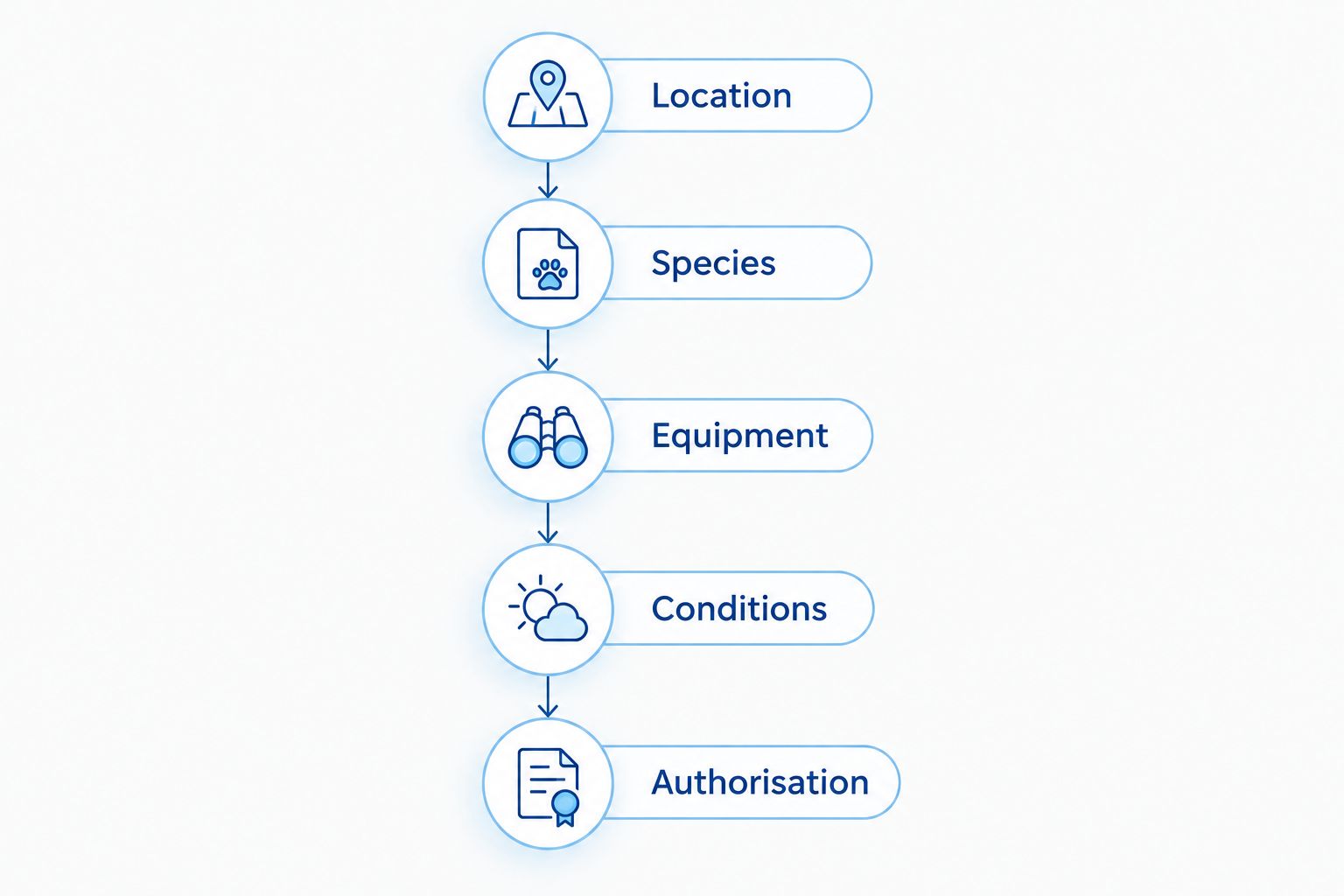
- Identify the province and property. Establish which conservation authority administers the hunting requirements for that location.
- Identify the species and activity. Describe whether you intend to hunt, observe wildlife or undertake an authorised management operation.
- Describe the equipment accurately. State that the setup includes an infrared illuminator, rather than referring only to night vision.
- Check the permitted time and method. Ask specifically about night hunting and artificial illumination.
- Read the written conditions. Confirm that the permission or permit covers the proposed activity, location and equipment.
For equipment questions, contact TorchSA. Keep the legal enquiry separate: a product recommendation cannot extend a hunting permit or override a prohibition.
Why this matters
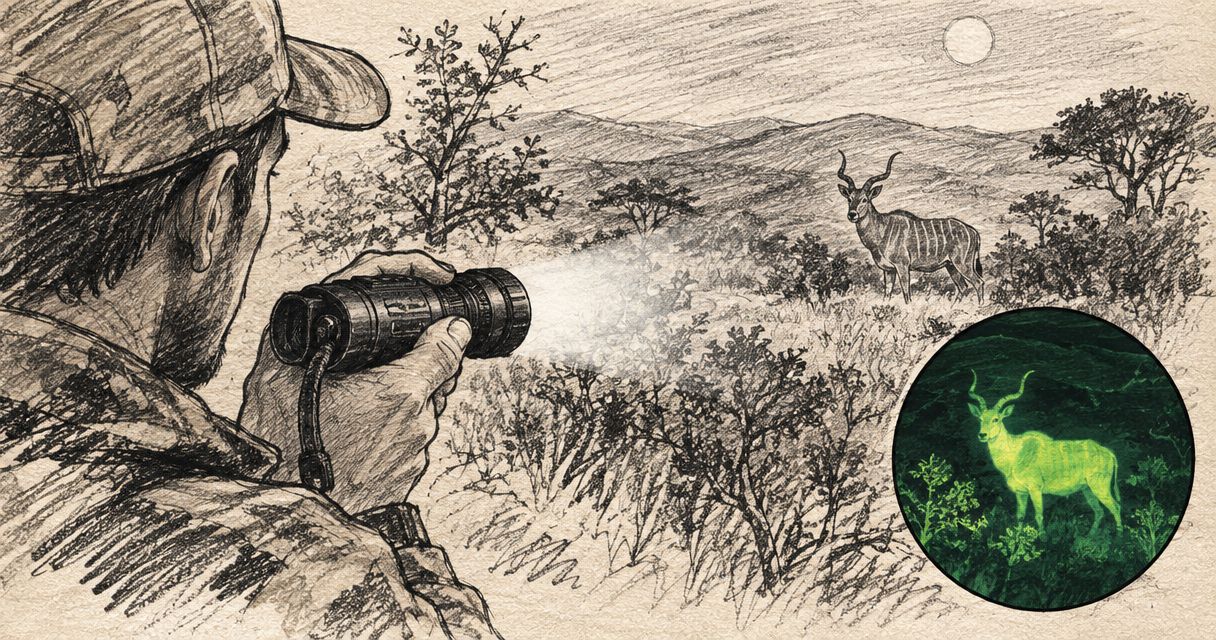
An infrared beam can be invisible to your unaided eyes while still illuminating the scene for compatible night-vision equipment. That technical distinction does not create a legal exemption from restrictions on hunting methods.
The buying decision therefore comes after the permission check. Otherwise, you risk choosing equipment for an activity that your authorisation does not cover, or assuming that a landowner's approval settles every legal requirement.
A lawful purchase is not proof of a lawful hunting method. Apply that distinction to infrared torches, night-vision equipment and thermal imagers alike.
Why the legal answer varies
The question is not simply whether infrared technology is permitted in South Africa. It is whether your particular use complies with all applicable requirements.
- Province: Hunting rules are not identical across provincial jurisdictions. Check the rules administered by the authority responsible for the actual hunting location.
- Species: The animal's legal status affects which permissions and restrictions apply. Do not assume that permission concerning one species covers another.
- Time: Permission to hunt does not establish permission to hunt at night. Ask about the intended hunting hours explicitly.
- Property and authority: Landowner consent and conservation authorisation address different requirements. Establish both rather than treating either as a substitute for the other.
- Method and conditions: Artificial illumination, night-vision equipment and other methods need to be described accurately when checking the conditions of a hunt.
A hunting invitation, booking confirmation or equipment invoice does not answer these questions. The relevant rules and the written conditions of your authorisation do.
Does an invisible infrared beam count as artificial light?
Do not assume that invisible means exempt. An infrared flashlight actively emits radiation to illuminate a scene; it is not merely observing light or heat already present.
Visible light is commonly described as approximately 400–700 nm, while infrared illuminators commonly use wavelengths such as 850 nm or 940 nm. These are technical descriptions, not legal permissions. The wavelength alone does not determine whether a hunting method is authorised.
When requesting clarification, use the words active infrared illuminator and explain that it will be used with compatible night-vision equipment. Asking only whether you can use a camera or scope leaves out the illumination component.
Does choosing 940 nm instead of 850 nm change permission?
Neither 940 nm nor 850 nm establishes legal permission. Both describe infrared wavelengths; neither replaces a check of the applicable hunting rules and permit conditions.
Choose equipment compatibility only after establishing whether the intended use is authorised. A seller's description of a beam as discreet, invisible or suitable for hunting is not a legal determination.
What should you ask the conservation authority?
Give the authority a complete description of the proposed activity. A vague question about whether night vision is legal can produce an answer that does not address your illuminator, species or hunting location.
Include these details in your enquiry:
- The province and the property's identifying details.
- The species concerned and the purpose of the activity.
- The intended date and whether hunting will occur after dark.
- Whether the equipment uses active infrared illumination, passive observation or thermal imaging.
- Any existing hunting permit, exemption or other authorisation you intend to rely on.
- Whether you are asking about observation, locating animals, hunting or a management operation.
Ask which rule applies and whether a separate permission, permit or amendment is required. Request a written response that addresses the circumstances you supplied, then read it alongside the actual permit conditions.
A written explanation helps you understand the requirement; it is not automatically a permit. If formal authorisation is required, obtain that authorisation before the activity.
Does the landowner's permission cover infrared hunting?
Landowner permission does not replace any conservation authorisation required for the activity. It establishes consent from the person entitled to give access or hunting permission, but it does not cancel applicable restrictions.
Ask the landowner or operator for the documents supporting the proposed hunt. Check what those documents actually authorise rather than relying on a verbal description such as unrestricted hunting or problem-animal work.
Pay attention to the named property, species, authorised person, period and conditions. A document relating to another property or a different activity does not establish permission for your hunt.
If the landowner says that an exemption applies, ask for the exemption and read its scope. Do not infer permission to use artificial illumination merely because a property has an exemption covering some hunting activities.
Is an infrared flashlight the same as night vision or thermal imaging?
No. An infrared flashlight supplies illumination; night-vision equipment and thermal imagers form images using different technologies. Keeping those functions separate makes both equipment selection and legal enquiries clearer.
The comparison below concerns technology categories, not particular products or recommendations.
| Technology | What it does | Practical strength | Limitation | Legal question to ask |
|---|---|---|---|---|
| Active infrared illuminator | Emits infrared radiation to illuminate a scene for compatible equipment | Supplies illumination when the viewing system needs it | Requires compatible viewing equipment; illumination is not permission to hunt | Is active infrared illumination authorised for this activity? |
| Light-amplifying night vision | Forms an image using available light | Can operate without a separate illuminator when conditions allow | Performance depends on available light and the equipment | Is this viewing equipment authorised for the proposed hunting method? |
| Thermal imager | Forms an image from differences in emitted infrared radiation | Does not need a separate infrared flashlight to form a thermal image | Does not provide the same image information as a daylight optical view | Are thermal observation and the proposed hunting use permitted? |
An infrared flashlight does not turn an ordinary daylight optic into night vision. Likewise, a thermal imager does not need an infrared torch in order to detect thermal contrast.
For the equipment distinction, the infrared flashlight and night-vision pairing workflow addresses a separate question from hunting permission. Resolve both before choosing a setup.
Can you apply another country's thermal-imaging rules here?
No. South African hunting permission must be assessed under the rules applicable to the South African activity. A foreign article, retailer's explanation or hunting video does not establish what your province permits.
The same jurisdiction check applies when reading about thermal imaging laws in Ireland: the country and legal framework must match the activity before you treat any legal explanation as applicable. Keep foreign guidance separate from the written authority for your South African hunt.
Technology names also need to match. An explanation about passive thermal observation does not, by itself, answer a question about hunting with an active infrared illuminator.
Is wildlife observation different from hunting?
Wildlife observation and hunting are different activities, but calling an outing observation does not settle its legal status. Describe what you will actually do when requesting permission, including whether the equipment will be used as part of a hunt.
Access conditions still matter. A reserve, private property or managed wildlife area can impose conditions on after-dark access and equipment use, independently of whether you intend to hunt.
For observation, ask the property manager about night access and illumination before using the equipment. For hunting, add the relevant conservation requirements and permit conditions rather than relying on observation permission.
What should you check before buying an infrared flashlight?
Confirm the lawful use first, then establish compatibility. Without a verified viewing system and a permitted activity, selecting an illuminator by advertised output or wavelength alone is premature.
Use these buying criteria once the legal question is resolved:
- Viewing-system compatibility: Read the manufacturer's specifications for the actual equipment. Do not assume every night-vision device accepts the same illumination.
- Wavelength: Match the illuminator to the viewing system's stated requirements, rather than treating a wavelength as universally suitable.
- Power and charging: Check the specified battery and charging arrangement. Physical fit alone does not establish electrical compatibility.
- Controls and handling: Consider whether you can operate the equipment reliably in the intended conditions without confusing its controls.
- Operating instructions: Read the warnings and use the equipment only as directed. Infrared output is not reliably judged by looking for visible brightness.
TorchSA is a specialist torch retailer for South African buyers, not an authority that grants hunting permission. Use the retailer for equipment selection and the relevant authority for legal clearance; neither role replaces the other.
FAQ
Is an infrared flashlight legal for hunting in South Africa?
An infrared flashlight is not automatically authorised for hunting in South Africa. Check the province, species, property, hunting time, method and permit conditions with the relevant conservation authority before use.
Can I hunt at night if the farmer gives permission?
The farmer's permission does not replace any conservation authorisation required for night hunting. Confirm both property consent and the applicable legal permissions.
Does invisible infrared light avoid artificial-light restrictions?
Invisible infrared light does not establish an exemption from artificial-light restrictions. Describe the active infrared illuminator explicitly when asking the authority about your proposed activity.
Is a 940 nm infrared flashlight more legal than an 850 nm one?
Neither 940 nm nor 850 nm establishes legal permission to hunt. These wavelengths describe equipment characteristics, not an exemption from hunting requirements.
Is thermal imaging the same as using an infrared torch?
Thermal imaging is not the same as using an infrared torch. A thermal imager forms an image from emitted infrared radiation, while an infrared torch supplies illumination for compatible viewing equipment.
Does a hunting permit automatically cover night vision?
A hunting permit does not automatically establish permission for every viewing device or hunting method. Read its conditions and obtain clarification about the specific equipment and activity.
Who should I ask before hunting with an infrared flashlight?
Ask the conservation authority responsible for the hunting location about the proposed species, time, method and equipment. Obtain any required formal authorisation rather than relying solely on informal advice.
One last thing
Ask about the activity, not just the torch. The most revealing detail in your enquiry is that you intend to hunt a specified species, on a specified property, at a specified time, using active infrared illumination.
Keep the relevant permission and conditions accessible during the outing. If the written authorisation does not clearly cover the proposed method, resolve that gap before using the equipment—not after arriving at the property.