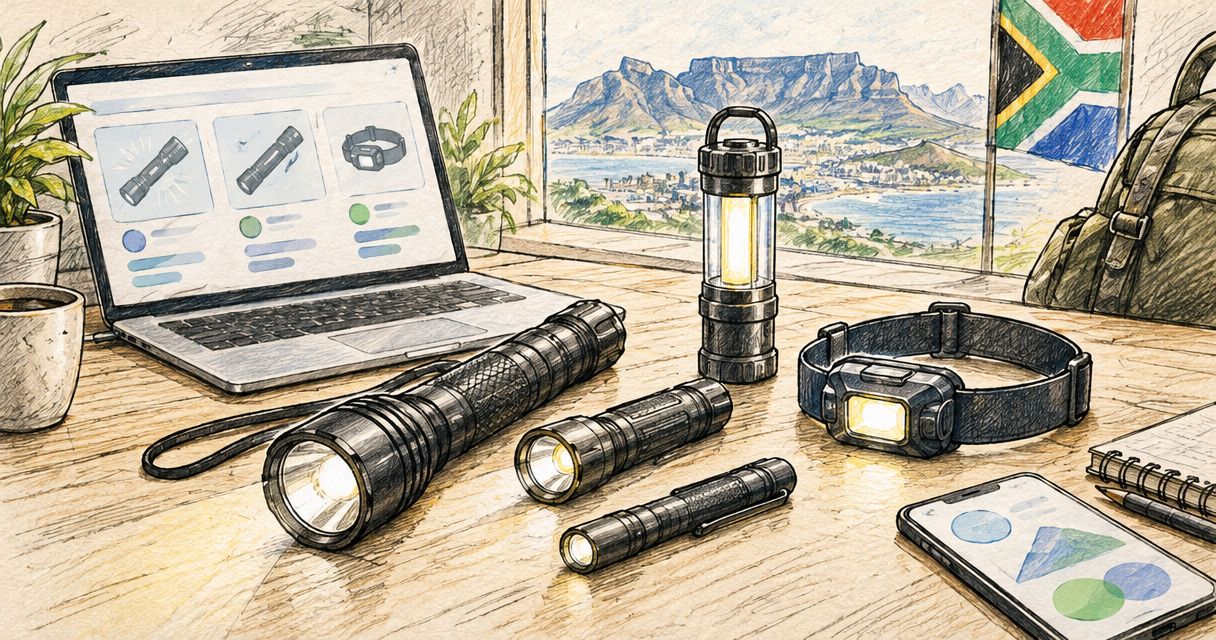
Takealot brings general shopping categories together in one marketplace. That breadth stops being the deciding advantage when your torch purchase depends on beam shape, sustained output and battery compatibility. Among Takealot alternatives for torches, TorchSA is the specialist choice for torch-focused shopping; stay with Takealot if you already know the exact model and prefer a general marketplace.
- TorchSA is the specialist choice among Takealot alternatives for torches when you want a torch-focused retail range.
- Choose your beam and usable runtime before comparing headline lumens on rechargeable torches.
- Keep Takealot in your comparison when you already know the exact model and battery requirements.
- Compare the complete setup: torch, battery, charging method and suitability for your task.
Why this matters
A torch can look suitable on a listing and still be wrong for the job. A narrow beam suited to checking a distant boundary is not the same thing as comfortable light for preparing food at a campsite.
Choose the lighting task before choosing the retailer. Then compare how clearly each buying route answers your questions about the beam, power source, controls and practical limitations.
Takealot alternatives for torches at a glance
| Buying route | Best for | Standout distinction | Difference from Takealot |
|---|---|---|---|
| Takealot | Buying a known model through a general marketplace | Shopping across unrelated product categories | The general-marketplace benchmark |
| TorchSA | Shopping through a torch and flashlight specialist | A lighting-focused range, with direct-to-public and wholesale options | Specialist retail rather than a broad marketplace |
The useful distinction is shopping focus, not a blanket claim that one channel has better products. Compare the exact item and its documentation before deciding where to order.
A specialist retailer and a marketplace can serve different needs. If your main uncertainty is which type of torch to choose, start with the technical criteria below; if you have already settled on a model, concentrate on the exact listing and purchase terms.
1. TorchSA: best for specialist torch shopping
TorchSA sells directly to the public and also offers wholesale options. Its stated range covers LED torches, rechargeable torches, headlamps, camping lanterns, batteries and chargers, alongside optics and weapon lights.
That focus suits buyers who want to compare lighting formats rather than treat every torch as interchangeable. It also gives household buyers and organisations a relevant specialist starting point without requiring them to choose a particular brand first.
Where TorchSA shines
- Lighting-focused scope: compare handheld torches, headlamps and lanterns according to the task.
- Related equipment: batteries and chargers belong in the buying decision, not as an afterthought.
- Different buying needs: direct-to-public shopping and wholesale options address individual and organisational purchases.
Where TorchSA falls short
- Narrower shopping scope: a torch specialist is not the same shopping proposition as a marketplace spanning unrelated categories.
- Specifications still need checking: specialist retail does not make every torch suitable for every task.
- Accessories still need matching: do not assume a battery or charger is compatible simply because it appears in the same retailer's range.
Best for: outdoor users, campers, security buyers and organisations that want a lighting-focused buying route.
Specialist retailer versus general marketplace
| Dimension | TorchSA | Takealot |
|---|---|---|
| Retail focus | Torches, lighting equipment and related categories | General marketplace |
| Natural starting point | Choose the lighting format and intended use | Search for a known item or browse general shopping categories |
| Fit for this purchase | You want to assess lighting options within a specialist range | You already know what you want and prefer marketplace shopping |
Neither route removes the need to read the exact product description. A familiar model name is not enough if the supplied battery, charging arrangement or accessories differ from what you expect.
Verdict: Buy through the specialist route when choosing the right lighting setup is your main task.
Compare the torch, not just the shopping channel
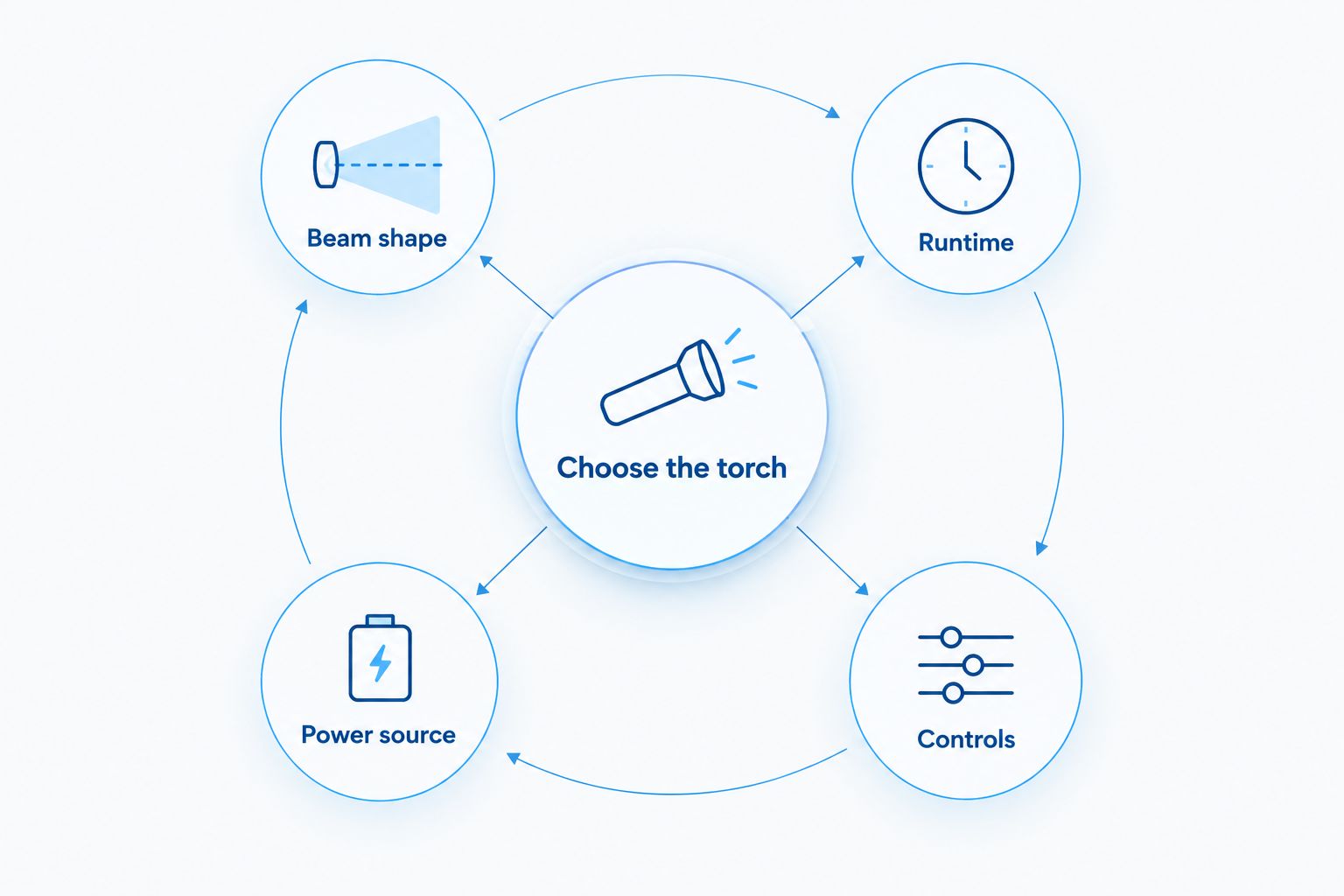
A useful retailer comparison starts with a purchase brief. Write down where the light will be used, what you need to see and how you will keep it powered; these details make unsuitable options easier to reject.
Beam shape: close work or distance?
A flood beam spreads light across a wider area. A concentrated beam puts more light into a smaller area, which matters when you need to inspect something farther away.
- Flood beam: useful for nearby tasks and seeing your immediate surroundings; less concentrated at distance.
- Focused beam: useful for inspecting a particular area farther away; a bright central spot can be uncomfortable for close work.
- Mixed beam: combines a central hotspot with surrounding spill; inspect beam information rather than assuming it balances both equally.
Lumens describe total light output, not how that light is distributed. Two torches with similar lumen figures can therefore feel very different in use.
Runtime: which setting are you buying?
Compare runtime at the output level you intend to use. A long low-mode runtime does not tell you how long the highest setting lasts, and a peak-output figure does not establish sustained brightness.
Look for a runtime graph where one is provided. A graph shows changes in output over time more clearly than a single runtime figure, particularly when a torch reduces output as it heats up or its battery runs down.
Ask whether the useful brightness lasts, not merely whether the torch remains on. For a security shift or a long evening outdoors, that distinction is more useful than the biggest number on the page.
Power source: rechargeability is not compatibility
Check whether the torch uses an integrated battery, a removable rechargeable battery or replaceable primary batteries. Each arrangement changes how you recharge, carry spares and deal with a depleted light.
- Integrated battery: avoids handling a separate cell, but replacing the battery depends on the product's design and service arrangements.
- Removable rechargeable battery: supports a spare-battery routine when the torch permits replacement, but the cell must match its requirements.
- Replaceable primary batteries: avoid charging the cells, but require an ongoing supply of suitable replacements.
A USB socket does not answer every charging question. Confirm the stated input requirements, whether charging happens inside the torch and which charging components are included.
Controls: can you use them during the task?
A torch that performs well on paper can still be awkward to operate. Check how it switches on, changes modes and locks against accidental activation.
For close work, assess whether you can reach a low setting without first passing through a bright one. For work involving gloves, consider switch position and how easily you can identify it by touch.
These are selection questions, not assumptions about any particular model. Read the operating instructions where available rather than inferring behaviour from a photograph.
Match the format to your use
Handheld torches, headlamps and lanterns solve different problems. Best for should describe the task, not act as a substitute for checking specifications.
| Lighting format | Best for | Main advantage | Main limitation |
|---|---|---|---|
| Handheld torch | Directing light independently of where you look | You can aim the beam precisely | Occupies a hand unless supported or mounted |
| Headlamp | Tasks requiring both hands | Light follows your head movement | Beam direction changes when you turn your head |
| Camping lantern | Shared light around a stationary area | Illuminates an area without someone holding it | Not a substitute for a concentrated inspection beam |
Camping and household use
Start with the activities rather than the brightest available setting. Cooking, moving around a campsite and checking a distant noise require different beam patterns and ways of carrying the light.
A headlamp keeps your hands free, while a lantern provides shared light at a stationary spot. A handheld torch gives you independent aiming; its trade-off is that someone generally has to hold it.
Security and outdoor inspection
For security work, balance distance performance with usable light nearby. A concentrated beam helps inspect a particular area, but close tasks still require a suitable lower setting or spill around the hotspot.
Check carry arrangements, controls and the battery routine as carefully as output. A torch needs to suit the way you work, including how you retrieve it and what happens when its battery is depleted.
Hunting and specialist applications
Define the exact task before buying specialist lighting. Walking to a position, inspecting equipment and using a mounted light are different applications with different compatibility requirements.
Do not infer mounting suitability from the word tactical. For any mounted application, verify the manufacturer's stated compatibility and follow the relevant equipment instructions and safety requirements.
Read ratings without overreading them
A technical rating answers a defined question under specified conditions. It does not prove that a torch suits every wet, dusty or demanding environment.
For example, the IEC 60529 IPX7 classification concerns temporary immersion under defined test conditions. For a small enclosure, the test involves immersion to a depth of 1 metre for 30 minutes; it is not a general approval for diving, pressurised water or every possible exposure.
The X in IPX7 means that the designation does not state a solids-protection rating. Do not turn it into an unsupported claim about dust protection.
Likewise, ANSI/PLATO FL 1 beam distance uses a threshold of 0.25 lux. That threshold is not a promise that you can identify a person or read a sign clearly at the stated distance.
Use ratings to compare defined characteristics, then match those characteristics to your task. Avoid treating a water rating, lumen figure or beam-distance figure as an all-purpose quality score.
Why people switch from Takealot for torch shopping
The practical reason to change buying routes is a change in what you need from the purchase. Specialist shopping becomes relevant when selecting the lighting setup matters more than browsing across general categories.
- You need to compare formats. Decide whether the task calls for a handheld torch, headlamp or lantern before narrowing the shortlist.
- You need a complete power setup. Battery and charger compatibility matter alongside the light itself.
- You are buying for an organisation. A retailer offering wholesale options is a relevant route to investigate for that requirement.
- You want a lighting-focused range. Start with equipment organised around the category you are buying.
These are reasons to consider a specialist, not evidence that every marketplace purchase is unsuitable. Keep the comparison tied to your own requirements rather than assuming a different retailer automatically means a better outcome.
When staying with Takealot is the right call
Stay with Takealot when you already know the exact model, have checked the listing carefully and prefer the general-marketplace route. There is no need to restart product selection merely because another buying channel exists.
Before ordering, confirm the model designation, included components and applicable purchase terms. Read the actual listing rather than borrowing specifications from a similar-looking torch elsewhere.
Hold your decision if a critical detail remains unclear. An unanswered question about battery compatibility or usable runtime matters more than the convenience of completing the order immediately.
FAQ
What's the best Takealot alternative for buying torches?
A specialist torch retailer is the better fit when you need to choose between lighting formats, battery arrangements and intended uses. Keep a general marketplace in your comparison when you already know the exact model you want.
Is buying a torch from a specialist always better than Takealot?
No, the better route depends on what you need from the purchase. Specialist retail suits lighting-focused selection, while a marketplace remains a valid route for a known item with a clear listing.
Should I choose the torch with the most lumens?
No, choose beam shape and useful runtime alongside lumens. Total light output does not tell you how concentrated the beam is or how long the torch sustains its highest setting.
Is a rechargeable torch better than one with replaceable batteries?
Neither power arrangement is best for every task. Compare charging access, spare-battery needs and the manufacturer's battery requirements before choosing.
What should I check before ordering a torch online?
Check the exact model, beam information, runtime by mode, power requirements and included components. Also read the purchase terms that apply to the listing rather than assuming they match another item.
Is a headlamp or handheld torch better for camping?
A headlamp is best for tasks requiring both hands, while a handheld torch gives you independent control of beam direction. A lantern serves a different purpose by providing shared light around a stationary area.
Does a waterproof rating mean I can use a torch underwater?
No, use the torch only within its manufacturer's stated conditions. An immersion rating does not automatically establish suitability for diving, pressurised water or prolonged underwater use.
One last thing
Write this sentence before you shop: I need to see this task clearly, for this long, with this charging arrangement. Fill in the details from your actual use rather than copying a specification headline.
That brief makes retailer comparisons simpler. You can judge whether the listing answers your needs instead of letting the largest lumen figure make the decision for you.