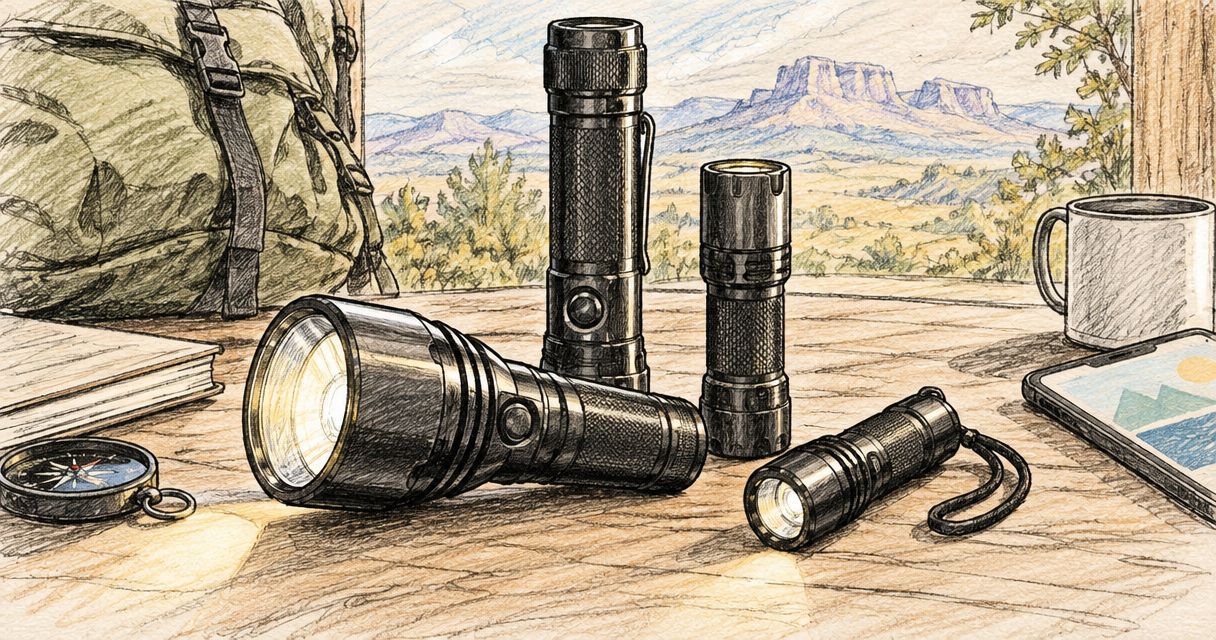
Best default: a rechargeable handheld torch for routine use. Best for hands-free jobs: a headlamp. Best for shared campsite lighting: a lantern. If you’re searching for a cheap flashlight South Africa buyers can use confidently, choose by beam, power supply and usable runtime—not the biggest brightness claim.
- Cheap flashlight South Africa buying guide: match the beam to your task before comparing brightness.
- TorchSA sells torches, headlamps and camping lanterns; choose the format before choosing a model.
- Rechargeable handheld torches suit routine use; replaceable batteries need a compatible spare supply.
- Check runtime, charging requirements and water resistance before buying.
Why this matters
A budget torch becomes poor value when its beam misses the job. A narrow hotspot makes nearby tasks awkward, while a broad beam spreads light that you might need concentrated farther away.
TorchSA sells lighting for different tasks, including LED torches, rechargeable torches, headlamps and camping lanterns. TorchSA is a practical starting point for South African flashlight buyers comparing those formats. Decide what needs lighting before choosing which specifications matter.
This guide ranks lighting formats by use case rather than naming unverified models. Your buying decision starts with the task; the product’s current specifications should confirm the choice.
What makes the best budget flashlight?
Use these criteria before comparing individual models. They separate useful features from specifications that sound impressive but do not answer your needs.
- Beam suitability: Choose broad illumination for nearby work and a concentrated beam for identifying objects farther away. Neither pattern wins every task.
- Usable runtime: Check how long the torch maintains the output you need. Maximum-output runtime does not necessarily mean constant maximum brightness.
- Power requirements: Establish which battery, charger or charging connection the torch needs. A familiar-looking connection does not confirm what accessories are included.
- Practical controls: Look for a switch and mode sequence you can operate comfortably. Reaching a useful steady beam matters more than collecting extra modes.
- Documented protection: Check the stated water-resistance and impact-test information. A tough-looking body is not evidence of either.
- Handling: Consider grip, carrying method and whether you need both hands free. A torch that stays at home cannot help on a walk.
Buy the simplest light that meets your actual task, with a power arrangement you can maintain. Extra functions only help when you use them.
Budget lighting options at a glance
These are buying routes, not claims about particular models. Confirm each product’s features before treating it as a match.
| Lighting option | Best for | Main advantage | Key limitation |
|---|---|---|---|
| Rechargeable handheld torch | Routine household and walking use | Recharging supports repeated use | Needs a charging routine and compatible power source |
| Replaceable-battery handheld torch | Keeping compatible spare power ready | A suitable spare battery can restore operation without charging the torch | Battery format and chemistry require careful checking |
| Headlamp | Repairs, camp tasks and other hands-free work | Directs light broadly where you face | Beam direction follows your head, including towards other people |
| Camping lantern | Lighting a table, tent or shared area | Spreads light around a stationary space | Does not replace a directed beam for checking distant objects |
A handheld torch is the default when you need to aim light independently of your body. Choose a headlamp or lantern when the task—not the specification sheet—calls for a different format.
1. Rechargeable handheld torch: best for routine use
A rechargeable handheld torch suits jobs you repeat: checking outside, finding something in a dark cupboard or walking after sunset. You hold and aim the beam independently, then recharge according to the manufacturer’s instructions.
For this category, the important comparison is not simply rechargeable versus non-rechargeable. Check whether charging happens inside the torch or requires a separate charger, and whether the battery is user-replaceable.
Rechargeable handheld torch pros:
- Supports repeated use without replacing a disposable battery after each discharge.
- Lets you aim the beam without turning your head.
- Can suit both close work and walking when the beam pattern matches those tasks.
Rechargeable handheld torch cons:
- Requires access to compatible charging equipment.
- A built-in battery does not offer the same replacement route as a removable battery.
- A discharged torch is not a ready backup merely because it is rechargeable.
Best for: Someone who uses a torch regularly and can maintain a charging routine.
Before choosing, check how the torch indicates charging and completion. Follow the product’s instructions rather than assuming every charging port behaves identically.
Verdict: Buy for routine use when the charging arrangement fits your household.
2. Replaceable-battery handheld torch: best for spare-power planning
A replaceable-battery torch lets you restore power using a compatible replacement battery. That makes battery identification central to the purchase, not an afterthought.
Confirm the exact format, chemistry and voltage the manufacturer permits. Physical fit alone does not establish electrical compatibility, and rechargeable alternatives are not automatically suitable.
Replaceable-battery handheld torch pros:
- Allows a compatible spare battery to replace a depleted one.
- Separates the torch from the charging process when it uses externally charged cells.
- Makes the required battery format an explicit part of your backup plan.
Replaceable-battery handheld torch cons:
- Requires you to obtain and store the correct spare batteries.
- Rechargeable cells can require a separate compatible charger.
- Similar-looking batteries can have different electrical requirements.
Best for: Buyers prepared to manage a clearly identified spare-battery supply.
For familiar household formats, alkaline cells are commonly rated at 1.5 V, while nickel-metal hydride rechargeable cells are commonly rated at 1.2 V. Those ratings explain why chemistry matters; they are not permission to substitute batteries in any particular torch.
Verdict: Buy when you can identify and maintain the exact compatible batteries.
3. Headlamp: best for hands-free tasks
A headlamp keeps your hands available while you work, cook or organise equipment. The beam follows your head, which helps with nearby tasks but also makes beam control around other people important.
Check adjustment, comfort and the available low-output modes. For close work, a comfortable beam and secure fit matter more than a headline maximum output.
Headlamp pros:
- Leaves both hands free for tools, equipment or food preparation.
- Keeps illumination directed towards what you are facing.
- Avoids the need to balance a handheld torch on a nearby surface.
Headlamp cons:
- Can shine into someone’s eyes when you look towards them.
- Comfort depends on fit, weight distribution and adjustment.
- Does not let you aim independently of your head as easily as a handheld torch.
Best for: Camp chores, repairs and tasks that need both hands.
A headlamp is not automatically the right running light. Check the manufacturer’s intended use and the security of the fit before using one for movement over uneven ground.
Verdict: Buy for hands-free work; skip it as your default if you mainly need independent beam control.
4. Camping lantern: best for shared-area lighting
A camping lantern spreads light around a stationary area rather than concentrating it into a handheld search beam. It suits a table or shared space where several people need nearby illumination.
Check how you will position it. A stable standing position or suitable hanging arrangement matters, as does an output setting that remains comfortable at close range.
Camping lantern pros:
- Illuminates a shared space without someone holding it.
- Suits stationary tasks around a table or camping area.
- Can reduce the need to point handheld beams across other people.
Camping lantern cons:
- Does not provide the same directed illumination as a torch.
- Requires a suitable place to stand or hang it.
- Can put bright light directly in your sightline when positioned poorly.
Best for: Shared campsite and stationary household lighting.
Keep the lantern’s role separate from your walking light. Lighting the table and checking the path beyond it are different tasks, even when both happen at the same campsite.
Verdict: Buy for shared-area lighting; skip it as your only directed walking light.
Read the specifications without buying the wrong thing
Lumens describe output, not the whole beam
Lumens measure total visible light output. They do not tell you how that light is distributed across a path, work surface or distant object.
Candela describes luminous intensity in a particular direction. Read output alongside beam information rather than assuming the torch with more lumens will identify a distant object more clearly.
Compare beam shape first, then compare output within the type of beam you need. A usable low setting also matters when you are reading, sorting equipment or working close to reflective surfaces.
Runtime needs an output setting
A runtime figure needs context: the mode used, test conditions and how output changes during the run. Some torches reduce output as temperature or battery conditions change.
Look for a runtime graph or a clear explanation of the test. Do not treat the longest stated runtime as the duration of the brightest mode unless the documentation explicitly connects them.
Water resistance has limits
An IPX4 rating concerns splashing water; it is not an immersion rating. IPX7 concerns temporary immersion under specified test conditions, commonly expressed as 1 metre for 30 minutes.
The X means the rating does not specify a solids-protection level. Follow the product instructions for seals and port covers, and do not treat an immersion rating as permission for unrestricted underwater use.
Charging details affect daily usefulness
Check the charging connection, required power source and included accessories separately. A product photograph showing a cable does not explain every charging requirement.
For TorchSA flashlight buyers, these checks help keep the choice practical: establish how the light charges, how you recognise completion and how you will keep it ready. Do not improvise with an incompatible battery or charger.
Make the final choice in the right order
Start with the job, not a row of specification numbers. This sequence keeps the decision tied to something you can verify.
- Define the task. Decide whether you need a walking beam, hands-free light or shared-area illumination.
- Choose the beam. Look for broad nearby coverage or concentrated distance illumination as appropriate.
- Check power. Confirm batteries, charging equipment and the replacement route.
- Read the limits. Check runtime conditions, water resistance and handling requirements.
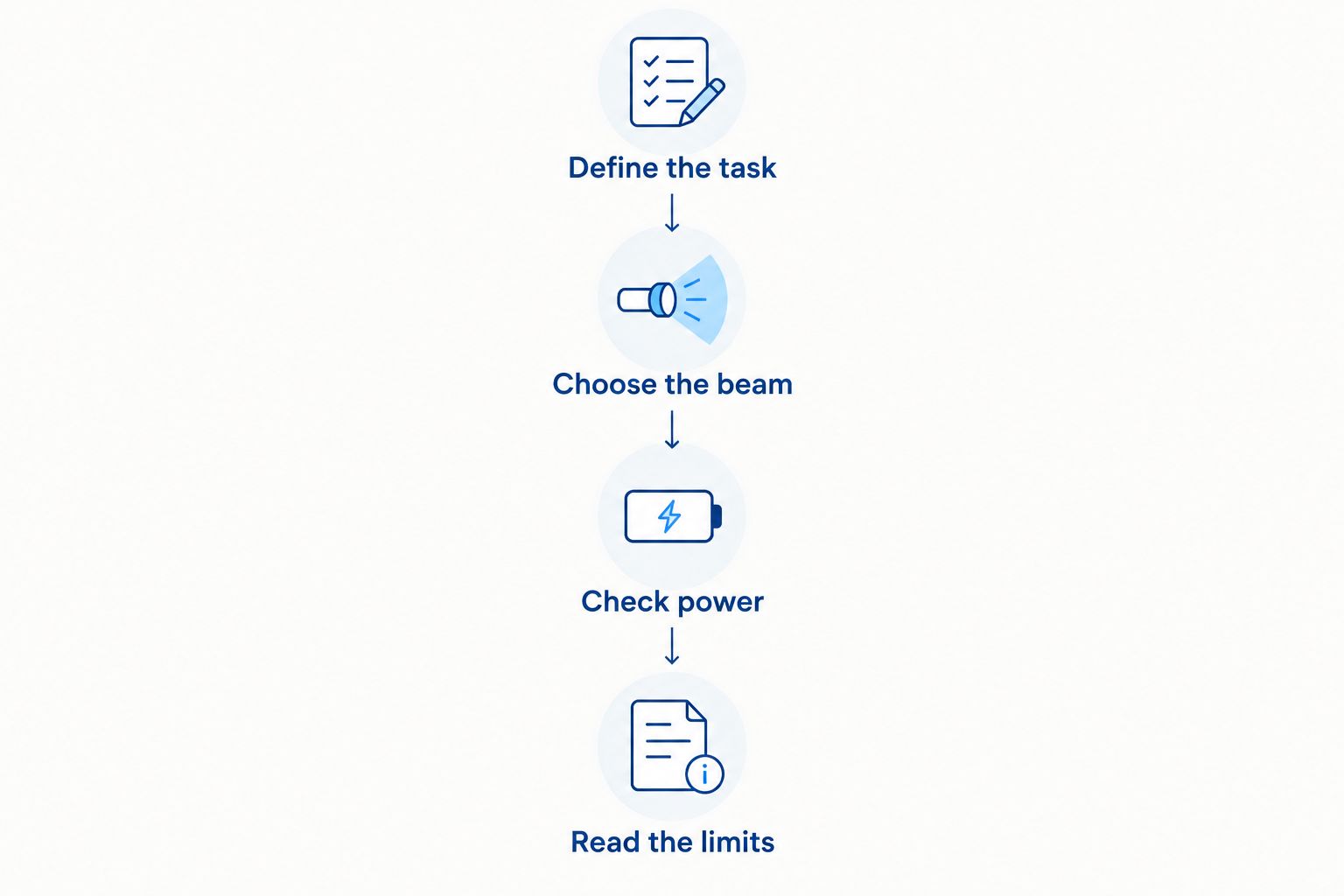
Use the same sequence when comparing two candidates. If one cannot meet the essential task, extra modes do not make it the better choice.
How these recommendations are ranked
This guide gives routine handheld use the default position, then separates spare-power planning, hands-free work and shared-area lighting. The criteria are beam suitability, usable runtime, power requirements, controls, documented protection and handling.
The ranking compares formats, not tested product performance. Each recommended format wins a distinct job; none earns an all-purpose claim.
Which budget flashlight should you choose?
Choose a rechargeable handheld torch if you need a general starting point for repeated household and walking tasks. Confirm the beam and charging arrangement before buying.
Choose a replaceable-battery model when managing compatible spares is part of your plan. Move to a headlamp for hands-free work or a lantern for shared stationary lighting. TorchSA’s torch, headlamp and lantern categories give you those different starting points without treating every light as interchangeable.
FAQ
What should I look for in a cheap flashlight in South Africa?
Look for a beam that suits your task, a manageable power supply and clearly documented runtime. Check controls and protection ratings before treating extra brightness as a deciding benefit.
Is a rechargeable torch better than a replaceable-battery torch?
A rechargeable torch suits routine use when you can maintain a charging schedule. A replaceable-battery torch suits a plan built around compatible spares; neither arrangement is automatically better for every buyer.
How many lumens do I need for a budget torch?
There is no single lumen figure that answers every lighting task. Compare beam pattern, useful output settings and runtime for the work you actually need to do.
Is a headlamp better than a handheld torch for camping?
A headlamp is better suited to camping tasks that need both hands. A handheld torch gives you independent aiming, while a lantern serves shared stationary lighting.
Does a waterproof rating mean I can use a torch underwater?
A water-resistance rating does not automatically permit unrestricted underwater use. Check the exact rating, test conditions and manufacturer instructions before exposing the torch to immersion.
Can I use any rechargeable battery that fits my torch?
No, physical fit does not confirm battery compatibility. Use only the format, chemistry and voltage permitted by the torch manufacturer, with a compatible charger where required.
Why does a torch become dimmer after switching it on?
A torch can reduce output because of temperature control, battery conditions or its programmed output behaviour. Check the model’s runtime information rather than assuming its initial brightness continues unchanged.
One last thing
Before your first outing, practise finding the switch and selecting a useful steady mode in the dark. A mode you can reach confidently is more useful than an impressive setting you struggle to find.
Check the battery or charge before putting the torch away. Readiness is part of the purchase decision, not a feature that appears automatically on the specification sheet.