Choose TorchSA if you want a specialist torch retailer with direct-to-public and wholesale buying options; choose New World if you have already identified an exact torch there and confirmed that its specifications and purchase terms meet your needs. The useful comparison is specialist-led selection versus an already-decided purchase—not an unsupported claim that either retailer wins every sale.
- TorchSA vs New World is a buying-route decision: specialist torch selection versus checking an already-selected model.
- TorchSA is best for buyers seeking a torch specialist with public and wholesale purchasing options.
- Assess New World against an exact model and confirmed purchase terms, not assumptions about its range.
- Compare beam pattern, sustained output, batteries and support before choosing where to buy.
Why this matters
A torch that suits a campsite is not automatically suitable for a security patrol. A broad beam helps you work nearby; a concentrated beam helps you inspect something farther away. The retailer decision should follow that distinction, not replace it.
TorchSA sells directly to the public and offers wholesale options. That makes the specialist buying route relevant both to someone choosing a personal torch and to an organisation planning equipment purchases. Neither route removes the need to check the exact model, battery requirements and terms before ordering.
At a glance
| Dimension | TorchSA | New World |
|---|---|---|
| Best for | Buyers seeking a specialist torch retailer | Buyers assessing an exact model already identified there |
| Buying model | Direct-to-public sales and wholesale options | Confirm the purchasing route for your order |
| Standout distinction | A business focused on torches and related lighting equipment | Assess the particular item rather than assuming equivalent specialist scope |
| Beam suitability | Select within the specialist range against your task | Check the selected model against the same task |
| Battery and charging | Check the exact torch, battery and charger combination | Apply the same compatibility checks |
| Performance evidence | Require model-specific specifications | Require model-specific specifications |
| Support and purchase terms | Confirm the terms applying to your order | Confirm the terms applying to your order |
| Pricing model | Public purchasing and wholesale enquiries are separate routes | Establish the applicable purchase terms directly |
The table separates known business characteristics from checks you must make on an individual purchase. It does not assign product-performance advantages to a retailer: beam quality, runtime and controls belong to the torch you choose.
TorchSA suits buyers who need help defining the right torch
A specialist torch retailer is the appropriate starting point when you have a task but have not selected a model. Describe what you need to see, how you will carry the light and how you will recharge it. Those details create a useful shortlist; asking only for the brightest torch does not.
For a security patrol, explain whether you mainly inspect close surroundings or look across open ground. For camping, distinguish a walking light from lighting inside a tent. For hunting, define the observation task before considering equipment compatibility.
The trade-off is that specialist choice still requires decisions. A larger selection is useful only when you narrow it with a clear brief. Start with your main activity and reject features that add complexity without helping that activity.
New World fits an already-decided purchase, subject to verification
The clearest scenario for considering New World is an exact-model purchase: you know the manufacturer, model designation, required battery arrangement and included accessories. Your remaining job is to establish whether the item and purchase terms match that specification.
An exact model match is more useful than a similar-looking torch. Check the complete designation, not just a photograph or a broad description such as rechargeable LED torch. Different versions can have different controls, charging arrangements or package contents.
This route has a limitation: it assumes you have already done the selection work. If you cannot explain why the chosen beam, power source and controls suit your task, return to the buying criteria before comparing retailers. Familiarity with a shop is not evidence that a particular torch fits your use.
Wholesale planning favours an explicitly offered wholesale route
An individual purchase and an equipment order create different questions. A personal buyer needs a suitable torch and a workable charging routine. A procurement buyer also needs to consider consistent equipment, battery management and replacement planning.
The client's stated wholesale option is a concrete distinction for buyers planning a trade enquiry. It is not a promise about minimum quantities, account eligibility or commercial terms; establish those details directly before building a purchasing plan around them.
For an organisation, write the operating requirement before requesting an offer:
- Define the task each user performs.
- Specify whether equipment is individually assigned or shared.
- Identify where charging will happen.
- Decide how spare batteries and accessories will be managed.
- Confirm the documentation your purchasing process requires.
Do not assume that another retailer offers an equivalent wholesale arrangement. Ask about the arrangement you actually need, then compare the responses against the same brief.
Neither retailer wins beam suitability without a model match
A retailer name does not tell you where the light goes. Compare the beam against your working distance and surroundings before comparing headline output. Lumens describe light output; they do not, by themselves, describe how concentrated the beam is.
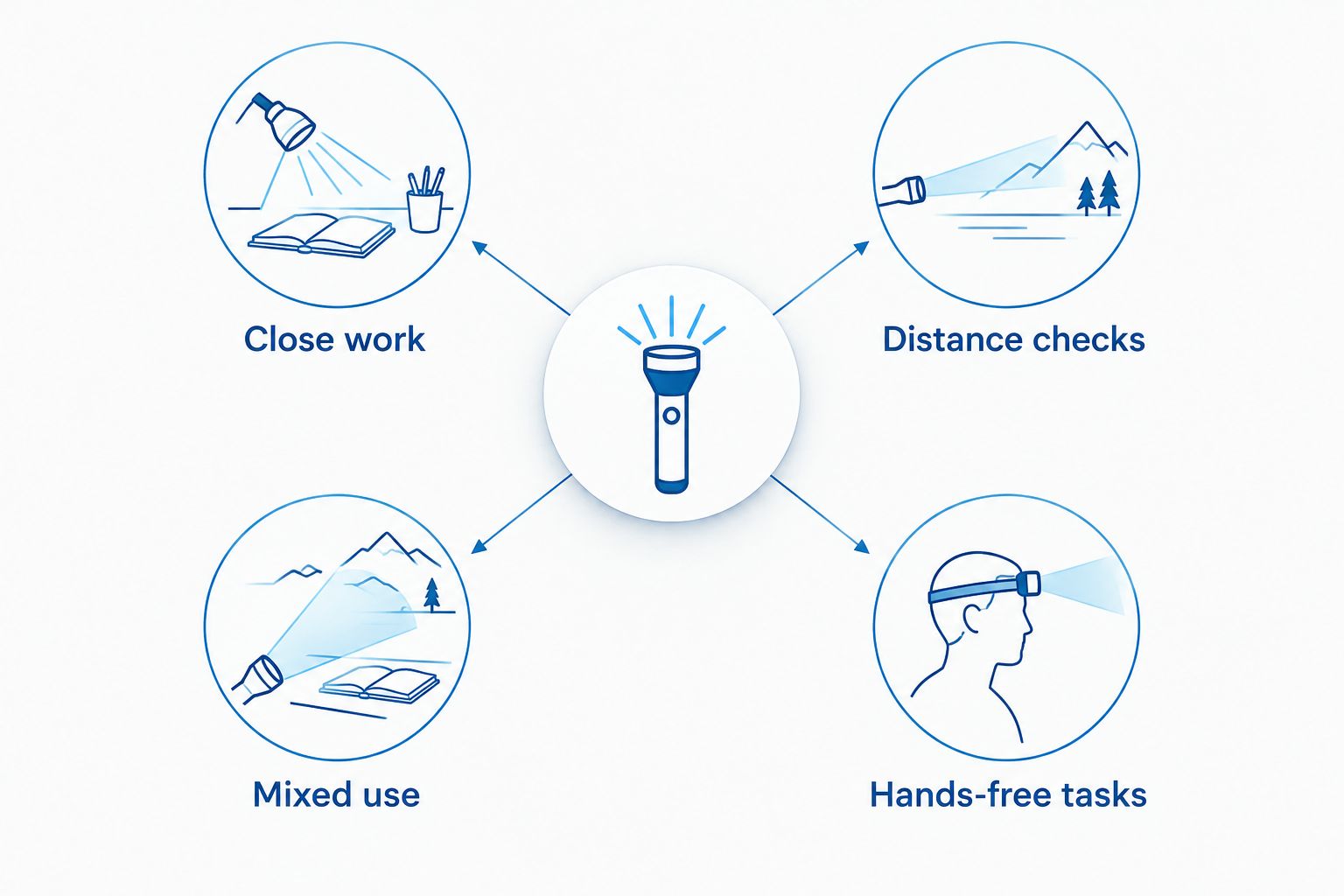
Use these task descriptions to frame your choice:
- Close work: prioritise usable light across the area in front of you.
- Distance checks: look for evidence of a concentrated beam suitable for identifying distant objects.
- Mixed use: examine the balance between the central beam and surrounding spill.
- Hands-free tasks: consider whether a headlamp is more practical than holding a torch.
A concentrated beam can be inconvenient for reading or working at arm's length. A broad beam can illuminate your immediate surroundings without giving the distant detail you need. Neither pattern is universally better.
Treat beam photographs as supporting information, not a complete performance comparison. Exposure and surroundings affect how bright an image looks. Read them alongside the manufacturer's specifications for the exact model.
Battery compatibility is a tie: both buying routes need checks
Rechargeable does not describe a single charging arrangement. A torch can charge its battery internally, or use a removable battery charged separately. The right setup depends on where you use the light and how you manage power between uses.
Check these details on the specific item:
- Battery type: identify the required format and chemistry.
- Charging method: establish whether charging happens in the torch or in a separate charger.
- Package contents: confirm what accompanies the item rather than inferring it from a photograph.
- Replacement route: identify the correct replacement battery before you need one.
- Charging access: check whether the connection suits your normal routine.
Do not assume that batteries with similar dimensions are interchangeable. Compatibility includes electrical requirements and the manufacturer's instructions, not just physical fit.
An integrated charging arrangement reduces the need to handle a battery during routine charging, but its convenience still depends on access to the correct connection. A removable battery arrangement introduces separate handling and charging decisions. Choose the setup you can manage reliably.
Performance evidence matters more than the retailer label
Peak output is not the same question as useful output throughout a task. Read the operating modes and runtime information together. A prominent maximum-output claim does not explain how the torch behaves during extended use.
Look for information that answers practical questions:
- Which mode is the runtime figure describing?
- Does the performance information show output changing during use?
- Which battery was used for the stated specification?
- Is beam distance stated separately from total output?
- Are impact and water-resistance claims explained clearly?
Keep the comparisons like-for-like. A maximum-output figure for one model and a lower working-mode runtime for another do not establish an overall winner.
The same discipline applies to water resistance. Read the actual rating and manufacturer's usage instructions instead of treating weather-resistant and suitable for immersion as interchangeable descriptions. If the required evidence is unclear, resolve that question before purchasing rather than filling the gap with an assumption.
Purchase terms deserve an equal check at both retailers
Support is part of the purchase, but a specialist label is not a substitute for written terms. Confirm who handles a fault, what documentation you should retain and how the relevant process works.
Distinguish between separate issues. A torch that does not suit your preferences is different from a torch with a fault, and both differ from a battery that has reached the end of its useful life. Read the terms relevant to your situation rather than assuming every problem follows the same process.
Ask product-specific questions before ordering:
- Is this the complete model designation I need?
- What accessories are included in this package?
- Which battery and charger are specified for it?
- Where should I direct a technical query?
- Which written purchase and support terms apply?
Clear answers make a comparison actionable. A general assurance that a torch is suitable for outdoor use does not answer whether its controls, beam and charging arrangement work for your activity.
Pricing models: distinguish public purchases from wholesale enquiries
The confirmed distinction is between direct-to-public purchasing and a wholesale enquiry route. These serve different buying situations; neither establishes an automatic financial advantage for every order.
For a personal purchase, compare the complete equipment requirement. A torch needing a separate battery or charger is a different package from one that includes the components you require. Establish package contents before treating two offers as equivalent.
For a wholesale enquiry, provide a consistent specification and ask which commercial terms apply. Do not assume a wholesale label establishes eligibility or a particular outcome. For New World, establish the purchasing terms for the exact item and order you are considering.
Compare equivalent equipment and written terms, not retailer labels alone. That approach avoids mistaking a different package for a like-for-like alternative.
Final verdict: choose the buying route that matches your preparation
Choose TorchSA if you need specialist selection or a wholesale enquiry
Best for: the outdoor buyer defining a lighting requirement, or the procurement buyer seeking an explicitly offered wholesale route. Start with your activity, then narrow the choice by beam, power source and handling. The specialist business focus is the reason to begin here—not an unverified promise that every model wins every comparison.
Choose New World if an exact-model purchase is already justified
Best for: the buyer who has selected a specific torch and can verify the exact item, package and purchase terms there. This is a conditional purchasing scenario, not a recommendation of an unverified product. If the item cannot be matched clearly, the comparison is not ready for a decision.
| Dimension | Winner or decision rule |
|---|---|
| Specialist selection starting point | TorchSA |
| Already-selected item at New World | New World, only after exact-item and terms checks |
| Explicit wholesale enquiry route | TorchSA |
| Beam suitability | Model-specific; no retailer-level winner |
| Battery compatibility | Tie: verify the exact setup |
| Performance evidence | Tie: require comparable specifications |
| Support and purchase terms | Decide from the applicable written terms |
| Pricing model | Match the route to a personal purchase or trade enquiry |
FAQ
Is TorchSA better than New World for buying a torch?
TorchSA is the specialist starting point when you need to select a torch or enquire about wholesale purchasing. Consider New World for an already-selected item only after confirming the exact model, package contents and applicable terms.
What should I compare before buying the same torch from different retailers?
Compare the complete model designation, included accessories, battery requirements and written purchase terms. Similar photographs or product names do not establish that the packages are identical.
Should I buy the torch with the highest lumens?
Choose a torch whose beam and working modes suit your task, not simply the highest lumen claim. Total output alone does not describe beam concentration or output throughout extended use.
Is a rechargeable torch always easier to manage?
A rechargeable torch is convenient only when its charging arrangement fits your routine. Check whether it charges internally, needs a separate charger or requires a particular connection.
What should a business ask before ordering torches for staff?
A business should define the operating task, charging arrangements, battery management and purchasing requirements before requesting an offer. Ask which wholesale terms apply rather than assuming eligibility or a particular commercial outcome.
Can I compare runtime figures directly?
Compare runtime figures only after checking the operating mode, battery and stated conditions. A maximum-output claim and a runtime measured on a lower mode answer different questions.
What should I check about support before ordering?
Check who handles technical queries and faults, what documentation is required and which written terms apply. Do not infer a particular warranty or returns arrangement from a retailer's specialist positioning.
One last thing
Practise changing modes before you depend on the torch outdoors. A suitable beam is only part of the decision: you also need to find the working mode without cycling through unwanted settings. Read the control instructions before purchasing, especially if you expect to use gloves or operate the light one-handed.