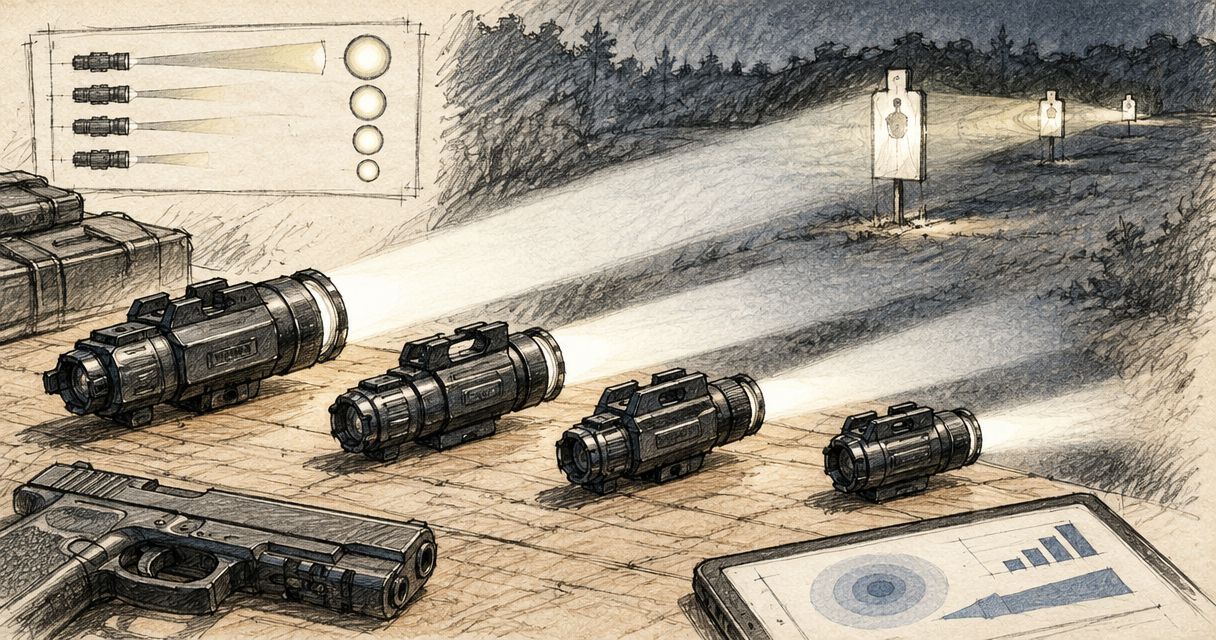
A weapon light lumens comparison only works when you read three numbers together: lumens, candela and beam distance. This page gives you the formula that links them and a conversion table you can apply to any pistol or rifle light on the market in 2026.
- Lumens measure total output. Candela measures how hard the beam hits at distance. Beam distance is derived from candela.
- Beam distance in metres equals two times the square root of peak candela (ANSI FL1, 0.25 lux cutoff).
- A 10,000 candela weapon light reaches 200 m on paper. A 1,000 candela light reaches about 63 m.
- Two lights with identical lumens can differ several times over in reach. Always check candela.
The short answer
There is no single average lumen figure for weapon lights, and a page that quotes one is guessing. Output varies with the mount, the reflector and the intended range. What does not vary is the maths: beam distance = 2 × √(peak beam intensity in candela). If a spec sheet gives you candela, you can calculate reach yourself. If it only gives lumens, you are missing the number that predicts distance.
For a deeper look at how lumens translate to throw across all torch types, see the flashlight throw distance benchmarks by lumens.
Why lumens alone mislead
Lumens count all the light leaving the lens, in every direction. A wide flood and a tight spot can both be rated at the same lumens. The flood fills a room. The spot reaches across a field. Candela is the figure that separates them, because it measures intensity at the centre of the beam.
For a weapon light, that split matters. A broad, even beam suits close-range identification inside a house or vehicle. A tighter hotspot suits an open farm yard or a rifle-mounted light at longer distance. Which is better depends on where you will use it, not on which number is bigger.
Candela to beam distance conversion table
This table applies the ANSI/PLATO FL1 rule: beam distance is the range at which the beam falls to 0.25 lux, roughly the light of a full moon. Every row below is arithmetic from that formula, not a product measurement.
| Peak beam intensity (candela) | Calculated beam distance | Typical use of that reach |
|---|---|---|
| 1,000 cd | about 63 m | Room, passage and yard use |
| 2,500 cd | 100 m | Homestead and driveway |
| 5,000 cd | about 141 m | Open ground, mixed use |
| 10,000 cd | 200 m | Long yard, farm track |
| 20,000 cd | about 283 m | Rifle-mounted, open veld |
| 40,000 cd | 400 m | Specialist long throw |
Overall yardstick: to double the beam distance you need four times the candela. That is why a modest jump in reach costs a large jump in reflector size, lens size or LED power.
High and low: what the table tells you
Reach scales with the square root, so gains flatten fast. Moving from 1,000 cd to 10,000 cd multiplies candela by ten but only about triples the distance, from about 63 m to 200 m. Going from 10,000 cd to 40,000 cd quadruples candela and only doubles the distance, from 200 m to 400 m.
The practical consequence: a compact pistol light sits at the low end of the table by design, because a small reflector cannot concentrate much light. A longer rifle light with a deeper reflector sits at the high end. Neither is wrong. Each is matched to a range.
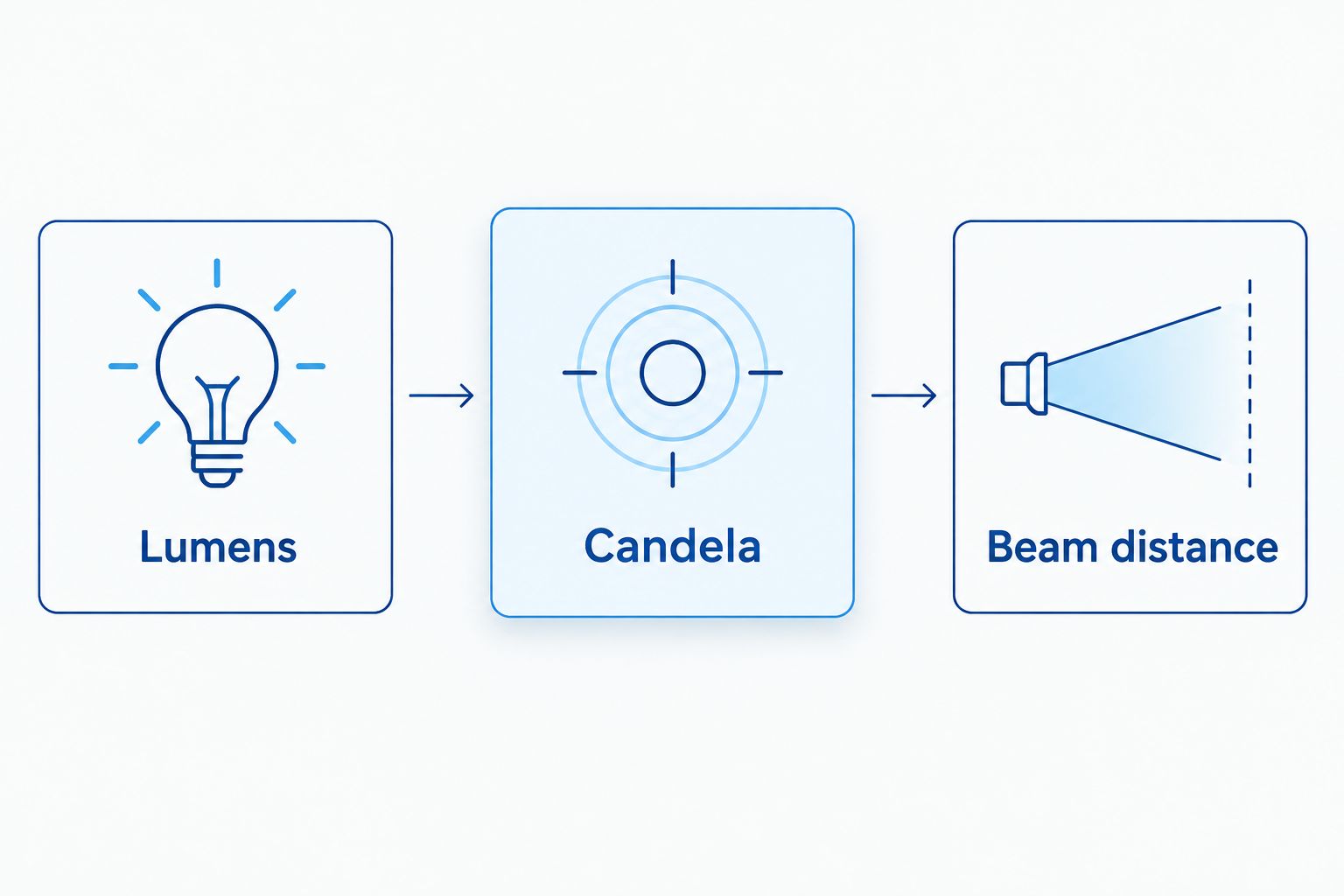
How the three figures are defined
Lumens
Total light output. Under the FL1 standard, output is measured 30 seconds after switch-on, so the figure on the box is usually a peak that steps down as the light warms up. If a light advertises a headline lumen number, look for the sustained figure too.
Candela
Peak beam intensity, measured at the centre of the hotspot. This is the number that drives distance. Reflector depth, lens size and LED size all shape it.
Beam distance
The calculated range to 0.25 lux. It is a lab figure on a clear test range. Fog, dust, rain and reflective backgrounds change what you see in the field.
Methodology and limits
The table above uses the published ANSI/PLATO FL1 relationship between candela and beam distance. It contains no measured product data. Per-model lumens and candela are set by each manufacturer, and a figure that is not on the manufacturer's spec sheet or the product page is not in this table.
One limit to know: manufacturers test to the standard on their own equipment, and some brands publish lumens without candela. When candela is missing, you cannot calculate reach, and any beam distance claim should be treated as unverified.
How to compare two weapon lights
- Find the candela figure. If the spec lists beam distance but not candela, square half of the distance to get candela. A 200 m rating means 10,000 cd.
- Match reach to your real range. Most home-defence use is inside 25 m. Paying for 400 m of reach adds weight and bulk you will not use.
- Check sustained output. A light that drops sharply after a minute is brighter on paper than in your hand.
- Check the mount and rail fit. A light that does not seat properly on your rail is useless whatever its output. The weapon light to Picatinny rail mounting workflow covers the fitting steps.
- Check runtime and battery type. Output means little if the light cannot run when you need it.
Where lumens still matter
High lumens with a wide beam give you a flooded room and good peripheral awareness. That is the right profile for a pistol light used at short range. A narrow, high-candela beam in the same room gives you a bright dot and dark edges.
TorchSA is a multi-brand torch specialist, so the range covers both profiles. Olight is one of the brands covered, and Olight's own site at olightsa.co.za lists its full weapon light range with model specs.
Choosing by use case
- Home defence, pistol-mounted: prioritise a wide beam and moderate candela. Reach beyond 100 m rarely helps.
- Farm and smallholding: a middle ground, with a defined hotspot for checking fence lines and yards.
- Rifle-mounted, open ground: prioritise candela and a tight hotspot.
- Security work: prioritise sustained output and a reliable switch.
Our best tactical weapon lights for pistols guide ranks options from the TorchSA range against these use cases. If you are budgeting, the guide on what a pistol light costs in South Africa explains what drives the price difference. For wider torch output rankings, the flashlights ranked by lumens and brightness page covers general-purpose lights.
Need help matching a weapon light?
Tell us your platform and range and we will point you to the right fit.
FAQ
How many lumens should a weapon light have?
There is no single right number. Lumens set how much light you get overall, but candela sets how far it reaches. Pick the lumen level for the room you shoot in and check candela for distance.
How do I convert candela to beam distance?
Take the square root of the candela figure and multiply by two. A 10,000 candela light has a calculated beam distance of 200 m under the ANSI FL1 standard.
Is a higher lumen weapon light always better?
No. A higher lumen light can be a wide flood with short reach. A lower lumen light with a deep reflector can throw further. Compare candela as well.
What does beam distance mean on a spec sheet?
Beam distance is the range at which the beam drops to 0.25 lux, about the light of a full moon. It is measured under lab conditions on a clear range.
Why does my torch output drop after a minute?
Most lights step down output to manage heat. The FL1 lumen figure is taken at 30 seconds, so the sustained output is lower than the headline number.
Do I need long beam distance for home defence?
Usually not. Most home-defence distances are short, and a wide beam with moderate candela handles them better than a narrow long-throw beam.
Can I calculate candela if only beam distance is listed?
Yes. Halve the beam distance in metres and square the result. A 100 m rating equals 2,500 candela.
One last thing
If a weapon light lists lumens and nothing else, ask for the candela or the FL1 beam distance before you buy. A seller who cannot supply either is selling you a headline number, and the 2026 market has plenty of those. Questions about a specific model can go to the TorchSA team through the contact page above.